Taliban Commander Targeted In Badakhshan, Says AFF

The Afghanistan Freedom Front says it targeted a vehicle carrying a Taliban commander in Badakhshan on Tuesday evening, killing the commander and four of his guards.
The Afghanistan Freedom Front says it targeted a vehicle carrying a Taliban commander in Badakhshan on Tuesday evening, killing the commander and four of his guards.
The group said the vehicle was travelling through Kuran wa Munjan district in Badakhshan towards Panjshir when it was attacked on Tuesday, 6 October.
The Afghanistan Freedom Front did not identify the Taliban commander, and Taliban officials have not yet commented on the claim.
In a statement on Thursday, 8 October, the group said that at a gathering of religious preachers, students and teachers from religious schools in provinces north of Kabul, held at the Panjshir provincial headquarters, participants had been urged to intensify propaganda against opposition fronts in the area.
The Afghanistan Freedom Front has recently expanded its attacks against the Taliban across several provinces.
On Wednesday, 7 October, the group also said Taliban forces had attacked its commandos in Kamdesh district of Nuristan.
The group claimed that 11 Taliban members were killed and eight others wounded in the fighting. It did not provide information about casualties among its own forces.
Taliban police say they arrested four men in Kabul who allegedly planned to attack UNAMA’s office and staff, claiming they belonged to the National Resistance Front. The NRF rejected the allegation as intelligence propaganda.
Taliban police released a video on Wednesday, 7 October, saying the four men, residents of Panjshir and Kapisa, had been arrested in three different areas of Kabul with military equipment and explosives.
The police claimed the detainees had been involved in multiple crimes and had recently planned to use explosives to target the UN Assistance Mission in Afghanistan, or UNAMA, and its staff.
The video also showed purported confessions by the detainees, with the Taliban claiming they had admitted to the alleged offences.
The National Resistance Front of Afghanistan rejected the allegations. In a statement on Wednesday, the group said those shown in the Taliban video identifying themselves as NRF members were Taliban intelligence operatives and described the footage as part of a conspiratorial strategy of defamation and intelligence propaganda.
The NRF said the purpose of releasing the video was to create distrust between the group and the international community.
It also said that under its military principles and guidelines, attacks on civilians and domestic or foreign civilian institutions are prohibited, and that its operations target only the Taliban and groups allied with it.
The NRF called on UNAMA, the UN political mission in Kabul, to independently investigate and question the detainees, saying it was prepared to respond to any evidence or concerns that might emerge.
The group also warned that such videos could be used to prepare the ground for future attacks that might then be blamed on Taliban opponents. It urged diplomatic missions and international organisations to strengthen their security measures.
It remains unclear under what circumstances the Taliban’s special police obtained the statements from the detainees. The Taliban has also presented no evidence establishing a connection between the men and the National Resistance Front.
The United Nations has previously accused the Taliban of obtaining forced confessions through torture.
In a 2023 report, the UN documented what it described as widespread torture of detainees, particularly during arrest and interrogation. The report said the Taliban had used torture to extract confessions and called on the group to end torture and other cruel treatment.
Iran’s Jomhouri-e Eslami newspaper accused the Taliban of waging a silent war against Iran, warning that Tehran’s current approach towards the group could harm Iran’s long-term interests.
In an editorial published on Wednesday, 7 October, the newspaper strongly criticised Tehran’s policy towards the Taliban.
It wrote that since the Taliban returned to power in Afghanistan in 2021, some Iranian politicians and officials had sought to justify the group’s rule and had even praised it for ending the 20-year US presence in Afghanistan.
The editorial described that view as mistaken and alleged that the Taliban returned to power with US support and through an agreement with Washington.
It argued that developments including the rapid collapse of Ashraf Ghani’s government, the Taliban’s takeover of Kabul with little resistance, the withdrawal of US forces and the military equipment left behind at Afghan bases pointed to secret understandings between the United States and the Taliban.
Jomhouri-e Eslami also alleged that the Taliban had maintained relations with the United States since returning to power and benefited from monthly financial assistance from Washington.
The editorial claimed that the Taliban had not taken a critical stance towards US regional policies while also pursuing measures inside Afghanistan that, according to the writer, weakened Iran’s influence and position in the country.
The newspaper accused the Taliban of restricting institutions and groups close to Iran, targeting some ethnic and religious communities and reducing the presence of Shia groups in Afghanistan’s social and political structures in an effort to erode Iran’s traditional sources of influence.
Iran maintains extensive relations with the Taliban. Tehran has handed control of the Afghan embassy to Taliban-appointed diplomats, and Taliban delegations have repeatedly visited Iran in recent years. However, Iran has not formally recognised the Taliban administration.
The editorial also accused the Taliban of adopting a confrontational approach over Iran’s share of water from the Helmand River.
Disputes over Helmand water rights have become one of the main sources of tension between Tehran and the Taliban over the past three years. In 2023, border tensions between Iranian and Taliban forces in Nimroz escalated into an armed clash that left several people dead and wounded.
The writer also accused the Taliban, without providing specific evidence, of infiltrating operatives into Iran, involvement in some attacks and explosions, and organising operations against the group’s opponents in Iranian cities.
Relations between Iran and the Taliban have undergone major shifts over the past three decades. The two sides came close to war in the late 1990s after Iranian diplomats were killed in Mazar-i-Sharif.
After the fall of the Taliban’s first government in 2001, however, channels of communication gradually developed between Tehran and the group.
Disputes over Helmand River water rights, border security, large-scale Afghan migration to Iran and Tehran’s concerns about militant groups operating in Afghanistan remain among the main challenges in relations between the two sides.
Pakistan President Asif Ali Zardari told UN Secretary-General António Guterres on Tuesday that militant groups based in Afghanistan continue to target Pakistan, adding that Islamabad has shared evidence of foreign support for them.
Zardari said Pakistan remained committed to fighting terrorism and had made great sacrifices in doing so. He stressed that Afghan territory must not be used to launch attacks against Pakistan or any other country.
The Pakistani president added that while his country remained committed to dialogue and regional cooperation, it would defend its people and territory in accordance with international law.
Pakistan has repeatedly accused the Taliban in recent months of sheltering and allowing armed groups opposed to Islamabad, particularly Tehreek-e-Taliban Pakistan, or TTP, to operate from Afghanistan.
The Taliban has rejected the allegations and said it would not allow Afghan territory to be used against other countries. Taliban officials have, in turn, accused Pakistan of seeking to destabilise Afghanistan and of supporting Islamic State and anti-Taliban armed groups.
Tensions between Pakistan and the Taliban have increased in recent months. Disputes over the activities of armed groups along the border have led to military clashes and Pakistani air strikes inside Afghanistan.
Guterres awarded Nishan-e-Imtiaz
During the same meeting, Zardari awarded António Guterres the Nishan-e-Imtiaz, one of Pakistan’s highest civilian honours.
Pakistan’s presidency said the award recognised Guterres’s international service, his leadership at the United Nations and his efforts to promote global peace and development.
According to the presidency, this was the first time the Nishan-e-Imtiaz had been awarded to a UN secretary-general. Guterres received the honour at a ceremony at the Presidential Palace in Islamabad.
Prime Minister Shehbaz Sharif, National Assembly Speaker Ayaz Sadiq, Deputy Prime Minister and Foreign Minister Ishaq Dar, several cabinet members and foreign diplomats also attended the ceremony.
Zardari praised Guterres’s role in promoting peace, dialogue and the peaceful resolution of conflicts, and said Pakistan supported the UN chief’s efforts to draw attention to the concerns of developing countries.
Guterres is on an official visit to Pakistan and has discussed terrorism, Afghanistan, the return of Afghan migrants and regional developments with Pakistani officials.
Russian Foreign Minister Sergei Lavrov on Tuesday described the dispute between the Taliban and Pakistan that prevented a final statement at the Moscow Format meeting as an unpleasant development.
Lavrov made the remarks during a joint press conference in Moscow with the foreign minister of Timor-Leste. According to the Russian foreign ministry’s website, he said the failure to issue a statement should not be treated as a tragedy because the roots of the tensions were foreseeable.
Lavrov said there were currently serious tensions between the Taliban and Pakistan, which he linked mainly to the presence of Islamic State and affiliated groups carrying out attacks and causing insecurity in both countries.
Lavrov said this group creates problems and carries out terrorist attacks on the territory of Afghanistan and Pakistan.
He added that one of the main lessons from the situation was the need to end interference by countries outside the region in its geopolitics.
Lavrov also linked the emergence of Islamic State to the US invasion of Iraq, saying the militant organisation later expanded into other parts of the world. He added that new terrorist groups had also emerged following NATO’s intervention in Libya.
The Russian foreign minister said he was confident that both the Taliban and Pakistan were interested in normalising relations and that Moscow supported such efforts.
Earlier, Zamir Kabulov, the Russian president’s special representative for Afghanistan, said the eighth Moscow Format meeting ended without a joint statement because of disagreements between the Taliban and Pakistan, a development Moscow said it regretted.
Kabulov said differences arose between the Taliban and Pakistani delegations during the drafting of the final statement because the Taliban believed Afghanistan had been mentioned “too extensively in relation to terrorism” in this year’s text.
According to him, Moscow found the Taliban’s position surprising because similar language had appeared in last year’s final statement. The Taliban, however, argued that bilateral relations had changed and that the inclusion of such wording was no longer acceptable to them.
Russian officials nevertheless stressed that the failure to adopt a joint statement would not prevent the Moscow Format from continuing its work and that the mechanism would remain a platform for coordinating regional cooperation.
The eighth Moscow Format meeting was attended by representatives and officials from Russia, Pakistan, Iran, India, China, Kazakhstan, Kyrgyzstan, Tajikistan and Uzbekistan, while Belarus and Egypt participated as guests.
Russia’s foreign ministry said Moscow Format participants agreed there was no alternative to expanding cooperation with the Taliban administration and integrating Afghanistan into the global economy.
The eighth Moscow Format meeting was held in Moscow on Monday, 5 October, with representatives and senior officials from Russia, the Taliban, India, Iran, Kazakhstan, Kyrgyzstan, China, Pakistan, Tajikistan and Uzbekistan.
Taliban Foreign Minister Amir Khan Muttaqi led the group’s delegation, while representatives from Belarus and Egypt attended as guests.
In a statement, Russia’s foreign ministry said participants stressed the importance of developing relations with the Taliban administration “on the basis of equality and mutual benefit” and called for support for Afghanistan’s further integration into the global economy.
Participating countries also urged the international community to continue providing humanitarian assistance to the Afghan people on a regular basis and not make such aid conditional on political requirements.
The Moscow Format is one of the regional frameworks for discussions on Afghanistan. Russia, China, Iran, Pakistan, India and Central Asian countries are among its main participants. Previous meetings have addressed issues including security, counter-terrorism, narcotics, the economy and Afghanistan’s regional relations.
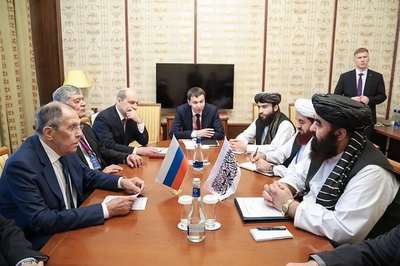
On the sidelines of Monday’s meeting, Russian Foreign Minister Sergei Lavrov met Muttaqi. Russia’s foreign ministry said the two discussed expanding bilateral relations and cooperation within regional and international meetings and organisations.
The Taliban’s foreign ministry also said in a statement that Muttaqi and Lavrov discussed political relations, economic and trade cooperation, regional issues and the continuation of political consultations between the two sides.
According to the Taliban foreign ministry, Muttaqi called for greater focus on economic, trade and transit cooperation, saying the Taliban attached considerable importance to developing long-term relations with Russia.
The ministry quoted Lavrov as saying Russia was also interested in expanding economic and trade relations with Afghanistan. It said Lavrov also praised the Taliban’s efforts to combat narcotics and maintain security.
Russia has gradually expanded its relations with the Taliban in recent years and has recognised the group’s administration. Moscow has repeatedly supported increased economic and political engagement with the Taliban at regional meetings, while also expressing concern in previous Moscow Format sessions about militant groups operating in Afghanistan.
Russian officials have said expanded relations with the Taliban are necessary for security reasons. Moscow is concerned about the potential movement of Central Asian and other foreign militants from northern Afghanistan into Tajikistan and other countries in the region.