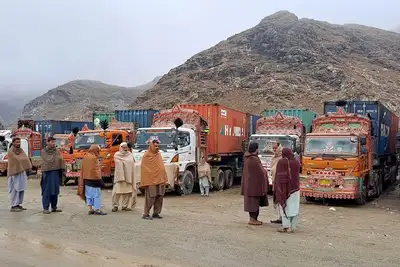
512 Civilians Killed in Taliban-Pakistan Border Clashes Over One Year

UNAMA says 512 civilians were killed and 1,236 others injured over the past year in military incidents along the Afghanistan-Pakistan border.
UNAMA says 512 civilians were killed and 1,236 others injured over the past year in military incidents along the Afghanistan-Pakistan border.
The United Nations Assistance Mission in Afghanistan published its quarterly human rights report on Thursday, 15 October, covering the period from July to September 2026.
UNAMA said the casualty figures were recorded between 1 October 2025 and 30 September 2026.
According to the report, between 1 July and 30 September this year alone, 13 people were killed and 20 others injured.
UNAMA referred to civilian deaths caused by attacks by Pakistani forces in Kunar, Paktika and Helmand.
The UN mission said women and children were among the victims. It also documented several cases of civilians being injured by pressure-plate improvised explosive devices in border areas of Kunar.
Tensions between the Taliban and Pakistan escalated into widespread border clashes from October 2025.
Taliban Officials Arbitrarily Detained 443 People in Three Months
UNAMA said Taliban morality police arbitrarily arrested or detained at least 443 people over the past three months and documented 97 cases of ill-treatment involving women and men.
The mission said it recorded more than 50 cases in which women were arrested, detained or warned over what the Taliban considers violations of its hijab rules.
Most of the detentions took place in Herat, where, according to UNAMA, the chador remains the mandatory form of dress for women.
Cases were also documented in Kabul and Badakhshan.
In one incident, UNAMA said morality police detained a 13-year-old girl for allegedly failing to comply with the hijab rules. She was held overnight and released the following day after her father intervened.
On 10 July, morality police in Herat also detained 10 women who were not wearing chadors. They were held until family guardians and local representatives pledged that the women would comply with the hijab rules in future.
Saif-ul-Islam Khyber, spokesperson for the Taliban’s Ministry for the Propagation of Virtue and Prevention of Vice, confirmed on 27 September that women and girls had been detained in Herat and Kabul over their clothing and described non-compliance with the hijab rules as a “very serious offence”.
In another interview, he said a woman who was aware of the hijab rules but failed to comply with them was considered an offender by the Taliban.
UNAMA also documented cases in which women were denied access to healthcare facilities or markets because they were not accompanied by a mahram, or male guardian.
According to UNAMA, on 8 August in Parwan, morality police prevented two women from entering a healthcare facility because they did not have a mahram (male guardian) with them.
On 17 August in Helmand, a woman was similarly denied access to a market because she was unaccompanied by a male guardian.
During the same period, Taliban institutions issued official messages telling women to remain at home and obey their husbands.
In a sermon prepared for Friday prayers on 7 August, the Taliban’s Ministry of Hajj and Religious Affairs said women should obey their husbands, stay at home and not leave without their husbands’ permission.
Shias Detained and Religious and Educational Centres Closed
UNAMA confirmed that the Taliban detained a number of employees of institutions affiliated with Afghanistan’s Shia community in September and closed several educational, religious and healthcare centres in Kabul.
Afghanistan International had published several reports during the same period about Taliban actions against Shias in Kabul and the closure of their religious and educational centres.
The cases included the detention of 28 employees of Khatam al-Nabieen University and the closure of seven centres in western Kabul.
According to the report, the detentions and closures were linked to Taliban claims of ownership over land used by these institutions.
UNAMA said that on 5 September, employees of the Taliban’s Ministry of Justice, accompanied by security forces, detained 28 male staff members of Khatam al-Nabieen University on Darul Aman Road in Kabul. The university is described as an institution affiliated with the Shia community.
Four lecturers were released the same day, while the remaining 24 were freed on 8 and 9 September.
Between 6 and 9 September, UNAMA documented the detention of at least six other people in connection with events at Khatam al-Nabieen University.
According to UNAMA, they were detained for criticising or protesting the Taliban’s actions concerning the university, with their detention lasting from several hours to seven days.
On 16 September, the Taliban’s Ministry of Higher Education revoked the operating licence of Khatam al-Nabieen University in Kabul and its branch in Ghazni.
A ministry spokesperson said the licence had been revoked because of the “continued violation of applicable regulations” and failure to implement corrective measures despite several rounds of discussions and warnings.
UNAMA also said that on 19 September, the Taliban’s Ministry of Justice detained six employees of Al-Anbiya school and cultural complex in the Qala-e-Nazer area of Kabul. They were released later the same day.
On 27 September, the Ministry of Justice also closed seven centres in different parts of western Kabul that primarily served the Shia community.
UNAMA said the centres included one health clinic, two educational centres, one sports club, two religious schools and one mosque.