• العربية
  • پښتو
  • فارسی
BrandBrand
  • Afghanistan
  • Sport
  • Analysis
  • Markets
  • Afghanistan
  • Sport
  • Analysis
  • Markets
  • Theme
  • Language
    • العربية
    • پښتو
    • فارسی
  • Afghanistan
  • Sport
  • Analysis
  • Markets
All rights reserved for Volant Media UK Limited
volant media logo

Army Destroyed Several Taliban Posts Along Border, Says Pakistan

Oct 28, 2026, 10:58 GMT+0

Pakistani officials said the army destroyed several Taliban border posts after a shell struck a house in Angoor Adda, South Waziristan, killing one civilian. Five other members of the family were wounded, according to the officials.

The Associated Press reported that Taliban forces had fired mortar shells at residential areas and the market in Angoor Adda, Khyber Pakhtunkhwa province.

According to the report, one of the shells struck a house, killing one person and wounding five other family members. Several shops in the local market were also damaged.

Samar Haroon Bilour, a local official in Khyber Pakhtunkhwa, wrote on X on Tuesday, citing security sources, that Taliban forces had targeted residential areas in Angoor Adda. She said the attack had sparked anger among local residents and prompted the Pakistani army to destroy several Taliban border posts in a retaliatory operation.

A local official in South Waziristan also said Taliban forces had opened fire on civilian homes and shops in the Angoor Adda market without provocation.

According to the official, Pakistani forces stationed along the border responded to the attacks strongly and effectively.

Faisal Karim Kundi, governor of Khyber Pakhtunkhwa, condemned the attack on residential areas and the Angoor Adda market, describing it as unprovoked aggression by the Taliban.

Pakistani officials also said the country's border forces remained on high alert and were prepared to respond to any further attacks.

The Taliban has not yet commented on the clashes or Pakistan's claim that its border posts were destroyed. It remains unclear what triggered the exchange of fire between the two sides.

The clashes occurred days after Islamabad renewed its demand that the Taliban take concrete action against armed groups that Pakistan says use Afghan territory to launch attacks.

Border tensions between Pakistan and the Taliban have escalated in recent months, with the two sides repeatedly clashing along the frontier.

Pakistan has also carried out several air strikes inside Afghanistan this year, saying the operations targeted positions belonging to armed groups operating in Pakistan.

Islamabad has repeatedly accused the Taliban of sheltering Tehreek-e-Taliban Pakistan (TTP) and the Balochistan Liberation Army (BLA).

The TTP is a separate organisation from the Afghan Taliban, although the two groups maintain close ties.

The Taliban has rejected these allegations, saying it does not allow Afghan territory to be used against other countries. The group also maintains that insecurity in Pakistan is an internal matter.

Most Viewed

Taliban Launches Widespread Reshuffle Of Civilian & Military Officials In Badakhshan
1

Taliban Launches Widespread Reshuffle Of Civilian & Military Officials In Badakhshan

2

Man Claiming Ties To Pakistani Taliban Leaders Approaches Haqqani In Khost

3

Pakistan Calls for International Pressure on Taliban Over Counterterrorism Failures

4

Afghanistan Faces World's Most Severe Women's Rights Crisis, Says UN Women

5

Taliban & Pakistani Forces Clash In Paktika, Say Local Sources

•
•
•

More Stories

Poppy Cultivation Detected On 26,000 Hectares In Afghanistan In 2026, Says Taliban

Oct 27, 2026, 15:24 GMT+0
100%

The Taliban's Interior Ministry says satellite imagery has identified 26,800 hectares of land used for drug cultivation across Afghanistan in 2026, with the crops subsequently destroyed.

Abdul Rahman Munir, the Taliban's deputy interior minister for counter-narcotics, said improved security and the group's efforts to combat drugs had contributed to a decline in narcotics cultivation and production.

Meanwhile, Abdul Mateen Qani, spokesman for the Taliban's Interior Ministry, said most narcotics, including traditional and synthetic drugs, were being smuggled into Afghanistan from Pakistan through border crossings.

Qani called on Islamabad to fulfil its responsibilities in preventing drug trafficking.

He stressed that counter-narcotics operations must continue and called for greater attention to security at Afghanistan's customs facilities and borders to prevent drug smuggling.

He also urged the international community to increase cooperation in combating narcotics, saying efforts to tackle drug trafficking could not be fully effective without regional and international support.

Munir said expanding alternative crops and supporting farmers could play a significant role in preventing a resurgence of poppy cultivation.

He added that providing sustainable livelihoods for farmers was essential to the success of counter-narcotics efforts.

The Taliban has banned poppy cultivation in Afghanistan, and its officials have repeatedly claimed a sharp decline in opium production since the ban was introduced.

In a report published in June 2026, the United Nations Office on Drugs and Crime (UNODC) said Afghanistan had produced around 80 percent of the world's illicit opium until 2022, but production had fallen by 95 precent following the Taliban's enforcement of the poppy cultivation ban.

According to the UN report, the area under poppy cultivation declined from approximately 232,000 hectares in 2022 to 10,200 hectares in 2025, while opium production fell from 6,200 tonnes to around 296 tonnes.

However, the UN warned that existing opium stockpiles in Afghanistan were expected to last until the end of 2026.

European Engagement Risks Legitimising Taliban Rule, Says Tribunal Judge

Oct 27, 2026, 11:03 GMT+0
100%

Elisenda Calvet, a judge at the People's Tribunal for Women of Afghanistan, has warned that European governments' diplomatic engagement with the Taliban could legitimise the group.

In an interview with Spanish newspaper El País, she said Afghan women's greatest concern was that the world would gradually become accustomed to Taliban rule.

Calvet said: I am concerned that, over time, the system of oppression against women will become normalised, a system in which the repression of women has reached such extremes that I have not witnessed anything comparable anywhere else in the world.

She noted that officially inviting Taliban representatives to Brussels for technical talks contradicted the European Union's position of not recognising the Taliban government and could contribute to normalising relations with the group.

The legal expert stressed that the international community must not forget that millions of women in Afghanistan continue to face severe restrictions and should be given opportunities to express their demands and share their experiences.

Referring to negotiations on a future convention on crimes against humanity, Calvet said the process provided an opportunity to include gender apartheid among internationally recognised crimes.

She explained that although such provisions would probably not apply retrospectively, formally recognising the offence could strengthen other efforts to secure justice and prosecute those responsible.

The legal expert also stressed that Afghanistan's neighbouring countries and Muslim-majority nations had a responsibility to speak out against Taliban policies and make clear that the group's actions did not represent Islam or Sharia law.

The People's Tribunal for Women of Afghanistan is a civil society initiative established to examine violations of the rights of Afghan women and girls. It was held in Madrid in 2025.

The tribunal aims to draw international attention to the systematic oppression of Afghan women and girls under Taliban rule, document crimes against humanity, particularly gender-based discrimination and persecution, and increase international pressure to hold the Taliban accountable.

Afghanistan Faces World's Most Severe Women's Rights Crisis, Says UN Women

Oct 27, 2026, 09:28 GMT+0
100%

UN Women Deputy Executive Director Nyaradzayi Gumbonzvanda expressed concern over restrictions imposed on women and girls in Afghanistan during a meeting on women, peace and security, warning that the country faces the world's worst women's rights crisis.

Speaking at a meeting at the United Nations headquarters in New York on Monday, 26 October, Gumbonzvanda addressed the situation of women in conflict-affected areas, rising conflict-related sexual violence, women's role in peace processes and the need for their participation in negotiations.

Gumbonzvanda said that Afghanistan today faces the most severe women's rights crisis in the world, girls are being denied an education that could transform their lives.

She also warned that wars had become increasingly deadly for women and girls, stressing that the international community must not remain indifferent to rising civilian casualties and the suffering of women and girls.

The UN official said more than 37,000 civilians were killed in armed conflicts last year, a quarter of whom were women and girls.

According to Gumbonzvanda, more than 750 million women and girls live within 50 kilometers of areas affected by active conflict, while at least 25 women and girls are killed every day.

The UN Women deputy executive director said war also posed serious threats to women's access to healthcare, including pregnancy and maternity services.

Referring to the situation in Gaza, she said the destruction of hospitals and maternity facilities, alongside disruptions to access to basic necessities, had been accompanied by a 41% decline in live births and a 300% increase in miscarriages.

Gumbonzvanda also expressed concern over rising conflict-related sexual violence, saying the United Nations had verified 9,788 cases in 2025.

According to Gumbonzvanda, women accounted for just 5% of negotiators across 57 peace processes in 2025, while none of the 13 ceasefire agreements explicitly prohibited conflict-related sexual violence.

The UN official called for women to participate in all peace negotiations as decision-makers and urged increased funding for women's organisations.

In Afghanistan, women and girls have been deprived of their rights to education, employment, participation in public life and many other fundamental freedoms. Over the past five years, Taliban restrictions have increasingly excluded them from various aspects of social, economic and political life.

Taliban Members' Daughters Attend Secret School In Afghanistan, Says Italian Aid Worker

Oct 27, 2026, 08:46 GMT+0
100%

The founder of an Italian aid organisation said she established a secret school for girls in Afghanistan after the Taliban returned to power, only to discover two years later that daughters of some Taliban members were among its pupils.

Susanna Fioretti, founder of the aid organisation Nove Caring Humans, told the Italian newspaper Corriere della Sera that the girls' parents wanted their daughters to receive an education.

She said she decided to establish an underground school in Afghanistan after the Taliban returned to power and banned women from higher education.

According to Fioretti, classes were held in a room containing sewing machines. If Taliban inspectors arrived, notebooks and pens were to be hidden, and the pupils would pretend to be sewing.

She said no Taliban officials visited the premises for inspections during the first two years. After that period, she discovered that daughters of several Taliban members were also attending the school.

Asked whether there had been Taliban informants among the pupils, Fioretti replied that no, they were daughters of Taliban members. Their fathers and mothers wanted them to study.

She added that not everyone associated with the Taliban shared the same views, and that some wanted to change restrictions they considered wrong but pursued such changes discreetly.

The Italian aid worker said operating the secret school for girls involved serious risks. If someone had reported its activities to the Taliban's morality police, those involved could have faced severe consequences.

The founder of the Italian organisation also spoke about her efforts to create economic opportunities for Afghan women. She said that through dialogue and compromise with the Taliban, she had managed to establish a programme recognising Afghan women entrepreneurs.

According to Fioretti, Taliban officials were initially surprised by the proposal and asked whether she understood which country she was in. She said she explained that women's economic activities could generate income for the country to secure their approval.

Fioretti added that the Taliban eventually approved the programme, and the women who received awards attended a ceremony in the presence of a Taliban minister.

She recalled that during one meeting, a senior Taliban official asked what she, as an Italian woman, thought of the Taliban government.

Fioretti said that if she had grown up under a government like the Taliban, she would not be here today doing the work she does with this organisation.

According to her, the Taliban official responded by accusing her of having a colonial mindset but then invited her to share a meal. Fioretti said she never met the official again.

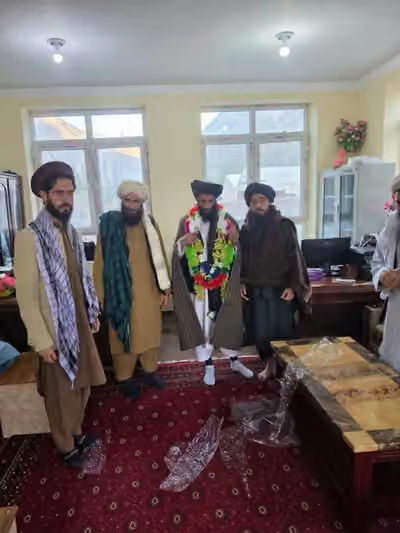
Taliban Launches Widespread Reshuffle Of Civilian & Military Officials In Badakhshan

Oct 26, 2026, 16:51 GMT+0
100%

Several sources told Afghanistan International that the Taliban has recently begun reshuffling civilian and military officials across Badakhshan province. The changes have so far affected police commanders, district governors and intelligence chiefs.

As part of the reshuffle, the Taliban has appointed new officials in Faizabad, Yaftal district and the Darwaz districts of Badakhshan.

Sources said those appointed to civilian and military positions in the Darwaz districts were close associates of Ghulamullah Ahmadi, deputy commander of the Taliban's military division in Badakhshan.

According to the sources, Musaddiqullah has been appointed district governor of Nusay, Mawlawi Shafiqullah as district governor of Shekay, Salahuddin Ayubi as police commander of Nusay, and Abdul Ghani Fayeq as police commander of Maimay district. Sheikh Mohammad, also known as Abdul Basir, who is Ghulamullah Ahmadi's son-in-law, has been appointed intelligence chief of Maimay district.

Local sources in Darwaz said the reshuffle was also continuing at administrative levels below district governors and police commanders. According to them, individuals close to Juma Fateh are being dismissed and replaced by associates of the Taliban's deputy divisional commander.

According to information obtained, Mawlawi Saqib has been appointed deputy head of administration at Badakhshan's police command, Shadab Raghi as head of the second police district, and Qari Samiullah Rasuli as the new district governor of Yaftal. The border commissioner of Ishkashim district has also been replaced.

Another source in Faizabad said changes had been made across various departments of the Taliban's police command in Badakhshan.

A credible source within the Taliban told Afghanistan International that extensive personnel changes were being implemented at all levels of the group's administration in Badakhshan. According to the source, the local Taliban administration recently decided that officials in various departments should be appointed from among Badakhshan residents and people native to the respective areas.

The latest changes come after the Taliban replaced nearly all district governors, police commanders and intelligence chiefs following the fall of Yaftal district in July this year.

Experts view the frequent and rapid reshuffling of Taliban officials in Badakhshan as a sign of the group's concerns over maintaining control of the province. They believe anti-Taliban resistance groups are gaining strength and that the Taliban is preparing for the possibility of widespread clashes next spring.