• العربية
  • پښتو
  • فارسی
BrandBrand
  • Afghanistan
  • Sport
  • Analysis
  • Markets
  • Afghanistan
  • Sport
  • Analysis
  • Markets
  • Theme
  • Language
    • العربية
    • پښتو
    • فارسی
  • Afghanistan
  • Sport
  • Analysis
  • Markets
All rights reserved for Volant Media UK Limited
volant media logo

700 Health Centres Closed In Afghanistan In One Year, Says UN

Nov 7, 2026, 11:59 GMT+0

Bruno Lemarquis, the UN Deputy Special Representative for Afghanistan, said more than 700 health facilities, accounting for 40% of the country's primary healthcare centres, have closed between 2025 and 2026 due to cuts in international funding.

Speaking at a press briefing in New York on Friday, 6 November, Lemarquis said the Taliban's restrictions on women and girls had severely limited their access to education, employment, public services and participation in social life.

He said the Taliban's continued restrictions on the fundamental rights of women and girls had further deepened Afghanistan's international isolation.

The UN Deputy Special Representative added that the ban on Afghan female employees entering UN premises, imposed in September 2025, remained in place and had also affected the organisation's operations.

Lemarquis warned that declining international funding had made Afghanistan's humanitarian situation increasingly difficult. According to him, humanitarian assistance funding had fallen from $2 billion in 2023 to $570 million in 2026.

He said that although the number of people requiring assistance was expected to decline next year, the severity of humanitarian needs would increase by approximately 30%.

According to Lemarquis, around 6.7 million people have returned to Afghanistan from neighbouring countries, particularly Iran and Pakistan, since 2023, placing considerable pressure on the economy, public services and host communities.

He stressed that returnees needed identity documents, shelter, employment opportunities and access to essential services.

Addressing the economic situation of farmers, Bruno Lemarquis said reductions in poppy cultivation would not be sustainable without providing alternative livelihood opportunities.

He warned that some farmers might return to poppy cultivation because of insufficient economic support and inadequate income from alternative crops.

The UN Deputy Special Representative also cautioned that rising poverty, weak public services and failures to reintegrate returnees could have consequences beyond Afghanistan's borders, affecting security, regional stability and migration patterns.

He emphasised that the international community must not abandon Afghanistan under the current circumstances and that international assistance should continue.

Most Viewed

Engagement With Taliban Does Not Amount To Recognition, Says EU Official
1

Engagement With Taliban Does Not Amount To Recognition, Says EU Official

2

Washington Acknowledges Pakistan’s Concerns Over Cross-Border Terrorism

3

Taliban Government Fails To Follow Sharia, Says Interior Minister

4

Pakistani Forces Arrest Afghan Taliban Member In Khabar Pakhtunkhwa

5

EU Must Choose Between Afghan People & Taliban, Says Former Lawmaker

•
•
•

More Stories

Taliban Intelligence Seeks Telegram & TikTok's Help In Combating ISIS

Nov 7, 2026, 10:34 GMT+0
100%

The Taliban's intelligence chief, Abdul Haq Wasiq, urged technology companies, including Telegram and TikTok, to cooperate with the Taliban administration against ISIS-K.

He claimed the group uses their platforms for communication, financing and ideological propaganda.

The Taliban's intelligence chief also warned that ISIS-K could use artificial intelligence to learn how to manufacture toxic substances and lethal weapons, potentially bypassing restrictions imposed on the technology.

Wasiq made the remarks during the first Shanghai Plus expert meeting on security issues in Samarkand, Uzbekistan.

Uzbekistan hosted the first Shanghai Plus expert dialogue on security issues under the Shanghai Cooperation Organisation (SCO) in Samarkand on 5 and 6 November.

The meeting brought together 33 delegations from 24 countries and five international organisations to discuss strategies for combating terrorism and extremism, as well as emerging security threats arising from the expansion of artificial intelligence and digital transformation.

The Taliban's intelligence chief said the Taliban, which he described as being on the front line of the fight against ISIS-K, faced serious limitations in countering the group's technological capabilities.

He said major technology companies such as Telegram and TikTok, whose platforms are used by ISIS-K, were not cooperating with the Taliban.

ISIS-K uses Afghanistan as one of its main operational bases and seeks to expand its influence across the region.

Through extensive social media propaganda, recruitment of young people and the establishment of links with affiliated cells in other countries, the group aims to strengthen its operational capabilities.

The group's attacks in Afghanistan and other countries in the region demonstrate that the threat posed by ISIS-K extends beyond Afghanistan's borders and has become a shared security concern for regional countries.

Taliban officials have previously claimed that they have severely weakened ISIS-K through extensive operations against the group.

The remarks come as Alexander Zuev, the UN Assistant Secretary-General for Counter-Terrorism, also claimed at the same meeting that ISIS-K had acquired modern tactical equipment, including drones, and that its members had received the necessary training to use them in operations.

Pakistan Urges International Action Against Terrorist Groups In Afghanistan

Nov 6, 2026, 14:44 GMT+0
100%

Pakistan's Foreign Ministry spokesman said Islamabad is seeking coordinated international efforts to counter terrorist threats originating from Afghanistan.

Speaking at a press briefing on Friday, 6 November, Sajjad Haider Khan said the Taliban administration's misleading narratives did not absolve it of responsibility for preventing Afghan territory from being used to launch attacks against other countries.

The Pakistani Foreign Ministry spokesman said the country's foreign minister had discussed terrorist threats originating from Afghanistan and ways to counter them during a meeting with Dan Jarvis, the UK's Minister of State for Security.

Pakistani Foreign Minister Ishaq Dar met the British official in Islamabad on Friday. According to Pakistan's Foreign Ministry, the two sides discussed bilateral relations and expanding cooperation in security, law enforcement, migration, trade and investment.

British and Pakistani officials described the presence and activities of terrorist groups, including Tehreek-e-Taliban Pakistan (TTP), in Afghanistan as a serious threat to the region. The assessment was made on Wednesday, 4 November, during bilateral counterterrorism talks in Islamabad.

Sajjad Haider Khan also rejected the Taliban administration's claims of civilian casualties resulting from Pakistani airstrikes on Afghan territory, describing them as baseless.

He said that disinformation and misleading narratives neither conceal the threat posed by terrorist networks operating on Afghan soil nor absolve the Taliban administration of its responsibility to prevent Afghan territory from being used to attack Pakistan.

The Taliban administration says civilians, including women and children, have been killed in Pakistani airstrikes. The United Nations has also previously confirmed civilian casualties in these attacks. Pakistan, however, maintains that it targets militant positions and facilities belonging to armed groups.

In recent months, Pakistan has carried out airstrikes in Kandahar, Helmand, Paktia, Paktika, Kunar and Khost provinces. It has also previously bombed Kabul. In one attack on the Afghan capital, hundreds of people were killed at a drug rehabilitation centre.

Relations between Pakistan and the Taliban administration have become severely strained in recent months amid escalating border clashes, airstrikes and mutual accusations.

Pakistan accuses the Taliban administration of allowing anti-Pakistan armed groups to operate from Afghanistan and claims that India supports these groups.

The Taliban administration denies the allegations and, in turn, accuses Pakistan of supporting armed groups opposed to its rule.

Diplomatic efforts and negotiations between the two sides have so far failed to produce an agreement to end the tensions.

Pakistan is now calling for international involvement in countering what it describes as terrorist threats emanating from Afghan territory.

The US Secretary of State has also previously said he understands Pakistan's concerns about security threats.

French Parliament Speaker Calls Taliban's Treatment Of Women Gender Apartheid

Nov 6, 2026, 11:31 GMT+0
100%

Yaël Braun-Pivet, President of France's National Assembly, said the Taliban's systematic policies and restrictions against women amount to gender apartheid. She described the situation as unacceptable and stressed the need to challenge the Taliban's treatment of women.

In a post on X, Braun-Pivet wrote that women have been systematically excluded from public life in Taliban-controlled Afghanistan. She added that Afghan women have been denied their fundamental rights and forced into silence.

The French official said she had discussed the need to recognise gender apartheid and take action against it with Nargis Nehan, a former minister in the Afghan government.

In recent days, French Foreign Minister Jean-Noël Barrot met with several Afghan women's rights activists. During the meeting, he warned that the Taliban's policies aimed at excluding women from public life were jeopardising the futures of millions of women and girls, as well as the prospects for peace and stability in Afghanistan.

Barrot said that since returning to power, the Taliban had gradually deprived women of access to school and university education, employment, justice and other areas of public life.

On Thursday, Margarita de la Pisa Carrión, a Spanish member of the European Parliament, said the Taliban terrorist regime had reduced women to second-class citizens and violated their fundamental rights by denying them access to education and employment.

She called on the European Union to take action against those responsible for violating women's rights in Afghanistan.

Previously, at a meeting in Paris on 8 May this year, several Afghan activists submitted a request to the French Foreign Ministry calling for the recognition of gender apartheid in Afghanistan.

The proposal sought to bring the issue of gender apartheid before the United Nations Security Council and pursue legal and diplomatic measures against the Taliban's restrictions on women.

Last week, the secretariat of the European Parliament's Delegation for Relations with Afghanistan informed Baktash Siawash, a former Afghan parliamentarian, in a letter that it would cooperate in advancing efforts to secure recognition of gender apartheid within the European Parliament.

The secretariat said discussions concerning a new convention on crimes against humanity were continuing.

In early May this year, the European Parliament announced that a petition titled “Recognition of Gender Apartheid in Afghanistan and Designation of the Taliban as a Terrorist Organisation” had been referred to its Committee on Petitions.

Richard Bennett, the UN Special Rapporteur on the situation of human rights in Afghanistan, has also stressed that gender apartheid, as a crime against humanity, is the most accurate description of the institutionalised oppression of women in Afghanistan.

He has urged governments to recognise gender apartheid as a crime against humanity.

Engagement With Taliban Does Not Amount To Recognition, Says EU Official

Nov 5, 2026, 17:19 GMT+0
100%

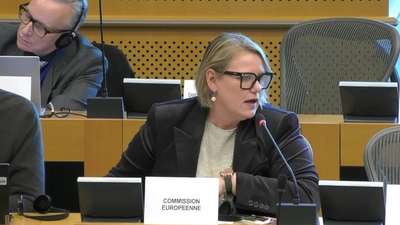
Henna Virkkunen, Executive Vice-President of the European Commission, said the European Union has not recognised the Taliban and that any change in relations with the group would depend on significant progress in human rights, particularly women's rights.

Virkkunen made the remarks in response to statements by Baktash Siawash, a former Afghan lawmaker, at the European Parliament.

Siawash accused the European Union and the international community of applying double standards towards Afghanistan during Thursday's meeting. He called for the recognition of gender apartheid, an end to diplomatic relations with the Taliban and the group's designation as a terrorist organisation.

The European Commission's Executive Vice-President said the EU continues to support Afghan women and consistently criticises the Taliban's policies towards women and girls. She added that human rights violations, particularly the situation of Afghan women, remain among Brussels' main concerns.

Speaking at the meeting, Virkkunen said the European Union had not recognised the Taliban despite continuing to provide humanitarian assistance to Afghanistan. She explained that the EU had maintained its official presence in Kabul to monitor developments in the country closely.

She added that the EU's presence in Kabul did not constitute endorsement or recognition of the Taliban. Instead, its purpose was to engage with different sections of Afghan society and hear their perspectives, particularly those of women.

Describing the situation in Afghanistan as involving systematic human rights violations, Virkkunen said the EU's policy was based on engagement with the Taliban but stressed that such engagement should not be interpreted as recognition of the Taliban government.

She emphasised that maintaining contact allows the European Union to address issues including the formation of an inclusive government, combating drug trafficking and counterterrorism.

The senior European official also referred to ongoing discussions about using the term "gender apartheid" to describe the situation in Afghanistan, saying the European Union does not currently use the term.

Virkkunen said that we use the term gender-based persecution to describe the Taliban's treatment of women, but we are interested in and are following the legal and political discussions surrounding the concept of gender apartheid.

She added that meetings on crimes against humanity and human rights violations were expected to take place soon at the United Nations in New York, where the issue of gender apartheid would also be discussed.

The European Commission's Executive Vice-President further stressed that any future steps towards recognising the Taliban would first require substantial and measurable progress on women's rights and human rights.

According to her, combating terrorism and drug trafficking would also be among the important preconditions for any such move.

In another part of her remarks, Virkkunen highlighted efforts to establish an independent investigative mechanism for Afghanistan, saying the European Union had allocated funding to support its implementation.

She added that further financial contributions from EU member states and other countries could help strengthen accountability for human rights violations in Afghanistan.

Responding to Siawash's call for the Taliban to be designated a terrorist organisation, Virkkunen said the European Union had not currently listed the group as a terrorist organisation.

She explained that such a designation would require specific legal procedures and decisions by competent authorities in EU member states or partner countries.

Virkkunen also recalled that the European Union implements UN sanctions against individuals and entities linked to terrorism in Afghanistan.

She added that the EU had also placed five individuals on its human rights sanctions list for their involvement in serious violations of the rights of Afghan women and girls.

EU Must Choose Between Afghan People & Taliban, Says Former Lawmaker

Nov 5, 2026, 15:53 GMT+0
100%

Baktash Siawash, a former Afghan lawmaker, criticised the international community's approach to the Taliban during a European Parliament meeting, accusing countries of applying double standards towards Afghanistan, particularly women.

He urged the EU to decide whether it stands with the Afghan people or the Taliban.

The former Afghan parliamentarian called for the recognition of gender apartheid in Afghanistan and urged countries to suspend diplomatic relations with the Taliban and designate the group as a terrorist organisation.

He also called on European lawmakers to adopt more concrete measures against the Taliban.

Siawash delivered his remarks on Thursday, 5 November, during a meeting of the European Parliament's Committee on Petitions.

He said more than 1,908 days had passed since the Taliban began implementing restrictive policies against Afghan women and girls. According to him, these policies have deprived millions of women and girls of their fundamental rights, including education, employment and participation in public life.

The politician added that the international community had largely remained a spectator to developments in Afghanistan, while the Taliban continued to expand restrictions and pressure on women. He said the world's response had been largely limited to issuing political statements.

Siawash also accused the Taliban of supporting and harbouring terrorist groups, saying the group had eliminated opportunities for political activity, suppressed the media, music and cinema, and prevented opponents from operating freely.

He described the current situation in Afghanistan as "gender apartheid", saying Afghan women had been deprived of normal lives and participation in society. He argued that the situation amounted to organised and structural discrimination against women.

The former Afghan lawmaker also criticised Western countries for issuing visas to Taliban officials and facilitating their participation in international meetings while simultaneously expressing concern about women's rights.

He said that the world's double standards are unacceptable.

Siawash urged the international community to stand for justice and human values and take practical measures to support the people of Afghanistan.

In another part of his speech, he stressed that Afghanistan's future must be based on the sovereignty of its people and that the country needs a political system in which citizens can determine their own future.

Siawash also called on European institutions to increase parliamentary and political pressure on the Taliban.

Recently, the secretariat of the European Parliament's Delegation for Relations with Afghanistan informed Siawash in a letter that it would cooperate in advancing efforts to secure recognition of gender apartheid within the European Parliament.

The secretariat said discussions concerning a new convention on crimes against humanity were continuing.

The European Union has repeatedly expressed concern over the deteriorating human rights situation in Afghanistan and strongly condemned the severe, institutionalised gender-based discrimination and repression faced by women and girls.

The EU recently told the Third Committee of the 81st session of the UN General Assembly that systematic violations of women's and girls' rights in Afghanistan could amount to gender-based persecution.