• العربية
  • پښتو
  • فارسی
BrandBrand
  • Afghanistan
  • Sport
  • Analysis
  • Markets
  • Afghanistan
  • Sport
  • Analysis
  • Markets
  • Theme
  • Language
    • العربية
    • پښتو
    • فارسی
  • Afghanistan
  • Sport
  • Analysis
  • Markets
All rights reserved for Volant Media UK Limited
volant media logo

Taliban Intelligence Ordered Attack On Afghan Commander, Says Iranian Media

Nov 12, 2026, 16:37 GMT+0

Iranian media outlet IRAF has reported, citing unnamed sources, that the man behind an explosion targeting former Afghan commander Ahmad Khan Ghori in Mashhad was an agent of the Taliban's intelligence agency who had received orders from officials in Kabul.

In a report published on Thursday, 12 November, IRAF quoted what it described as reliable sources as saying the alleged attacker had been directly instructed by Taliban intelligence officials in Kabul to assassinate Ghori.

Iranian authorities have not publicly commented on allegations of Taliban involvement in the attack.

Ghori, a prominent former mujahideen commander from western Afghanistan and a close associate of Mohammad Ismail Khan, was injured in an explosion at his home in Mashhad on 1 November.

Initial reports suggested that a portable phone charger, commonly known as a power bank, belonging to one of his guests had exploded.

The guest, whom IRAF identified as the alleged attacker, died in hospital the following day from severe injuries sustained in the explosion.

The Taliban have also made no official comment on the incident.

People close to Ghori previously said they believed the explosion had been deliberately caused in an attempt to assassinate him.

The incident follows the killings of other former Afghan commanders opposed to the Taliban in Iran. Marouf Ghulami and General Ekramuddin Saree were previously killed in Mashhad and Tehran, respectively.

IRAF claimed that the incidents exposed what it described as the dangerous extent of Taliban intelligence activities on Iranian soil and their potential implications for Iran's national security.

The outlet also suggested that an investigation into the attack on Ghori could uncover evidence relating to other similar killings of former Afghan officials in Iran.

Concerns over the safety of former Afghan commanders living in Iran have grown following the attacks. Sources previously told Afghanistan International that several commanders had restricted their movements and increased security precautions after receiving threats.

Taliban officials have previously threatened to target opponents beyond Afghanistan's borders.

Mohammad Nabi Omari, the Taliban's deputy interior minister, previously claimed that the group could, if necessary, arrange for opponents abroad to be killed for as little as 500 Pakistani rupees.

Saeed Khosty, a former spokesperson for Taliban interior minister, Sirajuddin Haqqani, also threatened Taliban opponents living abroad three years ago, warning that the group had hundreds of volunteers prepared to target its opponents outside Afghanistan.

Most Viewed

Terrorism & Drug Trafficking Pose Growing Threats, Says Regional Security Bloc
1

Terrorism & Drug Trafficking Pose Growing Threats, Says Regional Security Bloc

2

Six People Executed For Alleged Taliban Spying, Says Afghanistan United Front

3

Russia & Its Allies Are Monitoring Afghanistan Closely, Says Putin

4

Probe Possible Taliban Links To Killings Of Afghan Ex-Officials, Says Iranian MP

5

Tajikistan FM Calls For Inclusive National Dialogue In Afghanistan

•
•
•

More Stories

Russia’s Deputy Prime Minister Meets Senior Taliban Officials in Kabul

Nov 12, 2026, 13:07 GMT+0
100%

Alexey Overchuk, Russia’s deputy prime minister, led a high-level delegation to meet Mullah Abdul Ghani Baradar, the Taliban’s deputy prime minister for economic affairs, at the presidential palace after arriving in Kabul on Thursday, 12 November.

Taliban Foreign Minister Amir Khan Muttaqi also welcomed the Russian deputy prime minister and his delegation at Kabul airport.

Russia’s current prime minister is Mikhail Mishustin, and the government includes 11 deputy prime ministers. Overchuk is one of them and is responsible for areas related to economic and regional integration across Eurasia.

The Taliban’s presidential palace said Baradar and Overchuk discussed expanding economic and trade relations, increasing joint investment and facilitating trade between the two countries.

According to the palace statement, Baradar invited Russian companies to invest in the extraction of Afghanistan’s mineral resources in cooperation with Afghan partners. He also called for bilateral trade to increase in line with the economic potential of both countries.

The Taliban’s deputy prime minister for economic affairs pointed to Afghanistan’s geographical location, natural resources and 24 million people of working age, describing the country as having significant potential for economic growth and joint investment.

Baradar also proposed cooperation in establishing industrial parks that meet international standards, increasing joint industrial investment, building specialised hospitals, renovating and expanding existing healthcare facilities, and establishing factories to produce medicines and medical equipment.

He said Afghanistan also had the potential to increase exports of agricultural products to Russia, including pine nuts, figs, saffron, grapes, pomegranates and cotton, and welcomed Russian investment in agriculture and livestock farming.

Overchuk said trade between Russia and Afghanistan reached about $350 million in the first eight months of 2026. According to him, the figure doubled compared with the same period last year, while imports of Afghan fruit and vegetables into Russia have begun.

The Taliban’s presidential palace said the Russian delegation would also meet the Taliban prime minister and officials from several ministries during the visit. The talks are expected to cover political, economic, trade and transit relations, as well as investment opportunities in Afghanistan.

Russia recognised the Taliban government on 1 July 2025, becoming the first country to do so. Political and economic contacts between the two sides have increased since then.

Cross-Border Threats From Afghanistan Require Joint Action, Says Kyrgyz President

Nov 12, 2026, 09:46 GMT+0
100%

Kyrgyz President Sadyr Japarov called for coordinated efforts among Collective Security Treaty Organisation (CSTO) members to counter cross-border threats from Afghanistan.

He also urged support for the country's economic recovery and humanitarian needs.

Speaking at a CSTO leaders' summit in Moscow on Thursday, Japarov reaffirmed Kyrgyzstan's commitment to strengthening collective security and expanding practical cooperation among member states.

Referring to joint military exercises held across the region and Kyrgyzstan's readiness to host CSTO joint activities in 2027, he placed particular emphasis on combating terrorism, extremism, drug trafficking and organised crime.

He stressed the need to strengthen cooperation among relevant agencies, including through the CSTO's Canal counter-narcotics operation.

Japarov specifically addressed the situation in Afghanistan, emphasising the importance of coordinated efforts to counter cross-border threats originating from the country, support its economic reconstruction and address its humanitarian challenges.

The Kyrgyz president also referred to Kyrgyzstan's upcoming membership of the United Nations Security Council for 2027-2028, expressing his country's readiness to engage constructively with partners on regional security and preventive diplomacy.

During the summit, leaders of CSTO member states signed 18 documents aimed at expanding cooperation and strengthening collective security.

The Collective Security Treaty Organisation is a Russia-led military and security alliance comprising Russia, Belarus, Kazakhstan, Kyrgyzstan, Tajikistan and Armenia.

Tajik President Emomali Rahmon, who also attended the Moscow summit, emphasised the need to strengthen border security along the frontier with Afghanistan.

He called for intensified efforts to combat terrorism, extremism, drug trafficking and transnational organised crime.

Russian President Vladimir Putin also said at the summit that Moscow was closely monitoring developments in Afghanistan.

According to Putin, the situation in Afghanistan holds particular importance in the organisation's plans to ensure the security of member states' borders.

Terrorism & Drug Trafficking Pose Growing Threats, Says Regional Security Bloc

Nov 11, 2026, 10:33 GMT+0
100%

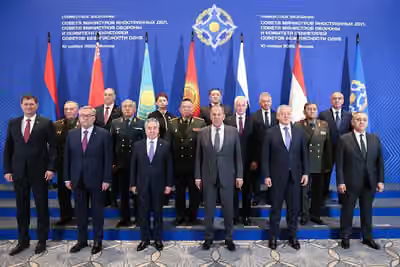
The Collective Security Treaty Organisation (CSTO) has warned of growing terrorist activity, drug trafficking and the risk of conflict in the region following a joint meeting of foreign and defence ministers, and security council secretaries in Moscow.

The meeting also highlighted the need to strengthen collective defence capabilities and address emerging security challenges.

According to a statement from Russia's Foreign Ministry, the meeting was held on Tuesday, 10 November, chaired by Russian Foreign Minister Sergei Lavrov.

The CSTO comprises six member states: Russia, Belarus, Armenia, Kazakhstan, Kyrgyzstan and Tajikistan.

Participants reviewed the security situation across CSTO member states and neighbouring regions, discussing measures to combat cybercrime, irregular migration and terrorist threats.

The meeting also saw the preparation of documents aimed at strengthening the organisation's military capabilities, including the development of joint air forces, air defence systems and biological security measures. The documents are expected to be submitted to the Collective Security Council for final approval.

Officials also announced that Tajikistan would host the next meeting of CSTO foreign ministers in the first half of 2027.

Tajikistan shares a border of more than 1,300 kilometres with Afghanistan, much of it running through mountainous and difficult terrain along the Panj River.

CSTO officials have repeatedly warned that the presence of terrorist and extremist groups in northern Afghanistan, particularly Islamic State Khorasan Province (ISKP), could pose a direct threat to Central Asia and the organisation's member states.

CSTO members have expressed concern that terrorist threats, drug trafficking and extremist infiltration could spread from Afghanistan into their territories. Strengthening border security has therefore become one of their main priorities.

As part of these efforts, the organisation has launched a five-year intergovernmental programme to reinforce security along the Tajikistan–Afghanistan border.

Under the programme, CSTO members, including Russia, Kazakhstan, Belarus and Kyrgyzstan, are expected to supply Tajikistan with weapons, military equipment and technical border protection systems by the end of 2026.

The initiative is intended to strengthen Tajikistan's border defences and prevent security threats originating in Afghanistan from spreading into neighbouring countries.

Probe Possible Taliban Links To Killings Of Afghan Ex-Officials, Says Iranian MP

Nov 11, 2026, 09:42 GMT+0
100%

Ahmad Bakhshayesh Ardestani, a member of the Iranian parliament's National Security and Foreign Policy Committee, has called for an investigation into the Taliban's possible involvement in attacks on figures from Afghanistan's former government in Iran.

However, he stressed that responsibility for the attacks could not be attributed to the Taliban without evidence.

In an interview with the IRAF news agency published on Tuesday, Ardestani said the recurrence of such attacks and the possibility that they were connected raised concerns about Iran's national security. However, he said the incidents would not necessarily affect relations between Tehran and the Taliban.

He identified political motives, personal disputes and organised operations as possible explanations that security agencies should investigate.

The Iranian lawmaker said that if the attacks against influential figures from Afghanistan's former government were found to be part of a series of organised operations, the possibility of political motives would arise.

He also described the Taliban's possible involvement as one of the hypotheses worth examining, but emphasised that attributing the attacks to the group or any other organisation would require evidence and the findings of security investigations.

Referring to the recent assassination attempt against Ahmad Khan Ghori, the former head of Ghor Provincial Council, in Mashhad, Ardestani said a political motive was possible, but personal disputes and financial issues should also be investigated.

He added that if links between the attacks were established, their recurrence could indicate weaknesses within Iran's security agencies and create the impression that certain individuals were not adequately protected in the country.

According to Ardestani, identifying those responsible and investigating any potential networks should be priorities for the relevant authorities.

Previously, Marouf Ghulami, a former mujahideen commander and an associate of Mohammad Ismail Khan, was shot dead at his office on Mofatteh Street in Mashhad on 13 September 2025.

Sources close to Ismail Khan blamed the Taliban for the assassination, but Iranian officials did not comment publicly at the time on the perpetrators or their motives.

On 24 December 2025, General Ekramuddin Saree, the former police chief of Takhar province, and Mohammad Amin Almas, a former Afghan military officer, were killed in an armed attack in Tehran.

Responsibility for that attack has not officially been attributed to any individual or group.

The Iranian government has not released information about these killings or the findings of its investigations.

US Was Humiliated During Afghan Withdrawal, Says Trump's War Secretary

Nov 10, 2026, 16:39 GMT+0
100%

US Secretary of War Pete Hegseth said the chaotic withdrawal from Afghanistan was a disaster for American credibility and demanded a thorough, candid review. He said the US was humiliated in Kabul five years ago as its adversaries watched.

Speaking on Monday, 9 November, Hegseth described the chaotic withdrawal of US forces from Afghanistan as one of the previous administration's major failures and criticised the performance of Lloyd Austin, who served as Defence Secretary under former President Joe Biden.

The Trump administration's Secretary of War also criticised Congress for its handling of Austin's performance, saying that despite the disastrous withdrawal from Afghanistan, no impeachment vote had been held against the then-Defence Secretary.

As part of a broader assessment of America's military educational institutions, Hegseth said the country's war colleges had avoided thoroughly examining recent strategic failures, including the US withdrawal from Afghanistan.

US forces withdrew from Afghanistan in August 2021 during the presidency of Joe Biden.

According to Hegseth, some instructors at these institutions consider such subjects sensitive or politically controversial, an approach he argued was incompatible with serious military strategy education.

Referring to the deadly attack at Abbey Gate at Kabul airport during the US withdrawal, Hegseth said 13 American service members had been killed as a result of operational, strategic and political failures.

He described the chaotic collapse of the US presence in Afghanistan as a complete disaster for American credibility and said the country's war colleges owed those who served during the 20-year war in Afghanistan a frank and candid assessment of America's performance.

Hegseth also questioned why senior US officials had failed to anticipate the collapse of the Afghan government and why the country's operational plans had fallen apart within days.

As American and international forces withdrew from Afghanistan, the Afghan government collapsed and the Taliban returned to power.

Donald Trump has also repeatedly criticised the way US forces withdrew from Afghanistan.