Taliban Transfer 105 Prisoners, Mostly Former Soldiers, To Kabul, Say Sources

The Taliban have transferred 105 prisoners from Kunduz, Takhar and Badakhshan provinces to Pul-e-Charkhi Prison in Kabul, according to sources.
The Taliban have transferred 105 prisoners from Kunduz, Takhar and Badakhshan provinces to Pul-e-Charkhi Prison in Kabul, according to sources.
Most are former members of Afghanistan's security forces detained over alleged links to anti-Taliban resistance groups.
Sources told Afghanistan International that the transfers took place on 16 and 17 November, involving 40 prisoners from Takhar, 40 from Badakhshan and 25 from Kunduz.
Some of the prisoners have been sentenced to more than 10 years in prison, the sources said.
The transfers have raised concerns among detainees' families, some of whom say they have been unable to establish the whereabouts of their relatives.
Relatives of Azim Warsaji, a former member of Afghanistan's security forces previously held in Kunduz, told Afghanistan International that they had received no information about his condition or whereabouts since his transfer to Kabul.
They said his family had spent the past week searching for him at Bagram and Pul-e-Charkhi prisons without success.
His relatives expressed fears that Warsaji could face reprisals from Taliban officials.
According to the family, Mohammad Aka, a Taliban commander in Kunduz and former commander of the group's 217th Omari Army Corps, accompanied Warsaji during his transfer from prison.
Warsaji was detained on suspicion of attacking forces under Mohammad Aka's command, his relatives said.
The Taliban have accused him of killing at least 11 of their fighters in an attack in 2022 in the Hawz-e Wighnan area of Warsaj district, Takhar province.
His relatives have appealed to international organisations to help establish his whereabouts, clarify his condition and ensure that his family can obtain information about where he is being held.
Sources attributed the prisoner transfers to Taliban concerns over increased activity by armed resistance groups and the possibility of attacks or unrest in provincial prisons.
They said these concerns had prompted the Taliban to move prisoners to Bagram and Pul-e-Charkhi prisons.
Meanwhile, a former detainee at a Taliban-run prison in Takhar described conditions there as dire, saying the facility was severely overcrowded.
The former prisoner told Afghanistan International that more than 2,000 people were being held at the prison, many of whom did not know why they had been detained.
According to the source, prisoners often spend months in detention without knowing when their cases will be reviewed.
Relatives of prisoners transferred from Badakhshan have also expressed concern, saying the move to Kabul has made it more difficult to visit detainees and obtain information about their welfare.
They said families had previously been able to visit provincial prisons more easily, but the distance to Kabul and the cost of travel now posed significant obstacles.
Most of those transferred are former members of Afghanistan's security forces, whose families are already struggling with severe financial hardship.
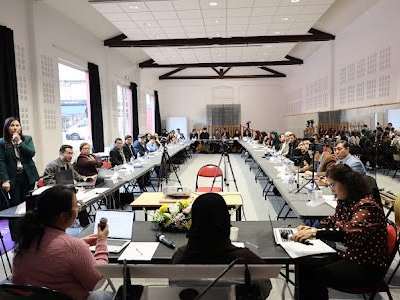
The fourth HearUs Summit brought together Afghan women leaders, United Nations officials, diplomats and civil society representatives in Madrid to discuss accountability for the Taliban, the protection of Afghan women's rights and international mechanisms for achieving justice.
The two-day gathering, held on Sunday and Monday, 22 and 23 November, at Spain's Ministry of Foreign Affairs was organised in partnership with Women for Afghanistan.
Held under the theme "Afghan Women's Leadership in Achieving Justice and Peace through Accountability", the summit brought together around 70 participants, including Afghan women and men, UN officials, diplomats, researchers, religious scholars and civil society representatives.
Why Was The Summit Held?
The fourth HearUs Summit took place more than five years after the Taliban returned to power in Afghanistan, where women and girls continue to face sweeping restrictions on education, employment, freedom of movement and participation in political and public life.
Organisers said the gathering aimed to strengthen efforts to hold the Taliban accountable for human rights violations, promote women's participation in political and peace processes, and improve coordination among governments, international organisations and civil society.
Participants stressed that lasting peace and stability in Afghanistan could not be achieved without meaningful participation by women and accountability for human rights abuses.
They urged the international community to maintain its support for justice, women's rights and international accountability mechanisms relating to Afghanistan.
What Did The Speakers Say?
Spanish Foreign Minister José Manuel Albares Bueno reaffirmed that his country would not recognise the Taliban government and stressed that Afghan women's rights must not become a bargaining chip in political negotiations.
He also expressed support for recognising gender apartheid under international law and called for investigations into abuses committed against Afghan women.
Pramila Patten, the UN Secretary-General's Special Representative on Sexual Violence in Conflict, warned that there were no signs of improvement in the Taliban's treatment of women and girls.
Referring to reports of forced marriage, sexual violence and increasingly severe restrictions, she called for stronger international efforts to document abuses and preserve evidence for future accountability.
Patten also warned that funding shortages were undermining programmes intended to support Afghan women.
Another speaker, Navanethem "Navi" Pillay, a South African jurist and former UN High Commissioner for Human Rights, addressed the summit in a video message.
Drawing parallels with the struggle against racial apartheid in South Africa, Pillay expressed confidence that efforts to end what she described as gender apartheid in Afghanistan would ultimately succeed.
She supported international efforts to hold Taliban leaders accountable and stressed the importance of pursuing justice for victims of human rights violations.
Fawzia Koofi, chair of the board of Women for Afghanistan and a former member of Afghanistan's parliament, described the situation in Afghanistan as one of the world's most severe human rights crises.
She criticised the Taliban's exclusionary system of government, describing it as a government "of the Taliban, by the Taliban and for the Taliban".
Koofi urged the international community to move beyond expressions of sympathy and take concrete steps towards accountability.
One Million Signatures Campaign
One of the summit's key initiatives was the launch of the One Million Signatures campaign, aimed at mobilising international support for the recognition of gender apartheid and increasing pressure on the Taliban to restore women's rights.
The initiative was presented by Katrín Jakobsdóttir, Iceland's former prime minister. Spanish Foreign Minister José Manuel Albares also expressed support for the campaign.
The campaign, known as "One Million Voices for the Women and Girls of Afghanistan", calls on the United Nations and governments worldwide to refrain from recognising the Taliban and take concrete action to restore the rights of Afghan women and girls.
It also advocates women's meaningful participation in political decision-making concerning Afghanistan's future.
The organisers of the fourth HearUs Summit prepared the campaign statement and launched the initiative to collect one million signatures in support of Afghan women's and girls' rights.
On the sidelines of the summit, a women's rights activist presented Albares with photographs of Bibi Sediqa and Mozhda Uzbek, two women reportedly detained by the Taliban, along with letters from their families, and urged him to help secure their release.
In response, Albares described the situation facing Afghan women as completely unacceptable and reaffirmed Spain's commitment to supporting their freedom and security and pursuing accountability for abuses committed by the Taliban.
Panel Discussions And Specialist Sessions
Following the opening ceremony, participants took part in four specialist panel discussions covering education and women's resilience, employment and economic empowerment, accountability and justice, women's rights in Islam, and women, peace and security.
The summit programme also included plans to present an accountability framework for Afghanistan, intended to coordinate legal, political and international efforts to hold perpetrators of human rights violations accountable.
The discussions focused on strengthening cooperation among Afghan women leaders, international institutions and governments, and identifying practical measures to advance women's rights and participation in Afghanistan's future.
Spain's Support For Afghan Women
The HearUs initiative was launched in February 2022 to amplify Afghan women's voices in international forums and promote their meaningful participation in decisions affecting their country.
The fourth summit was held more than five years after the Taliban's return to power in August 2021, with restrictions on Afghan women and girls remaining in place.
Spain adopted a feminist foreign policy approach in 2021, placing gender equality, women's political participation and the protection of women's rights among its foreign policy priorities.
Under this approach, Madrid has become a prominent international supporter of Afghan women's rights, hosting successive HearUs conferences and advocating access to education, employment and political participation for women and girls in Afghanistan.
Pramila Patten, the UN Special Representative on Sexual Violence in Conflict, warned at the fourth HearUs Summit in Madrid on Monday that the Taliban's restrictions on Afghan women and girls continued to deepen, calling for stronger international action to ensure accountability.
Addressing the gathering on 23 November, Patten condemned the systematic discrimination faced by women and girls in Afghanistan and stressed the need to document violations and preserve evidence for future legal proceedings.
She said no other country had imposed such comprehensive and systematic restrictions on half its population solely on the basis of gender.
Patten warned that the violations taking place in Afghanistan could amount to crimes against humanity and urged the international community to recognise their gravity.
Her remarks came against a backdrop of documented sexual violence under Taliban rule. In its 2026 report on conflict-related sexual violence, the United Nations recorded cases of rape, gang rape, forced marriage and other abuses attributed to Taliban de facto officials, including security personnel.
Afghan women and girls also continue to face severe restrictions on education, employment, freedom of movement and participation in public life.
Patten stressed that accountability required credible evidence of violations and efforts to identify those responsible.
She argued that holding perpetrators accountable was not an act of revenge but a refusal to accept that anyone could remain above the law.
The UN representative also highlighted the importance of the independent investigative mechanism established by the UN Human Rights Council in October 2025 to collect, consolidate, preserve and analyse evidence of serious violations of international law in Afghanistan.
She said the mechanism's effectiveness would depend on political will, sustained international support and adequate resources.
Patten warned against praising the courage of Afghan women while failing to provide them with the protection and resources they needed.
Funding shortages have already affected services for survivors of gender-based violence in Afghanistan. The United Nations has reported the closure of hundreds of health facilities and support centres, further limiting access to assistance.
The UN envoy urged continued international support for Afghan women and stressed that evidence of abuses and networks providing assistance must be protected.
Afghan women's rights activists in France have called for the systematic discrimination and exclusion of women and girls in Afghanistan to be recognised as gender apartheid.
In a resolution, they urged the international community to hold the Taliban accountable and refrain from normalising relations with the group.
The demands were outlined in a resolution adopted at the second round of the Afghan Women's Dialogues, held on Saturday, 21 November 2026, in Alfortville, France.
Participants, including women's rights activists, researchers, journalists, academics and representatives of civil society organisations, described the Taliban's policies and practices restricting women's and girls' access to education, employment, freedom of movement and participation in public life as gender-based persecution and crimes against humanity.
The resolution called on the United Nations, the European Union and governments worldwide to work towards the recognition of gender apartheid in Afghanistan and support educational programmes, scholarships and opportunities for Afghan women and girls to continue their studies.
Participants also called for safe and legal pathways for the evacuation and resettlement of women and activists at risk, particularly human rights defenders, journalists, students, former members of Afghanistan's security and defence forces, and civil society activists.
The resolution further urged the French government and the municipality of Alfortville to support efforts to secure recognition of gender apartheid at the European and international levels and expand educational, protection and humanitarian programmes for Afghan women and girls.
The signatories also called on the French government to refrain from any engagement with the Taliban that could lead to the normalisation of relations or recognition of the group as Afghanistan's legitimate government.
The conference was organised by the Kolba-e Dost Association, with financial support from the municipality of Alfortville and in cooperation with the Hazara Diaspora Network.
In their concluding statement, the organisers stressed that the rights of Afghan women and girls must not be subject to negotiation and urged the international community to turn its support for them into sustained, concrete action.
World Television Day comes as media activities, particularly visual journalism, face censorship, restrictions and bans in Afghanistan under Taliban rule.
Since returning to power, the Taliban have imposed a range of restrictions on Afghanistan’s media landscape, from requiring women to cover their faces to banning the publication and broadcast of images of living beings.
In addition to these restrictions, the Taliban have revoked the licences of several media outlets and suspended their operations during more than five years in power.
In its annual report this year, the Afghanistan Journalists Centre (AFJC) said the Taliban’s ban on images of living beings had forced at least 21 local television stations to cease operations.
The organisation said in its annual report that the ban on images of living beings had expanded to 25 provinces across Afghanistan.
Reports indicate that the Taliban have also temporarily suspended the operations of several private television channels, including Noor, Barya, Arezo, Tamadon and Rah-e Farda.
The Taliban have also banned all female employees and presenters from working in state-run media. Although a limited number of women continue to work in private media outlets, they say they are allowed to do so only under specific conditions.
Nargis, a pseudonym for a woman currently working at a private television station in Afghanistan, told Afghanistan International that she has been forced to accept strict conditions to continue pursuing her profession.
She said the Taliban initially made it compulsory for female journalists, particularly television presenters, to cover their faces.
According to Nargis, the Taliban openly discriminate against female journalists, with many of the group’s officials refusing to allow women reporters to cover their press conferences.
“I have worked in the media for several years, but there are people who have only one year of experience and, simply because they are men, have a broader scope of work and greater authority than I do,” she said.
Nargis said journalism was incompatible with restrictions.
“Media work requires freedom and the ability to operate without restrictions because we need access to all sources to bring the truth to the public. Gender should not be an obstacle to doing this work, but unfortunately, it has now become one,” she said.
The female journalist said the Taliban currently prohibit women reporters from interviewing male experts. According to her, female journalists are also barred from contacting Taliban officials or attending meetings to provide news coverage.
Nargis expressed hope that one day she would be able to resume her profession normally, without facing any obstacles.
Afghan journalists say the Taliban’s restrictions are not limited to women reporters but also affect male journalists and the wider media environment.
Another media professional in Afghanistan, who holds a management position at a media outlet and requested anonymity because of security concerns, said that media activities in the country, particularly television broadcasting, no longer comply with journalistic principles.
The media professional said outlets are forced to prepare even the content and topics of their regular programmes according to the Taliban’s demands.
For political programmes, media outlets must prepare the subject matter, guest lists and sometimes even the questions in accordance with Taliban instructions, the source said.
“In this way, I can say that we currently have no freedom to report on society’s problems or the truth about the Taliban’s misconduct,” the journalist told Afghanistan International.
The Afghan journalist stressed that “the situation has become extremely exhausting”, but said continuing to work was necessary to support the family.
Meanwhile, the Afghanistan Media Support Organisation (AMSO) said in its latest monthly report that the Taliban had increased pressure on journalists and imposed restrictions on the publication of photographs and videos.
According to the report, journalists in some areas are encouraged to promote the Taliban’s positions on political and military issues and are compelled to attend religious training programmes.
The organisation expressed concern about the consequences of allowing these conditions to continue, warning that they pose a serious threat to the independence of news reporting, professional impartiality and journalists’ safety.
International human rights organisations, press freedom groups and media activists have repeatedly expressed concern over Taliban censorship and restrictions on the media, calling for an end to these measures and their repeal.
World Television Day is observed annually on 21 November by the United Nations. The day aims to highlight the value of television and its role in disseminating information, raising public awareness, providing education and bringing about social change.
The purpose of the day is not merely to celebrate television as a medium, but also to emphasise the importance of free media in shaping public opinion, presenting diverse perspectives, uncovering the truth and reflecting society’s problems.
The United Nations regards the occasion as an opportunity to reaffirm the importance of press freedom, unrestricted access to information and the professional work of journalists.
However, since returning to power, the Taliban have detained dozens of journalists over their reporting activities, and several journalists remain imprisoned.
According to the families of imprisoned journalists, those being held at Bagram prison are living in poor conditions and are not even permitted to receive visits from their relatives.
In an investigative report published in early November, Reporters Without Borders (RSF) said Directorate 015 of the Taliban’s intelligence agency plays a significant role in monitoring, threatening, detaining and torturing journalists, and seeks to turn Afghanistan’s media outlets into instruments of Taliban propaganda.
The organisation also included Taliban leader Mullah Hibatullah Akhundzada, alongside 33 other individuals and entities, on its list of those it says have restricted press freedom in 2026.
Russian Foreign Ministry spokesperson Maria Zakharova stressed the need to eradicate terrorism from Afghanistan and stabilise the country’s security situation during a press briefing in Moscow on Friday, 20 November.
Zakharova said international terrorist organisations, particularly Islamic State’s Khorasan branch (ISIS-K), continued to operate in Afghanistan.
She said efforts to combat international terrorism must be pursued without ulterior motives or hidden agendas, adding that Moscow considered the principle of “regional solutions to regional problems” essential.
The Russian Foreign Ministry spokesperson said Moscow remained ready to discuss specific counter-terrorism measures and help implement them on the basis of firm agreements.
Addressing Russia’s relations with Pakistan, Zakharova described Islamabad as one of Moscow’s key partners in combating terrorism in South Asia, including Afghanistan.
She said Russia maintained close dialogue and coordination with Pakistan, both bilaterally and through multilateral mechanisms.
According to Zakharova, Moscow prioritises the Moscow Format of Consultations on Afghanistan, which it considers the most inclusive regional mechanism. Its participants include Russia, Afghanistan, Pakistan, India, Iran, China and the five Central Asian countries: Kazakhstan, Kyrgyzstan, Tajikistan, Turkmenistan and Uzbekistan.
Commenting on tensions between the Taliban and Pakistan, Zakharova said Russia was closely monitoring developments and consistently advocated resolving disputes through political and diplomatic means.
She added that Moscow was prepared to facilitate dialogue between the Taliban and Islamabad if both sides requested its assistance.
Her remarks follow an earlier warning by Russia’s representative at the United Nations Security Council that, despite the Taliban’s counter-terrorism operations, the threat posed by ISIS-K had not been eliminated and the group retained significant military capabilities.
The Russian representative said foreign financial support and the presence of foreign fighters, particularly those with combat experience in Syria and Iraq, had helped strengthen ISIS-K’s military capabilities.
The representative also said the activities of groups such as Tehreek-e-Taliban Pakistan (TTP) and the East Turkestan Islamic Movement (ETIM) aligned with the objectives of ISIS-K.
Meanwhile, Alexandre Zouev, the United Nations Acting Under-Secretary-General for Counter-Terrorism, has warned of growing terrorist capabilities and activity in Afghanistan.
Zouev said ISIS-K was putting pressure on the Taliban authorities and appeared to be rebuilding its capabilities. He added that, according to information provided by some UN member states, the group had access to modern tactical equipment, including drones.
The remarks also came as Russian President Vladimir Putin and Tajik President Emomali Rahmon met in Dushanbe on Friday, 20 November, to discuss developments in Afghanistan, regional security threats and border cooperation.
The Taliban authorities have repeatedly denied that ISIS-K is operating freely in Afghanistan, claiming that their security forces have largely eliminated the group’s presence and capabilities.