
The Taliban detained Mohammad Razzaq Dawran, an influential tribal elder, in Charikar city of Parwan province on Sunday, local sources confirmed. Dawran has been detained on charges of collaboration with the National Resistance Front (NRF), the sources stated.
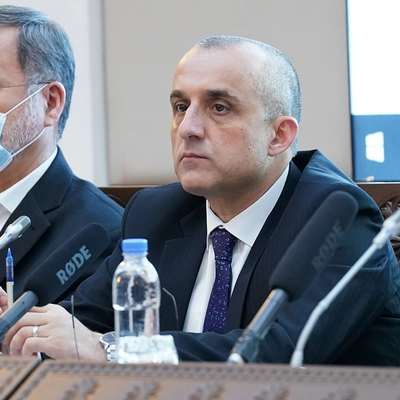
Dawran's family called the accusations "baseless" and stressed that he has no connection with the resistance group and has never cooperated with the NRF.
Dawran’s relatives said that he has been imprisoned without any proof and they are worried about his health condition and fate.
Taliban have increased detention of locals on charges of collaboration with the National Resistance Front as clashes between the group and the resistance forces are growing in the northern provinces, particularly in Panjshir and Baghlan.
In a recent report, the United Nations Assistance Mission in Afghanistan (UNAMA) confirmed the torture, arrest, and killing of dozens of people by the Taliban over the 11 months.

US Senators on Wednesday urged the United Nations to impose ban on international travel of Taliban leaders and ensure that the group does not get a diplomatic seat at the UN.
In a letter to the UN Secretary-General Antonio Gueterres, the senators asked the UN to take targeted measures to hold the Taliban responsible for its continued abuses of Afghan women and girls’ human rights.
US Senators Bob Menendez (D-N.J.) and Jim Risch (R-Idaho); Chairman and Ranking Member of the Senate Foreign Relations Committee; in addition to Senators Jeanne Shaheen (D-N.H.) and Joni Ernst (R-Iowa), asked the UN Security Council to re-impose sanctions on the Taliban.
The senators stated that Taliban leadership are allowed to travel freely due to an exemption put in place in 2019, while Afghan women can barely travel outside their own homes due to recent Taliban edicts. Moreover, Taliban leaders have misused the exemption, traveling to Beijing and Moscow in efforts to establish diplomatic ties, they added.
Additionally, they urged the UN to work to ensure the Taliban does not receive a seat at the United Nations when the UN Credentials Committee is scheduled to meet this September to determine diplomatic representation for Afghanistan.
“We must not stand by as the Taliban seeks to erase the human rights of Afghan women and girls. We strongly urge the United Nations to prioritize and advance the human rights of women and girls through all aspects of its work in Afghanistan,” the senators wrote against the backdrop of the Taliban takeover in Afghanistan completing a year soon.
In addition to calling on the UN to ensure its response in Afghanistan protects and advances human rights of women and girls, the senators also pressed for UN humanitarian agencies to maintain a principled approach to aid delivery that is inclusive of female aid works in all sectors and ensures Afghan women and girls are able to equitably access humanitarian aid.
“The new Special Representative of the United Nations Assistance Mission in Afghanistan (UNAMA) must depart from her predecessor’s approach and elevate the importance of women’s human rights and empowerment within its mandate, including by hiring more Afghan women and ensuring they are a part of political dialogue and negotiations,” they added.
Ali Akbar Mehrabian, Minister of Energy of Iran, said that the Taliban has only verbally promised to fulfil the country's water rights. Mehrabian told reporters that he will personally start negotiations with Taliban to fulfil Iran's water rights when he comes to Afghanistan.
Zabihullah Mujahid, the Taliban spokesperson had announced in February, that this group fully accepts Iran's claim of water rights.
Iran's Crisis Management Organisation had previously said that the country is vulnerable in the water sector and there is no safe water in Iran, except the sea.
Iran's water rights have always been a source of tension between Tehran and Kabul. Under the Taliban’s reign in the past year, the two countries have even witnessed armed clashes over water issues.
The Iranian Crisis Management Organisation said that according to the 1973 water rights treaty between the two countries, Afghanistan must send 50 cubic meters of water per second from the Helmand River to Iran, but so far not even a single cubic meter of water has been given.
Taliban and Iran recently formed a committee to resolve border issues, including water rights.
Taliban officials shot dead a young man and displayed his body at Share Naw in Herat city on Wednesday, according to local sources. Afghanistan International obtained images of the incident which revealed the presence of blood all over the man’s body.
The Taliban police in Herat claim that they have killed an "armed robber". However, texts plastered across the body of the man read “the assassin of Mujahedin was punished for his deeds”.
A statement from the Taliban in Herat stated that the group’s forces encountered armed robbers during patrol operations in Herat city.
After taking control of Afghanistan, the Taliban has displayed the bodies of several executed men in a number of provinces including Herat, Nimroz, and Nangarhar.
The Taliban’s act has garnered criticism and that’s why, the group's cabinet decided that Taliban members should avoid displaying the faces of "criminals" and the bodies of executed people without a court order.
Despite this decision of the Taliban cabinet, the members of this group have indulged in displaying the bodies of the people they had executed on charges of being members of the Islamic State-Khurasan (IS-K) and kidnapping.
Earlier, human rights groups criticized the Taliban for punishing the accused without due process and free and fair trails.
India has reacted strongly to reports stating the possible inclusion of Afghanistan in the China-Pakistan Economic Corridor (CPEC) project. New Delhi, in a statement on July 26, called a third country joining CPEC as “illegal, illegitimate and unacceptable”.
It has been reported that China and Pakistan have expressed their desire to include Afghanistan in the biggest joint infrastructure and economic project of the two countries in the region.
India considers the CPEC project a violation of its territorial integrity.
The China-Pakistan Economic Corridor project is part of China's One Belt One Road project, which focuses on building infrastructure and macroeconomic activities, such as mining. The development of Gwadar port in Pakistan's Baluchistan is part of this ambitious and strategic Chinese project.
The move to expand CEPC to Afghanistan seems to be a part of China's plans to expand influence in the region. At the Tashkent conference on Tuesday, Yue Xiaoyong, Chinese Special Envoy for Afghanistan, supported the railway project between Uzbekistan, Afghanistan, and Pakistan, which he said would "connect western China to Central Asia”.
India's objection to the CPEC project is not only because it expands the economic and political influence of the two traditional rivals of New Delhi, but also because CPEC is partially designed to be implemented in Pakistan-controlled Kashmir, where India claims ownership in principle.
India's foreign ministry said in a statement that the country "firmly and consistently opposes projects in the so-called CPEC, which are in Indian territory that has been illegally occupied by Pakistan”.
India has also threatened to "treat accordingly" to economic activities in Kashmir.
This means that the Taliban will face a strong reaction from New Delhi if they want to join the CPEC project. The new development happens even as in recent months, the Taliban have sought diplomatic relations with India.
Thomas West, US Special Representative for Afghanistan, announced after the Tashkent conference that US officials will continue to talk with "Afghan technocrats and the Taliban regarding the economic stability" of Afghanistan.
The conversation on economic stability of Afghanistan continues when there are differences between the Taliban and the US about access to the national reserve of the Central Bank of the country.
With winter approaching and Afghanistan's economic situation worsening, West urged the Taliban to improve the country's economic situation. This comment by West refers to the negotiations between the US and the Taliban regarding Afghanistan's access to frozen funds.
In a series of tweets about the Tashkent conference, West seemed positive about the Taliban's fight against the Islamic State-Khurasan (IS-K), but he also expressed concerns about the presence of Al-Qaeda, Tehreek-e-Taliban Pakistan and other terrorist groups in Afghanistan.
At the Tashkent meeting, several regional governments also expressed similar concerns about terrorist threats emanating from Afghanistan. These concerns seemed legitimate as in at least two cases, rocket attacks had been launched towards Uzbekistan and Tajikistan from Afghanistan and recently a new terrorist group of Tajik militias has been formed in northern Afghanistan.
As discussions were also focused on the formation of an inclusive government in Afghanistan during the Tashkent conference, West also expressed the US government's desire to "support the intra-Afghan dialogues”. Taliban has never expressed interest or taken any practical steps regarding this issue despite it being raised by stakeholders at the Tashkent conference.