Taliban Starts Search Operations in District Two of Kabul City
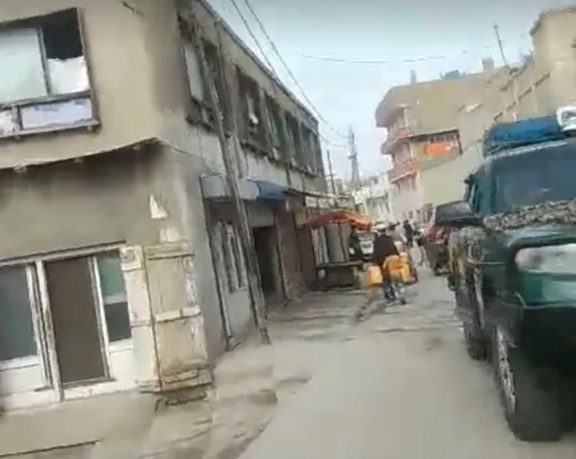
The Taliban started house-to-house search operations in District 2 of Kabul city on Friday morning. Residents said that the inspection started when most of the people had been sleeping.
The Taliban started house-to-house search operations in District 2 of Kabul city on Friday morning. Residents said that the inspection started when most of the people had been sleeping.
They added that people in this area started their day with panic caused due to the Taliban search operation.
Residents told Afghanistan International that the Taliban continued the search operation in the city center Deh Afghanan area.
In a video obtained by Afghanistan International, the presence of Taliban military vehicles can be seen in the Deh Afghanan area.

Sources in Panjshir told Afghanistan International that Taliban have threatened fathers of three families in Karamaan village to marry off their daughters. Taliban told the families that they could either agree of their own will or they will be forced to marry their daughters.
Earlier, there were reports that the Taliban in Badakhshan and Takhar were marrying off young girls to the group’s commanders.
Earlier, in a letter attributed to the Taliban, which was widely shared on social media, people were asked to enlist their young girls to the Taliban.
The Taliban called these letters as fake.
However, in Panjshir, the Taliban have visited residents of Karamaan village at least three times in the past week to marry off young girls.
Afghanistan International's sources stressed that in the last few days, a family from Karamaan village managed to escape from Panshsir to avoid the Taliban’s demands for the daughters. Two other families too have so far resisted the group’s threats.
The Taliban on Thursday confirmed that Mawlawi Rahimullah Haqqani, a high-profile supporter of the group, had been killed in Kabul. Bilal Karimi, a deputy spokesperson for the Taliban, said that Haqqani was killed through the "cowardly attack of the enemy".
Some sources have said that Haqqani was killed in a suicide attack at his seminary in Kabul.
A video clip published on social media shows that the door and window of a house had been destroyed as a result of this explosion, and people had gathered around a human body, who is said to have been the suicide bomber.
The people were seen kicking and throwing stones at the dead body.
The Human Rights Watch in a new report released on Thursday announced that Taliban leaders should recognize the catastrophe they have created over the past year and reverse course on rights.
The HRW’s report highlights that the Taliban have broken multiple pledges to respect human rights and women’s rights since taking over Afghanistan a year ago. This has brought widespread condemnation and imperiled international efforts to address the country’s dire humanitarian situation. HRW said that the economy has collapsed, largely because governments have cut foreign assistance and restricted international economic transactions.
“After capturing Kabul on August 15, 2021, Taliban authorities have imposed severe restrictions on women’s and girls’ rights, suppressed the media, and arbitrarily detained, tortured, and summarily executed critics and perceived opponents, among other abuses,” Human Rights Watch said.
More than 90 percent of Afghans have been food insecure for almost a year, causing millions of children to suffer from acute malnutrition and threatening serious long-term health problems. “The Afghan people are living a human rights nightmare, victims of both Taliban cruelty and international apathy,” said Fereshta Abbasi, Afghanistan researcher at Human Rights Watch. “Afghanistan’s future will remain bleak unless foreign governments engage more actively with Taliban authorities while pressuring them vigorously on their rights record.”
The Taliban’s horrendous human rights record and their unwillingness to meaningfully engage with international financial institutions have furthered their isolation, Human Rights Watch said.
It called on foreign governments to ease restrictions on the country’s banking sector to facilitate legitimate economic activity and humanitarian aid, and also asked the Taliban to curtail rights abuses and hold those responsible for abuses to account.
“The Taliban should urgently reverse their horrifying and misogynistic decision to bar girls and women from secondary school,” Abbasi said. “This would send a message that the Taliban are willing to reconsider their most egregious actions.”
The report also noted that the US air strike on July 30 that killed the al-Qaeda leader Ayman al-Zawahri does not appear to have derailed ongoing negotiations between the US and the Taliban. HRW asked each of the parties involved to act with urgency to reach a settlement to address the country’s economic crisis.
While adding that Afghans have been suffering from some form of food insecurity since last August, skipping meals or whole days of eating and engaging in extreme coping mechanisms to pay for food, including sending children to work, HRW said that the humanitarian situation would be even worse had the UN and other aid providers not substantially increased their operations in 2022.
Hazara community is experiencing increasing and widespread attacks since the Taliban seized control of Afghanistan in August 2021, the Holocaust Memorial Museum said.
The report by the genocide prevention organisation in the United States stated that the risk of mass atrocities has increased for vulnerable groups, including ethnic and religious minorities, under the Taliban regime. Afghanistan currently ranks fourth in the world for risk of a new onset of mass killing of civilians and has ranked among the three highest-risk countries in the Early Warning Project's last five risk assessments.
Noting that the Hazara community has a history of persecution, the organisation stated that there is a necessity for an immediate response by the US government and the international community in this matter. “The attack has been on every part of the social life of the Hazaras, this indicates that there’s a kind of wiping … or destruction of the community in part if it’s not in whole. The attacks on youth and infants … are signaling to the community that [they] do not have a future in this country,” Dr. Farkhondeh Akbari, a human rights advocate and postdoctoral fellow at Monash University, said.
The organisation added that over the past 11 months of the Taliban rule, the Hazara community has faced repeated targeting by at least two distinct perpetrator groups: ISIS-KP and the Taliban. Citing examples, it said that in the first week of August 2022, ISIS-KP claimed responsibility for multiple attacks targeting predominantly Hazara areas of Kabul, reportedly killing and wounding more than 120 people. The Holocaust Memorial Museum added that despite promises to protect the Hazaras from threats, the Taliban have committed targeted attacks and have forcibly displaced thousands of Hazara civilians. “A June 2022 Taliban offensive in Balkhab district against a former Hazara official in the de facto Taliban government has given rise to reports of atrocities and other serious violations of human rights targeting civilians in the region, including summary executions, property destruction, and communication/internet blackouts. Additionally, as of July 2022, more than 25,000 primarily-Hazara people have been forcibly displaced from their homes by the Taliban’s military campaign and currently face intolerable conditions as aid organisations have encountered difficulties in reaching them due to the mountainous landscape,” it said.
In the first months after seizing control, the Taliban killed 13 Hazara men in Daikundi province and forcibly displaced thousands of Hazaras across several provinces, claiming the community had disputed rights to the land “partly to distribute land to their own supporters.”
While several international groups and monitoring bodies have expressed concern about the increasingly dire crisis facing the Hazaras, the abuses have been underreported by global media, the organisation said.
The organisation also suggested some means to help alleviate the situation a little better. It asked for resources to be provided to the special rapporteur for human rights in Afghanistan; it said that atrocities should be documented now to identify perpetrators and risks to vulnerable communities; it called for an independent UN investigative mechanism and to break the cycle of impunity by supporting the International Criminal Court and universal jurisdiction cases.
The Hazaras—an ethnic and religious minority constituting an estimated 20 percent of Afghanistan’s population—have faced discrimination and persecution in Afghanistan for over a century and particularly during the last period of Taliban rule in the 1990s. The Taliban and other Sunni extremists, notably Islamic State Khorasan Province (ISIS-KP), view the Hazaras as a sworn enemy primarily because of their Shi’a faith.
Al Hadath Arabic TV reported that "Taliban's armed men attacked Al Hadath's team during a live broadcast" in Afghanistan. The TV station confirmed that the Taliban threatened Christian Baysari, a reporter with the channel, with whips and guns to stop reporting in Kabul.
Al Hadath TV announced that one of the Taliban members even flogged the cameraman of the TV station.
Baysari was reporting about the distribution of humanitarian aid in Kabul.
In the pictures, it could be seen that Baysari sat in a vehicle and left the place after being threatened by the Taliban.
The TV station’s report about this incident has met with strong reactions from the Arabic speaking audience and many have criticized the Taliban.
A social media user wrote, "The Taliban are extremists and brutal terrorists, and we all know that."
Previously, the Taliban had arrested a number of foreign journalists and expelled them from Afghanistan.
After taking control of Afghanistan, the Taliban imposed severe restrictions on the activities of the media and journalists across Afghanistan.