19 Million Afghans Face Food Insecurity, Says WFP

Nearly 19 million people in Afghanistan face severe food insecurity and six million people are on the brink of famine, the World Food Programme (WFP) announced on Tuesday.

Nearly 19 million people in Afghanistan face severe food insecurity and six million people are on the brink of famine, the World Food Programme (WFP) announced on Tuesday.
According to WFP, the price hike has caused the hunger situation to escalate and $960 million in aid is needed for the rest of 2022.
WFP warned of worsening humanitarian situation in Afghanistan a day after the US announced on Monday that it has ceased talks on the release of Afghanistan’s frozen assets.
The US’ latest stance is due to the Taliban’s failure to guarantee that Afghanistan will not be a safe haven for terrorists.
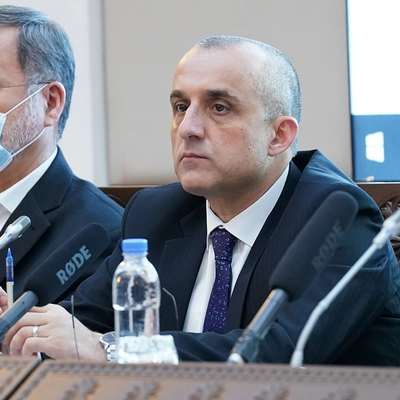
At least 25 Taliban members have been killed and 18 others were wounded while 40 of them have been captured in an operation in Panjshir province, announced the National Resistance Front (NRF).
Sibghatullah Ahmadi, the NRF spokesperson, said that the operation has been launched on Monday across the province.
According to Ahmadi, NRF forces captured the Taliban fighters in Dare Arezo of Annaba district of Panjshir province.
Ahmadi posted pictures of captured Taliban fighters on social media and wrote that three Taliban captives were treated too.
National Resistance Front operations have kicked off in Panjshir coinciding with the anniversary of the fall of Afghanistan to the Taliban.
NRF confirmed that last night they had attacked Taliban positions in Kapisa and Parwan provinces too.
The Taliban has not commented on the NRF statement yet.

At least four people have been injured in an explosion in district three of Kabul on Monday, local sources said. The explosion took place in front of the main gate of Bayat Media Center on Darul Aman road.
According to the sources, three security guards of Ariana Television Network were among the injured. It was reported to be an Improvised Explosive Device (IED) explosion, which had targeted a vehicle.
One of the wounded is a member of the Taliban, who was assigned as a guard at the entrance of the Bayat Media Center.
Some sources added that four occupants of the vehicle were injured.
Taliban haven’t commented on the explosion so far.

More than 1,500 civilians have been killed in Afghanistan since August 15, 2021, as per Afghanistan Independent Human Rights Commission (AIHRC). According to AIHRC, the Taliban have systemically violated human rights in Afghanistan.
In its annual report, the AIHRC stressed that in the past year under the Taliban, 17 major targeted suicide and complex attacks have taken place at holy shrines, educational centers, transportation systems, and sports stadiums across Afghanistan as a result of which 540 people had been killed and 519 others had been injured.
The Islamic State-Khurasan (IS-K) group has been identified as the main perpetrator of these attacks. According to AIHRC, the Taliban have failed to prevent large-scale and targeted suicide attacks by the IS-K.
In the report, AIHRC stated that targeted killings, clashes, cold-blooded killings of prisoners of war and kangaroo courts caused the most civilian casualties, because of which 980 civilians had been killed and 587 civilians had been injured. The victims included 98 women and 56 children.
The findings of AIHRC confirm that the human rights situation in Afghanistan is alarming and that the Taliban has systematically violated the human rights of Afghan citizens.
AIHRC confirmed that women, media personnel and former government employees have been affected the most and their human rights have been highly impacted under the Taliban.
The human rights commission stressed that there is enough evidence that Islamic State-Khorasan and the Taliban continue to systematically engage in inhumane behaviour despite international pressures.
According to AIHRC, in the past year, the Taliban have not been able to form the most basic standards of legitimate governance and rule of law.
The findings of the commission indicate that the Taliban removed 3,500 prosecutors from their duties and replaced them with non-professional religious seminary students.
The Human Rights Commission said that since August of last year, women have been experiencing the worst living conditions and that the Taliban’s gender apartheid rule is in clear conflict with the demand for women's political participation.
The AIHRC urged the international community not to recognize the government of the Taliban until the group conforms to the will of Afghan citizens and guarantees their human rights.

Several Afghan Twitter users have launched a campaign with the hashtag #FreeAfghanistan on the first anniversary of the Taliban's takeover of Kabul on Monday. The organisers of the campaign emphasised that last year on August 15, Pakistani agents occupied Afghanistan.
They also stressed that on August 15, a human rights disaster had been launched against the people of Afghanistan.
Afrasiab Khattak, a well-known Pakistani politician, wrote on his official Twitter account, using the hashtag, that “brutal Taliban militia imposed on Afghanistan by hegemonistic neighbours has established the only absolute gender apartheid regime on the globe”.
According to Khattak, the Taliban has completely violated the UN Charter and international human rights laws.
Abdullah Ahmadzai, Country Representative of the Asia Foundation, said that August 15, 2021, was the time when the Taliban fully crippled the country.
According to Ahmadzai, a gradual decay, long before 2021, made Afghans less prepared to prevent the collapse.
Ahmadzai said, “Lack of leadership/ownership led to bad choices and ultimately threw the entire nation to the wolves.”

A group of Afghan women blamed the United States and the international community for what they called “double standards” against terrorism. The women referred to Taliban and al-Qaeda and stressed that US installed one “ruler in Kabul” and “targeted” the latter with airstrikes.
The Afghan women said that the Taliban and al-Qaeda are both terrorist groups and they should not be defined as good and bad terrorists.
Holding a symbolic gathering at an unknown location in Afghanistan and Pakistan, these Afghan women questioned the international community’s interaction with the Taliban outside Afghanistan.
On the one-year anniversary of the fall of Kabul to the Taliban, these women said that the Taliban is a terrorist group and a threat to humanity.
