Taliban Rounds Up Over 17,000 Beggars From Kabul

A Taliban committee in charge of rounding up beggars in Kabul announced on Saturday that they have marshalled 17,262 beggars from different areas of the capital city.

A Taliban committee in charge of rounding up beggars in Kabul announced on Saturday that they have marshalled 17,262 beggars from different areas of the capital city.
The committee headed by Mullah Baradar, the deputy prime minister of the Taliban, said that this number includes 10,145 women, 5,540 children, and 1,577 men.
The Taliban members said that 3,908 women, 2,230 children, and 562 men have been found eligible for support from the group after their evaluations.
The Taliban has destroyed the tomb of Naqibullah Akhund, one of the former commanders of Jamiat-e-Islami, in Kandahar. Mullah Naqibullah Akhund, a Pashtun, was one of the leading commanders of Jamiat-e-Islami, a Tajik-led anti-Soviet Jihadi party in Afghanistan.
Ahmad Massoud, the leader of the National Resistance Front (NRF), condemned the action and said that it shows the "disgusting face" of the group.
In the picture published by Ahmad Massoud, it can be seen that the Taliban members had dug his tomb too.
Former governor of Balkh, Atta Mohammad Noor, reacted to the destruction of Naqibullah Akhund’s tomb and said that these Taliban actions increase Afghan people’s “hatred" towards the group.
A few days ago, Taliban members had also destroyed the tombstone of Afghanistan’s national hero, Ahmad Shah Massoud.
The Taliban have continuously denied involvement in the destruction of the graves of their opponents. However, in the past year, many reports that confirm the group’s involvement in destroying opponents’ graves have emerged across Afghanistan.
On the other hand, the Taliban have revealed the group’s leaders’ graves on various occasions and have reconstructed them.
In the latest case, the Taliban constructed a road leading to the grave of Mullah Omar, the founding leader of the group in Zabul province.
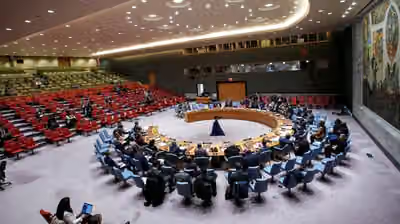
The National Resistance Front (NRF) on Saturday said that the United Nations General Assembly resolution on Afghanistan "has many paradoxes". The NRF added that the UN has asked the Taliban to fight terrorist groups, while the group "is itself a major part of global terrorism".
In the statement, the NRF stated that the international community expects the Taliban to "fulfill its obligations in countering the cultivation, and processing of narcotics", while according to the front, drug trafficking had been a major source of Taliban’s income in the twenty years of war in Afghanistan.
The NRF also said that while the Taliban has been infamous for targeting public properties, the UN has urged the group to "live up to its guarantees to ensure the security of the Afghan people".
The front has also published a list of what it calls "paradoxes of the UN General Assembly Resolution on Afghanistan".
The NRF warned that Afghanistan is quickly becoming a potential threat to the region and the world and stated that with the tyranny and oppression of the Taliban against the people of Afghanistan, and the current approach of the international community towards the group, soon many regional and global terror threats will emerge for the region and the world from Afghanistan.
European Union (EU) ambassadors met with several Afghan women rights activists in Brussels. Tomas Niklasson, EU Special Representative for Afghanistan, said that they discussed their concerns and ideas for EU support to Afghanistan.
Niklasson also said that they are inspired by how Afghan women work for a peaceful and inclusive Afghanistan where women can contribute.
The EU Special Representative has also published a group photo of women and officials of European Union countries in this meeting on his official Twitter account.
The discussion about the situation of Afghan women took place while the Taliban imposed extensive restrictions on Afghan women.
Mandatory hijab, encouraging women to stay at home, non-participation of women in political activities, and closing girls' schools above the sixth grade are some of the restrictions being imposed by the Taliban.
Niklasson had previously said that the Taliban’s double standard and dishonest policies towards Afghan women has been frustrating.
In the latest move, the Taliban have also banned women from entering amusement parks. The Taliban said that women have been prohibited from entering parks and sports halls because of non-compliance with gender segregation laws.
Qalandar Ebad, Taliban’s health minister, announced that 150,000 female employees, including doctors, nurses and vaccinators, work in Afghanistan's health centers. Ebad has counted the United Nations’ vaccinators among the health ministry employees.
With the Taliban takeover of Afghanistan, majority of Afghan women became housewives, and the Afghan health system is on the brink of collapse.
Najm Sama Shafajo, the head of Afghan Obstetricians and Gynaecologists Association, said that in 2021, 2,300 health centers had been closed across the country.
Shafajo added that with the closure of these health centers, about 27,000 health workers, including Afghan 7,000 women, have lost their jobs.
Recently, Johns Hopkins University announced in a report that 81% of female health workers in Afghanistan have experienced harassment and violence from the Taliban in their work life.
These women have said that they were beaten by Taliban agents because of going around without a male guardian. According to the report, the strictness of the Taliban and the irregular payment of health workers who provide help to mothers and babies have caused some of them to not be able to work regularly and some of them to leave the service.
According to the report of the International Rescue Committee, in the previous government, about 75% of Afghanistan's public expenses relied on foreign sources. In particular, about 30 million Afghans depended on health services through a programme managed by the World Bank.
The World Bank provided a large part of the needs of nearly three thousand hospitals in Afghanistan, including the salaries of health workers.
Maria Zakharova, Russian foreign ministry spokesperson, said that the Moscow Meeting will discuss socio-political, economic, and humanitarian situation of Afghanistan. Zakharova added that the meeting will also focus on regional security and national reconciliation efforts.
The spokesperson of the Russian Foreign Ministry stressed that at the end of this meeting, a joint statement will be issued by the representatives of the participating countries.
Representatives of Russia, China, India, Iran, Pakistan, Kazakhstan, Kyrgyzstan, Tajikistan, Turkmenistan, and Uzbekistan will participate in the upcoming meeting.
Moscow's consultative meeting on Afghanistan will be held on Wednesday, November 16.
According to Zakharova, the Wednesday meeting will be the fourth meeting of Moscow consultations on Afghanistan.
Even though Taliban representatives were present in this meeting last year, they will be absent in the upcoming meeting. In 2021, the participants in Moscow meeting urged the Taliban to form an inclusive government in Afghanistan.
Although the Taliban claim that they have formed an inclusive government, the international community, including Russia, which is hosting the meeting on Afghanistan, has criticised the group for ignoring the international demands.