Iran Deports Nearly 19,000 Afghan Refugees to Afghanistan in Two Weeks

Majid Shuja, the border guard commander of Khorasan Razavi province, on Sunday, announced that over the past two weeks, 18,943 Afghan refugees have been deported from Iran.

Majid Shuja, the border guard commander of Khorasan Razavi province, on Sunday, announced that over the past two weeks, 18,943 Afghan refugees have been deported from Iran.
He said that these refugees were living illegally and have been deported and handed over to the Taliban through the Dowqarun border.
Quoting this border guard commander, IRNA News Agency reported, “In the past two weeks, border guards of Taybad regiment deported and handed over these Afghan refugees who have been living illegally or who had been arrested while trying to enter the country illegally, to the Taliban through the Dowqarun border”.
With the takeover of power by the Taliban in August 2021, a significant number of Afghans migrated to neighbouring countries, including Iran. However, the Iranian government has arrested many of them and deported them to Afghanistan. In May, 12,500 Afghan refugees had also been deported.
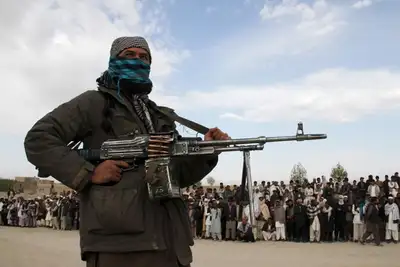

Eskandar Momeni, the Secretary General of Drugs Control Headquarters in Iran, said that the production and trafficking of drugs in Afghanistan has increased nearly 50 times in two decades.
On Monday, Momeni added that Afghanistan ranks top in drug production and second in industrial drugs production in the world.
Momeni said that despite the promises of the Taliban to counter narcotics, the cultivation and production of drugs have increased in Afghanistan.
He added, "The Islamic Republic of Iran has the highest rank of countering drug smuggling in the world. According to official statistics, Iran discovers 90% of opium, 50% of morphine, and 27% of heroin discoveries in the world.”
Momeni also announced a tenfold increase in the elimination of the economic foundations of drug traffickers in Iran.
These statements were made by the Secretary General of Iran's Drug Control Headquarters during a meeting that was held on Monday in the presence of directors and secretaries of the Drugs Control Coordination Council of Iran.

The Women’s Movement for Peace and Freedom has welcomed the recent report of the United Nations Security Council and said that Taliban has turned Afghanistan into a hub for international terrorism.
The women’s rights group in a statement said that the Taliban has deep ties with terrorist groups such as Al-Qaeda and ISIS.
The Afghan women movement on Sunday added that the Taliban has taken Afghan people hostage and emphasised that the group has the same thoughts, and behaviour as during their first rule in Afghanistan in the 1990s.
The Women’s Movement for Peace and Freedom consists of female activists who stand against the Taliban by holding protests and taking public stances.
The women’s rights movement has welcomed the report of the UN Security Council's monitoring committee about the Taliban.
According to the new report, the relationship between the Taliban and the Al-Qaeda and Tehreek-e-Taliban Pakistan (TTP) remains strong and the threat of terrorism in Afghanistan and the region has been increasing.
The Taliban has rejected the UN report as biased.
However, the Women's Movement for Peace and Freedom emphasised that along with the group’s ties to terrorist networks, the Taliban has increased forced and underage marriages, spread violence, and has taken millions of men and women hostage in Afghanistan.
The movement has also stressed that the Taliban has been suppressing religious minorities like in the 1990s.
The Women's Movement for Peace and Freedom has accused the Taliban of committing "war crimes" by referring to the reports of international organisations, including Amnesty International.
Expressing concern over the continuation of the humanitarian, security, and economic crisis in Afghanistan, the movement has urged the United Nations and the international community to take immediate action and, among other things, impose more sanctions against the Taliban.

A video clip which has been circulating on social media depicts a boat stranded in Greek waters while ferrying dozens of refugees. The person who recorded the video clip said that around 100, most of whom are children, are asylum seekers and have been stuck in the boat.
The crying children and panicked adults could be heard in the video clip.
The person who is heard in the video clip speaks in Persian and said that the boat is on the verge of sinking and the children are in poor health condition.
The nationality of these asylum seekers is not clearly known, but it seems that they are Afghans.
This video has been viral on social media for the last two days, but there is no information as to whether anyone has rushed to rescue these stranded asylum seekers.
The exact location of the recording of the video clip is not known, but it has been said that this video was recorded in Greek waters.
Afghan refugees, who seek asylum in Europe, usually migrate through Turkey and Greece and take dangerous routes towards European destinations.

Farshid Shokrkhodaie the head of sustainable development commission of the Iranian Chamber of Commerce, said that the Taliban has not allowed Iranian experts to visit the Kajaki Dam. Shokrkhodaei stressed that sticking only to diplomacy with the Taliban will never be effective.
However, he urged Iranian officials to utilise soft and hard power along with diplomatic efforts.
He explained, "Nearly five to six million Afghans live in our country as refugees. We also have fuel supply deals. If necessary, we must use the tools we have at hand.”
The member of the Iran Chamber of Commerce stressed that Iran has enough tools to pressurise the Taliban.
Following the escalation of tensions between Iran and the Taliban over Tehran’s water rights claims, the Taliban announced that there was not enough water in the Kamal Khan Dam.
The Islamic Republic, however, did not accept this claim of the Taliban and emphasised that Iranian experts should confirm the lack of water.
However, Sher Mohammad Abbas Stankzai, Deputy Foreign Minister of the Taliban, previously told Afghanistan International that the group will not allow the officials of the Islamic Republic to visit the Kajaki Dam.
However, the head of sustainable development of the Iran Chamber of Commerce believes that the Taliban will have to allow the Iranian delegation to visit the dam to assess the group’s claims of lack of water inside Afghanistan.

The UN Security Council in a new report said that the Taliban’s interior minister Sirajuddin Haqqani has been trying to build greater support among the Taliban for Mullah Yaqoob to replace Hibatullah Akhundzada as the group’s leader.
According to the UN report, Haqqani has been trying to undermine Akhundzada’s religious legitimacy with the goal of the Taliban’s ulema declaring him unfit to lead.
The report emphasised that several UN member states who had been consulted believed that Haqqani was content to play kingmaker rather than seek the role of Amir of the Taliban for himself.
The UN security council’s report stressed that the Taliban's differences began with Haqqani's speech in Khost province, where the leader of the Haqqani network criticised the group's monopoly of power in the government in a rather harsh tone.
According to the report, the "scholars" around Akhundzada advised him to attend to the views of the ulema, but his reaction was reportedly to dismiss Sirajuddin as Interior Minister, Mullah Yaqoob as acting Defence Minister and Mullah Fazl Mohammad Mazloom as acting First Deputy Defence Minister. The UN report said that possibly in a challenge to Hibatullah’s authority, no resignations followed and both sides appeared to be co-opting various commanders and others to their cause.
On the other hand, the UN report stated that the Taliban's ties with Al-Qaeda is also one of the obstacles to unity among the group. After Al-Qaeda leader Ayman al-Zawahiri was killed in Kabul, some Taliban officials thought they had been "deceived" about his presence in Afghanistan. According to the report, several other Taliban officials believed that the Taliban betrayed Al-Zawahiri to fulfil foreigners’ interests.
According to the UN report, Taliban Deputy Prime Minister Mullah Baradar told Sirajuddin Haqqani that he had been made to look like a liar in front of the international community for steadfastly denying the Taliban were sheltering Al-Qaeda. Haqqani was reported to have claimed that the Taliban leader was aware of his presence.
The UN report stated that Haqqani had also tried to find out how the whereabouts of Al-Zawahiri had been revealed. On the other hand, the report stated that some foreign Taliban fighters have been worried that they will be betrayed after the killing of the Al-Qaeda leader.
In the new report of the Security Council, it has been stated that the Taliban has not delivered on the counter-terrorism provisions under the Agreement for Bringing Peace to Afghanistan between the United States of America and the Taliban. The report said that Al-Qaeda is reviving its operational capabilities and the Pakistani Taliban is carrying out attacks against Pakistan with the support of the Afghan Taliban.
The Security Council added that "foreign terrorists" are present on the borders of Afghanistan and the Islamic State-Khurasan (IS-K) has been waging more deadly and complex attacks.
The report also stressed that is too early to judge the impact of the decree by the Taliban in April 2022 banning poppy cultivation. The report said that at this point, prices of narcotics and the production of the more profitable methamphetamine have increased. The report also said that key people of the Taliban are involved in drug trafficking and production in Afghanistan.
The report also touched on the impacts of the sanctions regime and said that there is little evidence that the sanctions substantially impact Akhundzada’s decision-making.
The exemption of the Taliban leaders for travel ended in August 2022, however, the new UN report stated that the Taliban are again seeking exemptions to the travel ban.
The report also said that the current Taliban under the leadership of Akhundzada has taken the monopolistic, Pashtun-centered, and authoritarian policies of the group implemented in 1990s.
The report stated that despite the Taliban’s differences, UN member states judged that Taliban unity is likely to prevail, some predicting, for at least 12–24 months. The report stated that stakeholders in the region have been concerned about the risk of a return to civil war should current Taliban policies continue in Afghanistan.