Taliban’s FM To Visit Doha To Hold Talks With US Officials

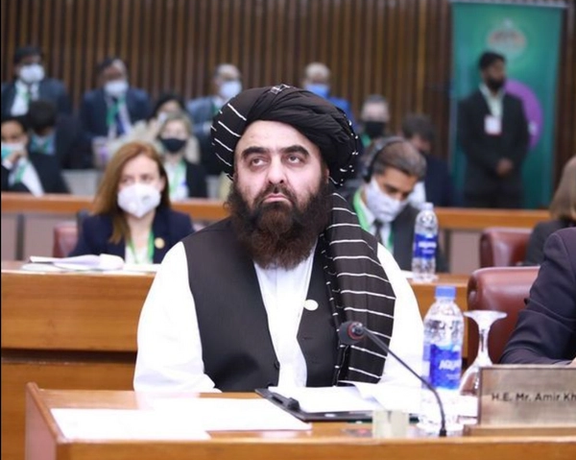
Amir Khan Muttaqi, the Taliban's foreign minister, will visit Doha at the end of July to hold talks with American officials.

Amir Khan Muttaqi, the Taliban's foreign minister, will visit Doha at the end of July to hold talks with American officials.
According to the Taliban, during this visit, there will be discussions regarding "lifting of sanctions, unfreezing the Afghan assets and violation of Afghanistan’s airspace".
In a statement on Wednesday, the Taliban’s Foreign Ministry said that Muttaqi will also discuss bilateral relations with several Qatari government officials.
The US State Department announced on Wednesday that US officials will meet with Taliban representatives from the group's key ministries in Doha this week.
The ministry said that the two sides will discuss security, drugs, and women's rights in Afghanistan.
According to the statement of the US State Department, US Special Envoy for Afghanistan Thomas West, and UN Envoy for Human Rights and Women Affairs Rina Amiri are scheduled to travel to Astana, Kazakhstan, and Doha, Qatar, from July 26 to 31 and meet with the Taliban delegation.
However, a US state department spokesperson has stressed that meetings between US representatives and the Taliban in Doha do not indicate a change in US’ policy towards the group.


Qatar's Foreign Minister Sheikh Abdulrahman al-Thani and British Foreign Secretary James Cleverly have discussed Afghanistan issues.
In a statement on Tuesday, the Ministry of Foreign Affairs of Qatar said that the two officials discussed the importance of the international community's support to the people of Afghanistan.
According to this statement, the strategic cooperation between Qatar and the United Kingdom, developments in Palestine, the situation in Syria, and the Iran nuclear agreement were among the other topics discussed by them.
Qatar has close ties with the Taliban, and according to a Reuters report in June, Qatari Prime Minister and Foreign Minister Abdulrahman al-Thani had been the first foreign officials to meet Taliban leader Hibatullah Akhundzada in Kandahar.

Human Rights Watch (HRW) has said that United Nations should prioritize human rights, especially the rights of women and girls, when making an assessment of Afghanistan.
The global rights body insisted that tales of survivors of human rights violations should be heard and the special coordinator should offer recommendations to prevent and provide accountability for rights abuses.
A United Nations Security Council (UNSC)-mandated independent assessment of the international approach to the crisis in Afghanistan is due and HRW made this submission to the special coordinator leading the assessment.
“The situation in Afghanistan right now is the most serious women’s rights crisis in the world,” said Heather Barr, associate women’s rights director at Human Rights Watch. “The independent assessment could guide a more effective international response to this dire situation, but to do so, it needs to give priority to women and girls and other survivors of rights violations.”
HRW stressed that the assessment team should include experts on human rights, including on the rights of women and girls, and that the assessment process should be transparent and provide an opportunity for all stakeholders to provide submissions.
The HRW noted that ever since seizing power in Afghanistan in 2021, the Taliban has continued to strip women of their basic human rights and even banned them from all spheres of life including political, social, and economic. The ban on education for girls and women is hampering Afghanistan’s future while the ban on working of women at even aid organisations is halting the much-needed humanitarian operations across the country, HRW noted.
It also added that the Taliban’s crackdown on the rights of women and girls continues to deepen, as evidenced by recent orders. It stated that the women’s rights crisis in Afghanistan is happening in the context of a broader human rights and humanitarian crisis, with many other abuses as well as severe hardship for much of the population.
The organization also spoke about the rights of media personnel and how the Taliban has decimated the media in the country.
It emphasised that the armed group Islamic State of Khorasan Province continues to carry out deadly attacks targeting civilians and their widespread attacks on the Shia and Hazara communities constitute crimes against humanity.
“The crisis in Afghanistan is overwhelming, and Taliban abuses are deepening what was already a devastating humanitarian crisis,” Barr said. “The independent assessment should aim to urgently redirect the international community’s response to the situation in Afghanistan, which so far has been inconsistent, ineffective, and insufficiently focused on human rights.”
HRW said that the assessment team should ensure that they hear from people who have personally experienced human rights violations, and the family members and associates of those arbitrarily detained, forcibly disappeared, or extrajudicially killed.
A UNSC resolution called for the assessment to include consultations with relevant stakeholders, including Afghan women and Feridun Sinirlioğlu had been appointed as the special coordinator in April.
Sirajuddin Haqqani, the Taliban's interior minister, admitted that allowing girls and female students to attend schools and universities is a "controversial issue" among the Taliban.
During his visit to Herat province, Haqqani stressed that in order to resolve the issue and prevent its escalation, the Taliban "needs time”.
The Taliban’s interior minister added that the group’s leaders look for reasonable solutions to address these differences.
Senior Taliban officials including the group’s defence minister Mullah Yaqoob, interior minister Sirajuddin Haqqani, intelligence chief, Abdul Haq Wasiq, and Abdul Hakim Haqqani, the group's head of supreme court, travelled to Herat on Monday.
Haqqani is one of the Taliban officials who had previously emphasised that there will be a quick solution to the issue of depriving Afghan girls and women of the right to education.
However, while it has now been almost two years since the ban on girls' education, Haqqani still emphasises on the temporary nature of the Taliban’s decision.
The Taliban has been against the right to work and education of Afghan girls and women since the group’s reign in Afghanistan in the late 1990s. In the past three decades, the group’s mentality and policies about women have not changed.

The National Resistance Front (NRF) claimed to have killed three Taliban members in separate attacks in Nuristan, Laghman, and Nangarhar provinces.
In a statement on Tuesday, NRF also added that a Taliban member had been wounded during an attack by its forces in Nangarhar province.
NRF said that on Tuesday morning, its forces killed two members of the Taliban in the "Digal" area in the west of Nuristan province.
The front also claimed to have killed a member of the Taliban in another attack on the same day in Chaharbagh area of Laghman province.
The Taliban has not reacted to the NRF claims so far.
According to NRF, the front has also carried out attacks against the Taliban in Kabul, Parwan, Kapisa, Baghlan, Takhar, and Badakhshan provinces in the past week, as a result of which it has inflicted casualties on the Taliban.

Ayatollah Sayed Mohsen Hojjat has asked the Taliban to respect Muharram rituals and ceremonies and lift the imposed restrictions on Shia practices in Afghanistan.
While speaking to a crowd of Shia mourners in Kabul, Hojjat pointed out the Taliban's harsh treatment of the mourners and asked Shias in Afghanistan not to obey the Taliban’s restrictive orders.
It is not clear when the speech had been delivered, but Tamadon TV in Kabul broadcasted it on Tuesday, in which Hojjat talks about the Taliban's new restrictions imposed on the Ashura ceremony. He has described these restrictions as the Taliban's disrespect for the Shia sect and its followers.
Sayed Mohsen Hojjat criticised the Taliban’s ban on raising flags during Muharram and opening of cabins for voluntary distribution of food and water and asked Shias to ignore these Taliban’s orders.
Hojjat said, "We are from this country and we obey this government as long as they don’t talk against our sect. If they ask us to take down our flag, you should not do it.”
He asked the people to commemorate the Ashura ceremony regardless of the "beating" of the Taliban.
The Taliban have said that they have restricted Muharram mourning ceremonies for security reasons. This position has angered the Shia Ulema Council of Afghanistan as the organisation has demanded the lifting of these bans.