Clash On Tajikistan–Afghanistan Border Leaves 3 Dead

Tajik border guards clashed with a group of armed men along the border with Afghanistan, leaving three of the suspects dead, the state-run Khovar news agency reported.

Tajik border guards clashed with a group of armed men along the border with Afghanistan, leaving three of the suspects dead, the state-run Khovar news agency reported.
Khovar, which operates under the Tajik presidency, said the men were smugglers who had crossed illegally from Afghanistan into Tajikistan.
Sources told Afghanistan International that the clash occurred Thursday evening and lasted for an extended period.
According to Khovar, the incident took place at about 7:30 p.m. local time in the Shamsiddin Shohin area, where Tajik border forces encountered five Afghan smugglers who had crossed the border unlawfully.
During the confrontation, three of the alleged smugglers were killed, while two others fled back toward Afghanistan.
Tajikistan’s State Committee for National Security said several weapons were seized from the group, along with four bags containing 73 packages of hashish and opium.
Tajik authorities said they are taking “all necessary measures to ensure border security” and are combating border violators and smugglers.
Officials said the situation along the border is currently under control and that further investigations into the clash are ongoing.
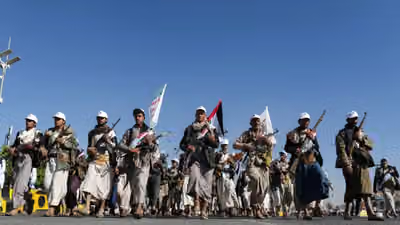

Trade between Taliban and Uzbekistan reached $1.7 billion in 2025, a sharp increase from about $1.1 billion in 2024, Uzbek news agencies reported, citing data from the country’s National Statistics Committee.
Uzbekistan’s total foreign trade turnover reached $81.2 billion last year, reflecting the country’s continued efforts to diversify its trading partners, the reports said. By the end of the period, Uzbekistan had established trade relations with 210 countries worldwide.
In Uzbekistan’s foreign trade structure, China ranked first with a 21.2 precent share, followed by Russia at 16.0 precent, Kazakhstan at 6.1 precent, Türkiye at 3.7 precent and South Korea at 2.1 precent.
After ties with Pakistan deteriorated in October 2025 and bilateral trade was suspended, the Taliban administration in Afghanistan has sought to expand trade with other regional partners, including Uzbekistan.

The US Senate Foreign Relations Committee has approved legislation seeking to halt US assistance to Afghanistan under Taliban control.
Republican Senator Rand Paul said that if the bill becomes law, $631 million allocated for Afghanistan’s reconstruction would be returned to the US Treasury. Paul said US resources should be used to defend the country, adding that the bill, titled No Taxpayer Dollars for Terrorists, would cut funding to what he described as failed missions abroad and refocus policy on national security and taxpayers.
He said no country or non-governmental organisation that sustains the Taliban should receive US taxpayer money. “America must not bankroll those who side with our enemies,” Paul said.
After the bill’s approval on Thursday, Paul wrote on X that the legislation would end what he called Washington’s blind commitment to resettling Afghans without adequate safeguards. He cited the killing of a National Guard member by a militant who entered the United States through a resettlement programme, saying security must be prioritised.
Paul said US foreign aid had for too long meant spending without accountability and added that the bill would ensure taxpayers’ money does not fuel corruption or terrorism overseas.
In a statement, Senator Jim Risch, the committee’s chairman, said the measure would ensure that no US taxpayer funds go to what he described as terrorist organisations in Afghanistan, including the Taliban.
Rep. Tim Burchett, a key sponsor of the legislation, said it would soon be brought to the Senate floor for a vote. Republicans will need Democratic support for the measure to pass.
Democrats have previously opposed a complete cut-off of aid to Afghanistan, and it remains unclear how much support the Republican-led bill will receive in the full Senate.
The Special Inspector General for Afghanistan Reconstruction has reported that the United States has provided more than $3.83 billion in humanitarian and development assistance to Afghanistan since the Taliban returned to power in August 2021.

Taliban intelligence forces have arrested Jan Ali Akbari, the former deputy head of the Ulama Council in Malistan district of Ghazni province, according to local sources.
Akbari, who also serves as a school principal, was detained last week in Ghazni city, the sources said.
Informed sources said the Taliban have not allowed his family to visit him since his arrest on January 18, and no further information has been released about his condition or whereabouts.
Relatives told Afghanistan International that Akbari was initially detained on suspicion of possessing military equipment linked to a former local commander, but the allegation was not substantiated during investigations.
According to a source close to him, the Taliban later held the cleric on accusations of document forgery at the school where he works as principal.

The Taliban Supreme Court said it had flogged 18 people in Kabul on charges including the sale and trafficking of alcohol, cannabis, methamphetamine and prohibited tablets.
In a statement issued Thursday, the court said the sentences ranging from 15 to 39 lashes and prison terms of seven months to two years were carried out on Wednesday, January 28. It did not provide details on how the punishments were implemented.
The Taliban authorities regularly carry out floggings, often in public.
Over the past 10 days, the Taliban have flogged 87 people across Afghanistan, including women, on various charges, according to official statements.
Despite opposition from international organisations to corporal punishment and the torture of detainees, the Taliban has continued public floggings.

The UN Food and Agriculture Organization and the Asian Development Bank have launched a $100 million food security project in Afghanistan.
The project is aimed at strengthening food security and restoring agricultural livelihoods for more than one million vulnerable people.
In a statement, FAO said the two-year programme would support more than 151,000 families, including returnees from Pakistan and Iran, host communities and households affected by recent earthquakes and floods.
Repeated natural disasters have destroyed crops, livestock and irrigation infrastructure, while large-scale returns of migrants from neighbouring countries have placed additional pressure on already vulnerable communities, the agency said.
The project seeks to mitigate the impact of successive climate-related crises by restoring rural livelihoods, protecting livestock and rebuilding agricultural production systems.
FAO said agriculture remains the backbone of Afghanistan’s rural economy, but low productivity, limited access to equipment, damage to irrigation systems and mass migrant returns have put severe strain on the sector.
While emergency assistance in recent years has helped prevent a broader spread of food insecurity, projections indicate that more than 17 million people in Afghanistan will face acute food insecurity in 2026. Of those, 4.7 million are expected to be in an emergency phase marked by major food consumption gaps and high levels of acute malnutrition.
FAO assessments indicate that continued drought, bringing below-average rainfall and above-average temperatures until early 2026, could further increase risks.
The initiative, centred on climate-smart and community-focused solutions, aims to boost agricultural production, improve food and nutrition security and diversify rural livelihoods. Female-headed households and provinces most affected by climate and economic shocks are being prioritised.
The Asian Development Bank said it has provided about $265 million in grants through FAO since 2022 to support Afghanistan’s agricultural sector. More than 5.6 million people have benefited from agricultural and food assistance under the partnership, it said.