Karzai Seeks Civilised Relations Between Afghanistan And Pakistan
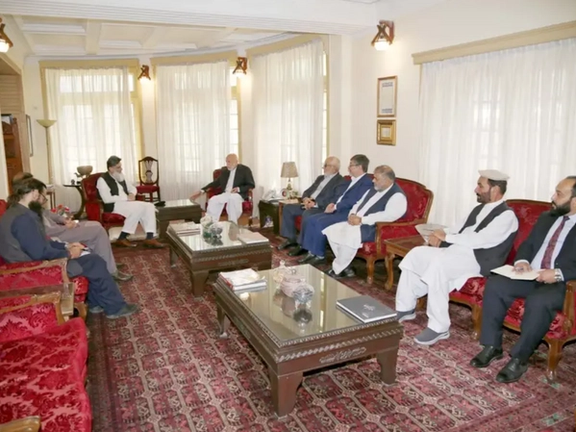
Former president Hamid Karzai on Thursday met the Pakistani ambassador in Kabul and stressed that the two neighbouring countries should have civilised relations.
Former president Hamid Karzai on Thursday met the Pakistani ambassador in Kabul and stressed that the two neighbouring countries should have civilised relations.
Karzai’s meet with Pakistan's ambassador comes even as there had been reports that the Taliban had imposed new restrictions on the former president.
It seems that after widespread coverage of the newly imposed restrictions of the Taliban on Karzai, he has been able to begin his public meetings with foreign officials.
Sources close to Hamid Karzai told Afghanistan International on Monday that the Taliban did not allow a delegation of the Islamic Republic to meet him in Kabul.
Earlier, the Taliban had imposed restrictions on Karzai's foreign travels too.
The Taliban claimed that these restrictions had been imposed to protect Karzai from ISIS threats.

Hoda Khamosh and Mina Rafiq, two Afghan women's rights activists, told Afghanistan International that they are on a hunger strike in front of the Norwegian Parliament to demand the recognition of the gender apartheid in Afghanistan.
Khamosh and Rafiq said that they started their hunger strike on September 7.
These two activists added that they have received permission from the Norwegian police to hold a civil protest in front of the Norwegian Parliament until September 12.
They said that their hunger strike is to support women rights activists’ demands in Cologne, Germany.
On September 1, Tamana Zaryab Paryani and many other human rights activists from Afghanistan and Iran went on a hunger strike demanding the recognition of gender apartheid in Afghanistan.
They also demanded that financial aid to the Taliban must stop and political prisoners in Afghanistan must be released.
Many activists inside and outside Afghanistan have shown sympathy and solidarity with these rights activists.
Masooma Ayoubi from Kabul and Sabera Akbari from Islamabad also announced that they will go on a hunger strike joining the activists in Cologne.
Sabera Akbari, an Afghan women's rights activist from Islamabad, told Afghanistan International on Thursday, that at least 10 Afghan women's rights activists have been on hunger strike in Pakistan since the past two days.
She added that these women activists wanted to set up a sit-in tent in Islamabad, but the police did not allow them.
Referring to the hunger strike of Afghan women activists, “Freedom Now” a human rights organisation on Wednesday, said that the Taliban has imposed 64 laws in the past two years which exclude women from the public sphere.
The organisation said that it stands in solidarity with Afghan women who are "bravely fighting for their rights". It also asked the international community to take immediate action in response to the human rights crisis in Afghanistan.
John Kirby, the US National Security Council spokesperson, said that the United States has not left any military equipment behind in Afghanistan.
Kirby added that the US handed over military equipment to the Afghan security forces and those forces abandoned the equipment.
Earlier, Anwar ul Haq Kakar, the interim Prime Minister of Pakistan, said that the weapons left by US in Afghanistan are used against Pakistan, China, Iran and other countries in the region.
In a press conference on Tuesday, responding to a Pakistani journalist, Kirby said that the United States had left extremely limited technical equipment and unusable aircraft, including firefighting equipment, in Kabul.
Last year, the Pentagon in a report to the US Congress had said that after the US ended its presence in Afghanistan, military equipment worth approximately USD 7 billion was left in Afghanistan.
The remaining equipment includes air munitions, military vehicles, weapons and communication devices.
Kirby also added that the United States had provided military equipment to the Afghan National Security Forces to increase their capacity so that they could take responsibility for Afghanistan's security.
Kirby further emphasised that it was the Afghan forces who abandoned the military equipment.
Nooruddin Azizi, Taliban’s Minister of Commerce and Industry, said that the goods of Afghan businessmen in transit to Pakistan are on the "sensitive list".
During a meeting with Ubaid Ur Rehman Nizamani, Charge d'Affaires of the Pakistani Embassy in Kabul, Azizi stressed that Afghan businessmen's goods at the Karachi port has also been processed with delay.
Taliban’s Ministry of Commerce and Industry in a statement added that Azizi asked the Pakistani authorities to cooperate with them to resolve these transit issues.
The Taliban ministry did not provide details about the goods which were included in Pakistan's sensitive list.
In the statement, it has stated that Nizamani stressed on developing trade relations between Afghanistan and Pakistan and assured that he would discuss with the Pakistani authorities on how to address the Taliban’s concerns.
In July, the State Bank of Pakistan had reported that Pakistan's exports to Afghanistan had increased by 32% this year, but imports from Afghanistan to Pakistan decreased by 76%.
Taliban officials in the Ministry of Commerce also said that exports to Pakistan have decreased by $66 million compared to last year.
Afghanistan has once again become a haven for global and regional terrorism, said Ahmad Massoud, the leader of National Resistance Front of Afghanistan (NRF).
Massoud, during the memorial ceremony at the British Parliament of Ahmad Shah Massoud, former Afghan jihadi commander, warned that the international community should not ignore the threat of terrorism in Afghanistan.
The British Parliament recently held a programme to honour Ahmad Shah Masoud, a former anti-Taliban commander.
In a virtual address, Massoud repeated his father, Ahmad Shah Masoud’s, warning of terror attacks emanating from Afghanistan.
According to the NRF leader, his father in the French Parliament had warned about the impending threat of terrorism from Afghanistan and stressed that the September 11 attack proved his predictions about terror threats.
He added that a similar threat stemming from terrorism and extremism once again endangers the world, and the international community should not ignore it.
Massoud added that this threat is not limited to the borders of Afghanistan and will penetrate the entire world.
In another part of his speech, the NRF leader said that Ahmad Shah Massoud believed that political legitimacy comes from the people and his suggestion for Afghanistan as a country that is religiously, ethnically and linguistically diverse, was to establish a pluralistic and decentralised system; where power is distributed among citizens in a fair and equal manner.
According to Massoud, the lack of such a vision and approach has once again turned Afghanistan under the control of the Taliban, into a ticking time bomb for bigger conflicts in the future.
He added that Ahmad Shah Masoud had the ability to unite all the people of Afghanistan against the Taliban and other terrorist groups. The country needs such a leader now, he said.
During the commemoration of Ahmad Shah Massoud, a number of British Parliament members and Afghans in this country asked the international community to stop supporting the "misogynist Taliban".
Ahmad Shah Massoud was assassinated on September 9, 2001, by two Arab suicide bombers who portrayed themselves as journalists.
On Wednesday, Iranian president Ebrahim Raisi called for the expansion of economic relations between Iran and Afghanistan.
During a meeting in South Khorasan province, Raisi said that barriers preventing trade with Afghanistan must be removed.
According to Iranian media outlets, he called the exchange of goods between Iran and Afghanistan an opportunity for both countries and said that "the shared border is an opportunity for both sides”.
The Iranian president pointed to the activation of border markets and ordered the governor of South Khorasan and Iranian officials to not miss the opportunity.
At the same time, Raisi stressed that the Iranian government should facilitate the country's private sector to work in the mining field.
Iran, like other countries, officially does not recognise the Taliban. Nevertheless, it has hosted Taliban diplomats within the Afghan embassy in Tehran and maintains economic relations with the group.
In July, Iran’s Customs agency announced that since the Taliban’s takeover of power in Afghanistan, the total value of trade between the two countries has reached $1.6 billion.