Thousands of Immigrants Returned from Pakistan And Iran, Says Taliban

The Taliban’s Ministry of Refugees and Repatriation announced that 534 Afghan immigrant families have returned to Afghanistan from Pakistan.

The Taliban’s Ministry of Refugees and Repatriation announced that 534 Afghan immigrant families have returned to Afghanistan from Pakistan.
The ministry also said that 3,165 other immigrants have entered Afghanistan from Iran.
According to statements from the Taliban’s ministry, published on Tuesday, these immigrants entered Afghanistan via the Torkham and Islam Qala borders.
The Taliban said that the immigrants have been referred to the International Organisation for Migration (IOM) to receive assistance.
Over the past few months, the Taliban's Ministry of Refugees consistently reported both "voluntary and forced" returns of Afghan refugees from Iran and Pakistan.
Recently, the Iranian and Pakistani governments have intensified the arrest and deportation of Afghan immigrants.
The Pakistani government has given "illegal" immigrants a deadline of November 1 to leave the country. This decision has invoked the criticism of human rights organisations as well as the Taliban government.
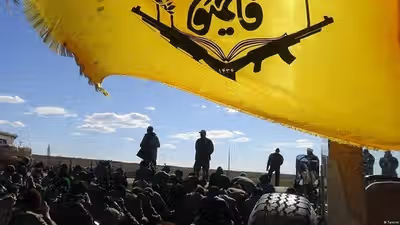

Condemning the recent ISIS attack on the Shiite Mosque in Pul-e-Khomri city of Baghlan province, Maria Zakharova Russia’s Foreign Ministry spokesperson said that the attack was carried out to incite religious hatred.
Zakharova called the attack "inhumane, unjustifiable and an incident which caused instability in Afghanistan".
On Monday, in a statement quoting Maria Zakharova, the website of the Russian Foreign Ministry wrote that Russia strongly condemns the latest terrorist attack by the ISIS group against the Shiite minority in Afghanistan.
She urged the Taliban to identify and punish the organisers of this terrorist attack.
Zakharova also stressed on eradicating terrorism in Afghanistan.
On October 14, a suicide attack took place at the Imam Zaman Mosque in Pul-e-Khomri city of Baghlan province. According to the Russian Foreign Ministry, 17 people were killed and more than 50 people were injured in the attack. The Taliban, however, reported a death toll of seven individuals killed and 17 wounded.
ISIS claimed responsibility for the attack, stating in a release that it resulted in the death of 50 Shiites and the injury of dozens of others.
During the past years, religious and cultural places and gatherings of Hazaras and Shiites have been attacked many times.
On Monday, Thomas West, the US Special Representative for Afghanistan, on social platform X wrote, “Afghanistan’s Shi’a community has suffered far too much from violent extremists.”
The United Nations Security Council and the European Union have also condemned the attack.

The United Nations Office for the Coordination of Humanitarian Affairs (OCHA) said that about 43,000 people have been directly affected by the recent earthquakes in Herat.
According to the organisation, the earthquakes affected vulnerable people who were already struggling with poverty.
During a video conference with reporters on Monday, Daniel Peter Endres, UN Resident and Humanitarian Coordinator for Afghanistan, described the situation in the earthquake-stricken Herat as "a race against time" for aid organisations to deliver aid before the onset of winter.
He added that although local people and organisations are providing food and non-food relief items, including tents, blankets and heating supplies for those in need, but more help is needed.
The UN said that the humanitarian community in Afghanistan have created an initial recovery response plan that focuses on the 1.14 million people whose homes have been destroyed or severely damaged.
Endres said that the “2023 Afghanistan Response Plan” is severely lacking in funds.
On Monday, the UN World Food Programme also said that the earthquakes have been added to a "mountain of hardship" for Afghans.
Philippe Kropf, WFP head of communication in Afghanistan, who went to the earthquake-affected villages last week, said that these communities are barely able to feed themselves and every one of the crises “pounds them back into utter destitution”.
He added that this comes “on the back of nearly 40 years of near uninterrupted conflict, of high levels of food insecurity, of five years of drought or drought-like conditions – and an economic downturn two years ago that has destroyed livelihoods and jobs”.
According to the latest report of the United Nations, more than 33,000 houses were destroyed, 2,100 houses were severely damaged, and 1,700 houses were moderately damaged.

Sources told Afghanistan International that on Monday, Taliban intelligence agents "detained" Shams-ul-Haq Yousofi, a former security forces member, in the Dara district of Panjshir province.
It has been said that Yousofi had been living in Iran for some time and was recently "deported" to Afghanistan.
The motive behind his detention is not yet clear. However, earlier organisations and reliable media outlets had accused the Taliban of arresting, torturing and killing former security forces members of Afghanistan.
In September, Volker Türk, the United Nations Human Rights Commissioner, stated that despite the Taliban's declaration of a general amnesty, extrajudicial killings, torture, and arbitrary arrests persist in Afghanistan.
Türk further emphasised that the UN has documented human rights violations committed against former government employees and security forces members.
On September 11, durning a meeting of the Human Rights Council of the UN, he said that with Taliban’s takeover of power, the group constituted “a systematic assault on the rights and freedoms of the population, which particularly targets women and girls”.

The United Nations Office for the Coordination of Humanitarian Affairs (OCHA) announced that a minimum of $93 million is required to provide assistance to the 114,000 individuals affected by the earthquakes in Herat province.
OCHA stressed that the support will focus on delivering both immediate and long-term relief to affected families.
In a report on Monday, OCHA stressed on providing immediate assistance to address the urgent needs of earthquake victims, particularly in preparation for the winter season. These essential requirements include temporary shelter, winter clothing, warm blankets, and fuel.
Explaining the plan to support the earthquake victims, OCHA highlighted the significant role of international donors in providing long-term support to the affected families.
According to OCHA, the earthquakes in Herat province have affected more than 1.6 million people, of which 114,000 people are in need of humanitarian aid.
The organisation has reported a death toll of 1,480 due to the Herat earthquake, along with 1,950 individuals injured.
Furthermore, 289 villages have sustained damage with severe destruction reported from many of them. The Zindajan and Injil districts have experienced the most significant impact.
Zindajan district has witnessed the destruction of over 3,330 houses.
In addition to houses, schools, health facilities and other infrastructures have also been affected by the earthquake.

Jalil Abbas Jilani, the Acting Foreign Minister of Pakistan, has said that immigrants who have residence permits can live in Pakistan.
In a press conference on Sunday, he warned that not only Afghans, but also immigrants from other countries who do not have legal documents of stay in Pakistan will be deported.
According to a new programme, the Pakistani government has set a deadline, requiring immigrants lacking official residency documents to depart the country by the end of November. Based on the plan, more than 1.7 million Afghan refugees and migrants are supposed to be deported from Pakistan.
In recent weeks, there have been numerous reports of the arrest and forced deportation of Afghan immigrants from this country.
International human rights organisations have urged Pakistan to revoke the decision to deport Afghan refugees and migrants, as according to them, this decision could jeopardise numerous lives.