Over 6,000 Afghan Refugees Return From Pakistan, Says Taliban
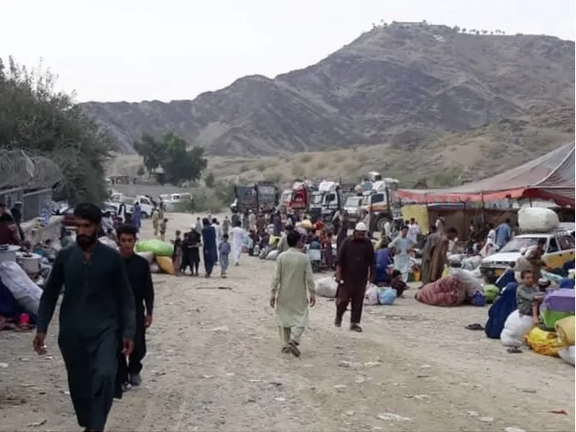
On Saturday, the Taliban’s Ministry of Refugees and Repatriation announced the return of 6,450 Afghan refugees from Pakistan.
On Saturday, the Taliban’s Ministry of Refugees and Repatriation announced the return of 6,450 Afghan refugees from Pakistan.
In a statement, the group stated that these refugees entered Afghanistan through the Torkham border crossing on October 19 and 20.
The Taliban said that the refugees who returned to Afghanistan include 1,062 families and have been referred to the International Organisation for Migration for assistance.
The Pakistani government has asked 1.7 million migrants and refugees without legal documentation to leave the country by November 1. In the past few months, Islamabad police have detained and forcibly deported thousands of Afghans for not having official residency documents.
The UK Foreign Office warned its citizens about the dangers of travelling to Afghanistan and asked them not to travel to this country.
In a statement on Friday, the UK Foreign Office wrote, "Terrorists are very likely to try to carry out attacks in Afghanistan."
The statement specifically warned of the risk of "terrorist attacks" around religious sites throughout Afghanistan as well as airports.
While the Taliban have been talking about providing security across Afghanistan for more than two years, the British Foreign Office’s statement stated that the security situation in Afghanistan is unstable.
It also warned about the risk of arrest and detention of British nationals in Afghanistan. The statement added that the British government may not be aware of the detention of its citizens, and as there are significant challenges in communication and consular services, detainees may not be able to contact their relatives and the period of detention may be very long.
Over the last two years, the Taliban has arrested dozens of foreign citizens, including American, British and French nationals.
Detainees in Taliban prisons can hardly contact their family members or have access to a lawyer.
Previously, international human rights organisations have said that the principles of fair trial are not observed in Taliban detention centres and courts. Access to a fair trial is more difficult for Afghan citizens who are imprisoned in Taliban prisons than foreigners.
The statement of the British Foreign Office states that there is no British consular official in Afghanistan and the ability of the ministry to provide consular assistance is severely limited.
It added, "If you are a British national already resident in Afghanistan, you should carefully consider the risk to your safety and security from staying there. The situation could change quickly and without warning."
The Afghanistan Freedom Front (AFF) claimed responsibility for the Friday evening explosion at the Taliban outpost in Mazar-e-Sharif city.
AFF said that three members of the Taliban had been killed and five others were injured after the explosion at the group’s outpost in police district 7 of Mazar-e-Sharif.
In a statement, AFF stated that following the incident, the Taliban blocked access to the incident site and retrieved their dead bodies and injured personnel from the area.
Residents of Mazar-e-Sharif said that two explosions were heard in the city on Friday evening October 20.
The Taliban have not commented on these explosions so far.
A video clip that reached Afghanistan International shows moments after the explosion in PD7 of Mazar-e-Sharif.
Abdul Salam Hanafi, the Taliban’s deputy prime minister, said that Islamabad's decision to deport Afghan immigrants creates rifts between the people of the two countries.
During a meeting with Obaidur Rahman Nizamani, Charge d’Affaires of Pakistani embassy in Kabul, Hanafi asked Islamabad to reconsider the deportation of Afghan immigrants.
In a statement, the Taliban added that Hanafi’s meeting with Nizamani was focused on the situation of Afghan immigrants in Pakistan.
Pakistan has asked all immigrants without legal documentation to leave the country by the end of October.
Based on the Pakistani authorities, more than 51,000 Afghans have been deported since the deadline for the deportation of illegal immigrants was announced.
Hanafi also demanded the release of children, women, and patients who had been detained and imprisoned by Pakistani forces at the borders.
Radio Pakistan reported that 3,248 Afghan refugees were deported to Afghanistan. According to Pakistani officials, more than 51,000 Afghans have been deported since the announcement of the deadline for deportation of illegal immigrants.
Jan Achakzai, caretaker Minister for Information and Public Relations for Balochistan province, said that the efforts of the Pakistani government to deal with the issue of illegal immigrants have gained momentum.
He stressed that the deadline of November 1 not only applies to Afghan refugees but also to all illegal immigrants living in the province.
Earlier, Sarfraz Bugti, interior minister of the interim government of Pakistan, warned that the country will not compromise on this decision after the deadline.
Meanwhile, Express Tribune also reported that the special branch has been given the task of identifying illegal immigrants living across Balochistan.
Pakistani officials said that so far more than a thousand Afghan families have been returned to Afghanistan through the Chaman border.
Kyrgyz media outlets reported that the country has dispatched a two-tonne humanitarian aid shipment, including medicine, to both Little and Great Pamir region of Afghanistan.
Sadyr Japarov, the president of Kyrgyzstan, ordered the delivery of humanitarian aid to residents of Pamir region.
Kyrgyz News Agency 24 reported that a number of medical workers had also been dispatched to the area. They examined and provided assistance to 600 local residents.
According to the report, Kyrgyz veterinary specialists vaccinated hundreds of animals, including 700 cows in Pamir, to prevent the spread of infectious diseases.
In addition, Kyrgyzstan held a training course for the prevention of various diseases in the Pamir region.
These measures were taken after the Kyrgyz Foreign Ministry last year had said that Kyrgyz people residing in the Pamir region of Afghanistan were facing dire living conditions and falling ill to an unidentified virus.
At the same time, Radio-Television Afghanistan, controlled by the Taliban, reported that in two weeks, Pamir residents were infected with an unknown disease and 21 people had died.
One of the residents of the Great Pamir region said that they have no facilities and that the residents have to walk for three or four days to reach a medical center.
The Pamir region, which is divided into two parts, the Little Pamir and Great Pamir, is located in Wakhan, Badakhshan province, in the northeast of Afghanistan.
After the Taliban’s takeover of power in Afghanistan, Kyrgyzstan’s concern regarding the well-being of Kyrgyz residents in Afghanistan increased.
