Afghan Refugee Commits Suicide In Indonesia
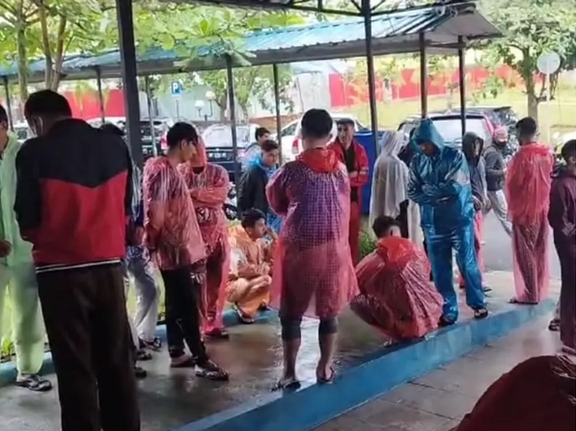
Several sources in Indonesia confirmed that an Afghan refugee committed suicide in the "Tanjung Pinang" city of this country.

Several sources in Indonesia confirmed that an Afghan refugee committed suicide in the "Tanjung Pinang" city of this country.
They said that the 27-year-old hanged himself in his room on Sunday evening "due to mental stress from a difficult life in Indonesia".
A source said, "Indonesian police have requested 30 million Indonesian rupiah to transport the body of the man to Jakarta. Consequently, the Afghan refugees have been unable to retrieve the body from the hospital so far."
The sources said that the family members of this young man are in Australia and have paid 12,000 dollars to an Australian company to transfer his body to Jakarta.
Earlier, several Afghan refugees in Indonesia held a protest rally in front of the United Nations office in Makassar city and demanded that their immigration cases be processed.
Afghan immigrants in Indonesia grapple with an uncertain future, separation from family, and immigration-related restrictions. The prolonged duration of this situation, spanning several years, has placed some of them under significant psychological pressure.


The National Congress Party of Afghanistan initiated an online poll, termed the "right to self-determination”, regarding the future political system of Afghanistan.
In the poll, the participants were asked to choose "Islamic Emirate", "Presidential Republic", "Federal Republic" or “Partition” as their choice for the future of Afghanistan.
On Monday, in a statement, the party wrote, "Following the announcement of the poll results, the National Congress Party will take practical political measures to achieve it, respecting the option that the majority of people have agreed to."
Latif Pedram, the leader of the National Congress Party of Afghanistan, has said several times that the centralisation of power is the fundamental problem of citizens of Afghanistan, and he believes that this challenge can be addressed through the establishment of a "federal republic system”.
He also said that if the supporters of the centralised presidential republic insist on the centralisation of power and are not ready to talk about the establishment of a federal republic and the "fair power sharing among all ethnic groups in the country", he does not hesitate to go for partition of Afghanistan.

A group of Afghan asylum seekers held a demonstration in front of the German embassy in Tehran to protest against the delayed processing of their asylum applications in Germany.
Protesters said that they have lost patience due to long waiting times for their asylum interviews.
In a video clip sent to Afghanistan International from Monday's demonstration, children, women and men can be seen holding placards that read: "Don't separate us from our families with long waiting time”.
In October 2022, the German foreign ministry had announced a programme to transfer 1,000 Afghan refugees to Germany every month.
According to the programme, priority would be given to the transfer of those who were active in justice, politics, media, education, culture, sport or academic sectors.
A year after the announcement of the programme, an organisation called "Kabul Luftbrücke" has said that only 13 Afghans have been transferred to Germany during this period. Kabul Luftbrücke operates to relocate at-risk refugees from Afghanistan to Germany.
However, Germany has sheltered thousands of Afghan refugees since the Taliban took over the power in 2021. Reports indicate that Germany has approved the transfer of over 1,400 of more than 30,000 Afghan applications since August 2021.

The polio vaccination campaign for children started on October 23 in 14 provinces of Afghanistan.
Children under the age of five will be vaccinated in Kunduz, Takhar, Baghlan, Parwan, Kapisa, Kabul, Kunar, Nuristan, Laghman, Nangarhar, Paktia, Paktika, Khost and Ghazni provinces.
Residents of these provinces have been urged to vaccinate their children so that this disease can be eradicated in Afghanistan.
Afghanistan and Pakistan are two countries in the world that have not yet succeeded in eradicating polio.
Earlier, health officials in Afghanistan had warned that this disease is increasing rapidly in the country.
According to these officials, this year at least six positive cases of polio have been registered in Nangarhar province.

Following the mistreatment of Afghan refugees in Iran, Afghanistan International has received a video clip which shows an Afghan immigrant being subjected to sexual violence and torture.
In the video, the individual’s hands have been tied behind his back and there is blood oozing from his head and face, while a man uses a sharp object on his face.
The video clip also shows that the perpetrator injures the man with a sharp object. Profanity and racial insults are used repeatedly during the video.
The video was recorded by an individual who subjected the refugee to severe torture and stripped them of their clothing.
The exact time of when the recording had been made is not clear; however, Afghanistan International's investigation indicates that this video had not been previously shared on social media.
During the conversations, it has been explicitly mentioned that the video was recorded in "Iran”. Nevertheless, the video has been captured at night, and no signs are visible to help identify its exact location.
This 2-minute and 14-second video clip features a middle-aged Afghan migrant man being forced into confessing to a sexual relationship with an Iranian woman.
The Afghan immigrant talks about the sexual relationship under pressure, but it is not clear whether it is true, or it has been with the consent of both parties.
After the takeover of power by the Taliban, millions of Afghan citizens have been displaced and many of them sought refuge in neighbouring countries, including Pakistan and Iran.
Recently, many inside Iran criticised the presence of Afghan immigrants in Iran, resulting in incidents of violent reactions towards Afghan refugees.
On October 6, Afghanistan International received another video clip that showed a group of people attacking Afghan immigrants' houses with stones and sticks in Eqbaliyeh city of Qazvin province.
Following the release of this video on Afghanistan International TV, the Iranian police announced the arrest of 19 people for allegedly attacking Afghan refugees’ homes in Eqbaliyeh city.

Sources told Afghanistan International that Pakistani police officials have started house-to-house search operations of Afghan immigrants at night and transfer them to prison.
These operations are taking place after Pakistan has decided to deport Afghan refugees who do not have legal documentation.
An Afghan migrant in the city of Karachi told Afghanistan International that Pakistani police officials enter houses of Afghan immigrants in the middle of the night without prior notice.
According to him, the purpose of house-to-house search operations is to identify Afghan refugees.
Afghanistan International has also received a video of one such night raid by the Pakistani police at an Afghan immigrant’s house in Karachi.
Pakistan has announced that 1.7 million Afghan immigrants live in Pakistan without legal documentation.
Afghan immigrants in Pakistan said that the new policy of the Pakistani government towards refugees and immigrants has made life difficult for them.
The government of Pakistan has given all the immigrants it considers "illegal" until November 1 to leave the country.
Pakistan's Interior Minister Sarfraz Bugti said in a press conference in Islamabad last week that Afghans have been involved in terrorist attacks in various areas of Pakistan.
Pakistan's interior minister has emphasised that the property of illegal immigrants in the country will be confiscated after the deadline for departure is over.
International organisations and human rights groups have criticised the Taliban’s deportation of Afghans. United Nations human rights experts have urged Pakistan to refrain from deporting Afghans.
The Taliban has also asked Pakistan to reconsider its decision about Afghan refugees. Earlier, Mullah Yaqoob, Taliban’s Defence Minister, called Pakistan's treatment of Afghan immigrants as "barbaric" and said that the deportation of Afghan immigrants harms the relations between the two countries.
Despite these widespread criticisms, Pakistan has deported thousands of Afghans so far. In the latest case, the Ministry of Refugees of the Taliban announced on Saturday, the return of 6,450 Afghan refugees from Pakistan to Afghanistan.