• العربية
  • پښتو
  • فارسی
Brand
  • Afghanistan
  • Sport
  • Markets
  • Afghanistan
  • Sport
  • Markets
  • Theme
  • Language
    • العربية
    • پښتو
    • فارسی
  • Afghanistan
  • Sport
  • Markets
All rights reserved for Volant Media UK Limited
volant media logo

Exclusive: Eyebrows Raised As Taliban FM’s 10-Day Stay In Turkiye Garners Attention

Oct 28, 2023, 14:28 GMT+1

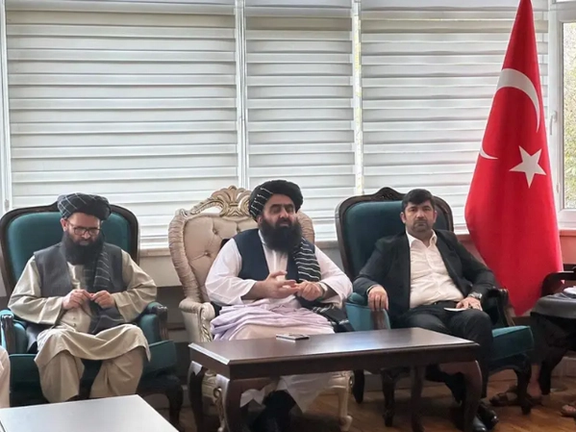
Reliable sources informed Afghanistan International that Amir Khan Muttaqi, Taliban’s foreign minister, has been in Turkiye since the last 10 days.

According to sources, Muttaqi arrived in Turkiye on October 19, but the Taliban spokespersons have avoided publicising the visit.

A credible source, who spoke to Afghanistan International on the condition of anonymity, said that Muttaqi had travelled to Turkiye for treatment of "his heart disease and general health examinations" as well as holding discussions with Afghan businessmen about his "personal business" issues.

There is no information about the details of Muttaqi’s conversations with the businessmen.

According to the details provided by the sources to Afghanistan International, the Taliban’s foreign minister requested a meeting with the Turkish Foreign Minister last week, but he has not received a response yet.

He also held a meeting with the employees of Afghanistan’s diplomatic mission in Ankara on Wednesday, October 25.

Sources said that employees who are in touch with the Taliban's foreign ministry participated in this meeting. However, several diplomats from the previous Afghan government refused to meet with the Taliban’s foreign minister.

Although the Turkish government does not recognise the Taliban regime in Afghanistan, it has close ties with the group.

Turkiye has so far issued visas to a number Taliban diplomats and allowed them to start their work at the Afghan embassy in Ankara and the Afghan consulate in Istanbul.

On the other hand, some of the leaders of the National Resistance Council for Salvation of Afghanistan, traditionally viewed as opposition to the Taliban, also reside in Turkiye.

Most Viewed

Taliban to Sell Confiscated Housing Estates Back to Residents
1

Taliban to Sell Confiscated Housing Estates Back to Residents

2

Explosions & Aircraft Activity Reported Over Kabul

3

Taliban Signs $46 Million Customs Laboratory Deal With Indian Company

4

Taliban Promised Inquiry Into Abuse Of Cleric, Says Shia Commission

5

Nearly 23,000 Militants Operating In Afghanistan, Says Russian Security Chief

•
•
•

More Stories

Amnesty International Calls On Pakistan To Reverse Decision To Deport Refugees

Oct 28, 2023, 12:27 GMT+1

Amnesty International urged Pakistan to immediately reverse the decision to deport refugees and adhere to international human rights laws.

The organisation said that the deportation of refugees is a violation of human rights and raises serious concerns about their access to safety, welfare, and basic services.

According to the latest statements of the Pakistani officials, the country’s government has decided to deport at least 1.4 million immigrants without official residence documents from the country starting November 1.

Amir Mir, Punjab's Caretaker Information Minister confirmed on Friday, that around 99,000 "illegal" immigrants have been arrested before the November 1.

Mir said that of them, 33,000 people do not have residency documents and will be deported.

Over the past few weeks, numerous media reports have surfaced regarding the detention and deportation of Afghan refugees in Pakistan.

Qaiser Khan Afridi, the spokesperson for the United Nations High Commissioner for Refugees in Pakistan, asked registered asylum seekers to refer to the organisation’s lawyers if they face police harassment.

Afridi told Afghanistan International that the lawyers of the organisation are available to asylum seekers all over Pakistan.

Afridi confirmed that there had been reports in recent months that Pakistani police had even harassed asylum seekers who had official documents from the UN Refugee Agency and were registered with the agency.

He said that if the police arrest these asylum seekers, they may be freed by contacting the defence lawyers hired by this organisation.

Herat Hit By Another Earthquake As UNICEF Announces Arrival of More Medical Aid

Oct 28, 2023, 11:04 GMT+1

An earthquake of 4.5 magnitude hit Herat province on Saturday around 10:15 am local time. There are no details of the possible damages caused due to the earthquake yet.

Earlier on October 7, a deadly earthquake with a 6.3-magnitude left more than 2,000 dead and many injured in Herat province. It has been followed by several other earthquakes in recent weeks.

Meanwhile, the United Nations International Children's Emergency Fund (UNICEF) has announced the arrival of more than 80 tonnes of medical equipment for the Herat earthquake victims in Kabul.

UNICEF said that this equipment will save the lives of many women and children affected by the several earthquakes in Herat.

The organisation added that children were severely affected by the earthquakes.

In a statement, UNICEF wrote that in the next few months, it will provide aid to 200,000 people, including 96,000 children, who were affected by the earthquake in Herat.

ISIS Claims Responsibility For Attack On Sports Club In Kabul

Oct 28, 2023, 09:40 GMT+1

ISIS has now claimed responsibility for Thursday's attack on the Millat Sports Club in the Dashte Barchi area of Kabul.

The group wrote on its Telegram channel that they had planted the bomb at the place where "Shiites" were gathering.

The Taliban had earlier said that four people were killed and seven people were injured in the attack.

However, on the day of the attack, local sources reported that the death toll of the attack reached six people.

In recent years, the Millat Sports Club had been operating under the supervision of Mohammad Rahim Afzali in the Poole Khoshk area of Dashte Barchi area in Kabul.

Earlier, Afghanistan’s Freedom Front condemned this attack and, in a statement, attributed the planning and implementation of this attack and explosion at the Imam Zaman Mosque in Pul-e Khumri city, to a group of "domestic and foreign terrorists who are directly funded, equipped and supported by the Haqqani Network.”

The ISIS group has consistently claimed responsibility for numerous attacks in areas where Hazaras live in Kabul and various other cities in Afghanistan.

The Psychological Imprints of Oppressive Regimes

Oct 27, 2023, 11:44 GMT+1
•
Maher Saadat

When an oppressive regime, such as the Taliban, exerts control over a society, it leaves an indelible mark not just on the political landscape, but on the collective psyche of its citizens.

This transformation is deep and multifaceted, with effects permeating individual perceptions, communal interactions, and the broader cultural ethos of the nation.

Central to a regime's power is its ability to control the narrative, which extends far beyond mere propaganda. Consider the stark implications of restricting education for females and girls. Beyond the immediate educational deprivation, this act communicates a woman's prescribed place in society. When young girls internalise such notions, it doesn't merely limit their aspirations; it fundamentally alters their self-concept. Project this over an entire generation, and we're potentially looking at a collective female psyche that views itself through the lens of perceived inferiority, with far-reaching consequences for societal dynamics.

The curricula within schools under the Taliban is not merely content—it's an instrument for shaping worldviews. By embedding skewed historical narratives and religious interpretations, young minds are conditioned with cognitive biases. Once established, these biases act as formidable barriers against alternative viewpoints. Over time, they insulate society, fostering a homogenised perspective that is resilient to external influences.

Moreover, living under the persistent shadow of surveillance, where dissent may lead to dire consequences, creates an omnipresent stress trigger. Chronic exposure to such environments can instigate a collective form of trauma, with communities in perpetual states of hypervigilance and anxiety. This isn't a fleeting state; such trauma can embed itself in societal interactions, altering community dynamics and eroding social trust for generations.

The Taliban's weaponisation of religion introduces another layer of psychological complexity. When faced with an extremist interpretation enforced as dogma, individuals undergo a profound internal conflict. This cognitive dissonance, where personal beliefs clash with imposed tenets, can fracture personal identities. The emotional distress ensuing from such internal turmoil can sometimes lead individuals to cling even more rigidly to extremist views, paradoxically seeking solace in the very source of their conflict.

The indoctrination of young minds in madrasas is particularly concerning, given that the formative years play a pivotal role in shaping an individual's world view. Exposure to extremist ideologies during this crucial phase can lay the foundation for a lifetime of unwavering beliefs. The Taliban's strategic approach to radicalising the young generation not only ensures a steady influx of loyal fighters, but also embeds their extremist views deeply within the social fabric. Over the long term, this can lead to a population that is less receptive to alternative perspectives, resistant to change, and more prone to sectarianism.

However, one of the most intriguing paradoxes within the scope of oppressive regimes is their inadvertent role in nurturing the very seeds of resistance they wish to obliterate. Philosophers throughout history have meditated on the nature of human freedom and agency. Existentialists like Jean-Paul Sartre proposed that the essence of human existence is freedom; to live authentically is to act in defiance of external determinants, to carve out one's own essence in a universe devoid of predetermined meaning.

Existential freedom becomes particularly poignant under oppression. When external forces work tirelessly to subjugate, suppress, and define individuals, the internal psychological drive to assert autonomy and resist becomes amplified. Yuval Noah Harari's observation: “Hatred is the ugliest of emotions. But for oppressed nations, hatred is a hidden treasure. Buried deep in the heart, it can sustain resistance for generations," taps into this complex interplay. Here, hatred isn't merely a visceral response to oppression; it morphs into a symbolic emblem of resistance, a deep-seated emotional reservoir from which individuals and communities draw strength and purpose.

Psychologically, oppressive conditions intensify the forging of collective identities. Shared suffering, experiences, and adversities under such conditions coalesce into a fortified sense of unity and solidarity among the oppressed. This collective consciousness serves as a psychological bulwark against the regime's dehumanising endeavours, creating a shared reservoir of resilience and defiance.

In observing the transformation of a society under authoritarian rule, it becomes evident that the most profound impacts aren't necessarily the visible ones. The psychological shifts—be they biases, traumas, or emergent solidarities—mould the societal fabric in nuanced ways. Recognising and addressing these shifts is crucial, not just for understanding the present, but for shaping a nation's future trajectory.
Attacks On Hazaras Carried Out Under Supervision of Haqqani Network, Says AFF

Oct 27, 2023, 10:42 GMT+1

The Afghanistan Freedom Front (AFF) condemned the explosion at a sports club in the Dashte Barchi area of Kabul city.

AFF stressed that the planning and implementation of this attack and explosion at the Imam Zaman Mosque in Pul-e Khomri was carried out by a group of "domestic and foreign terrorists who are directly funded, equipped and supported by the Haqqani network”.

On Thursday, an explosion hit the "Millat" sports club in Dasht e Barchi area of Kabul. At least six people were killed, and ten others were injured in this incident.

Following the explosion, the Taliban announced that two people were dead and nine were wounded.

AFF in a statement on Friday, said that the main targets of these attacks are Hazaras and the Afghan Shia population.

This anti-Taliban front has emphasised that "the Taliban and their allied terrorist groups are in collusion with each other and continue their chain of barbaric crimes", killing a number of innocent and defenceless citizens.

So far, no group has claimed responsibility for the explosion in Dashte Barchi area of Kabul.