Turkmenistan’s FM Visits Herat’s Torghundi Port In Unexpected Trip
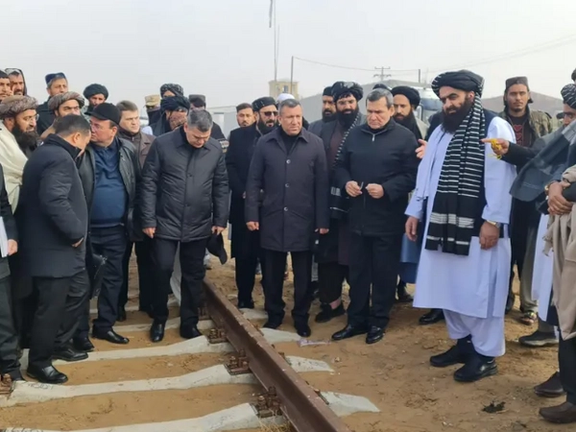
In an unannounced visit, Raşit Meredow, Turkmenistan’s foreign minister, visited Torghundi port in Herat province of Afghanistan on Saturday.

In an unannounced visit, Raşit Meredow, Turkmenistan’s foreign minister, visited Torghundi port in Herat province of Afghanistan on Saturday.
The Taliban's foreign ministry announced that Amir Khan Muttaqi, Taliban’s foreign minister, also went to Torghundi port in western Afghanistan to welcome Meredow.
The Ministry of Foreign Affairs of Turkmenistan has not yet announced the primary objectives of this trip. However, the Taliban stated that the purpose of the trip was “assessing the progress of joint projects between Afghanistan and Turkmenistan”.
The Taliban stated that the objective of Meredow’s visit and his accompanying delegation is to observe and enhance the progress of economic, transit, electricity, railway, and energy projects in both Afghanistan and Turkmenistan.
In a statement on Saturday, the Taliban's Foreign Ministry wrote that the officials of Turkmenistan and the Taliban also visited the Torghundi railway route in Herat.
Turkmenistan provides a major part of Herat's electricity supply. The country is also a partner of the TAPI regional project and an exporter of fuel to Afghanistan.


Pakistani media outlets reported that the country’s Chief of Army Staff, Asim Munir, expressed concern about the situation in Afghanistan and Indian Kashmir during a meeting with the Secretary General of the United Nations.
So far, more details of the conversation between Asim Munir and Antonio Guterres in New York have not been published.
Militant attacks on the country's security forces have increased in recent months, and Islamabad accuses the Afghan Taliban of harbouring the Pakistani Tehreek-e-Taliban fighters. However, the Afghan Taliban rejected the claim and said that Pakistan blames Afghanistan for the inability of its security forces to ensure its internal security.
He also expressed concerns regarding the recent decision of the Supreme Court of India on the merger of Kashmir and asked the United Nations to provide the grounds for a plebiscite so the “Kashmiris decide their future”.
The Pakistan Army announced the arrival of Asim Munir and Nadeem Anjam, Directorate General of Inter-Services Intelligence of Pakistan, to the United States on Friday. It stated that US Secretary of State Antony Blinken met these two senior Pakistani officials at the ministry's headquarters.
These two high-ranking Pakistani generals are set to meet General Lloyd Austin, the Secretary of Defence, and General Charles Q Brown, the Chairman of the Joint Chiefs of Staff of the US Army.
Pakistan's military officials hope to gain more support from the US in what Islamabad calls the fight against terrorism.

Rahmatullah Nabil, the former head of Afghan intelligence, has linked the Taliban's 2021 capture of Nimroz province to support from Jaish ul-Adl, a Sunni extremist group.
Nabil's statement came in response to a recent Jaish ul-Adl attack on an Iranian police centre in Sistan and Balochistan province, which resulted in the death of at least 12 policemen.
In a post on social platform X, Nabil stated, "In 2021, Jaish-ul-Adl fought in several provinces of Afghanistan to support the Afghan Taliban against the Islamic Republic of Afghanistan's security forces and overthrew the first province of Afghanistan in Nimroz." He also indirectly referenced the Islamic Republic of Iran's alleged support for the Taliban.
On 7 August 2021, just a week before Kabul's fall, Nabil had noted that despite ideological differences between Jaish al-Adl and the Afghan Taliban, Pakistan's ISI intelligence agency had dispatched around 600 Jaish-ul-Adl fighters with military equipment to aid the Taliban in various Afghan provinces.
Officials from the previous Afghan government have accused Iran of supporting the Taliban, alleging training, weaponry, and financial assistance for the group.
The attack on the police headquarters in Rask city of Sistan and Baluchistan by Jaish ul-Adl has heightened tensions, with Iranian officials asserting that the group operates from bases in Pakistan.

Geng Shuang, China's deputy permanent representative to the United Nations, warned that the terrorist threats in Afghanistan "remain serious".
China's Xinhua news agency quoted Shuang as saying that the international community must resolutely prevent Afghanistan from becoming a hub for terrorist organisations.
This request comes while the UN Security Council recently renewed the mandate of monitoring team sanctions against the Taliban.
On Thursday, the UN Security Council unanimously approved the resolution of the 15-member body to continue the 1988 sanctions against the Taliban. The Taliban will remain under UN sanctions for another year. However, the exemption of several Taliban leaders from the travel ban has not been extended.
China's deputy permanent representative to the United Nations has said that as stated in the preamble of the resolution, the Security Council must ensure that the sanctions effectively promote peace and stability in Afghanistan.
However, he added that considering the current situation, China believes that the Security Council should facilitate pragmatic engagement between the international community and Taliban by making timely adjustments to the sanctions and to avoid negative impact on the livelihood of the Afghan people and the development of this country.
According to him, in the first step, the Security Council should consider exemptions from sanctions regarding the travel of some Taliban officials as soon as possible.
“China has always maintained that the travel exemptions are a necessary tool that facilitates dialogue and engagement and that they should not be taken as a bargaining chip for pressure,” said Shuang.

In a virtual meeting, Ismatilla Ergashev and Tomas Nicholson, the respective Uzbekistan and European Union Envoys for Afghanistan, concurred on the critical need for unified international efforts to establish peace and stability in Afghanistan.
They highlighted that without a consolidated stance from the global community towards Afghanistan's new regime, achieving stability remains an elusive goal.
Uzbekistan’s Ministry of Foreign Affairs, in a statement, announced that both parties emphasised the vital role of the United Nations in Afghanistan and the necessity for co-ordinated international actions.
Uzbekistan's President, Shavkat Mirziyoyev, had previously expressed concerns that global conflicts might divert attention away from Afghan issues. At the meeting of the heads of the Organisation of Turkic States in Astana, he advocated for a mechanism to address the challenges faced by the Afghan people. Mirziyoyev underscored that establishing peace in Afghanistan, a nation deeply connected with Turkish nations for millennia, is essential for regional stability and strategic security.
Despite not recognising the Taliban regime, Uzbekistan has continued engaging with the group, even while critiquing certain actions like the construction of the Qosh Tepe Canal.

Neda Parwani, a prominent women's rights activist, along with her husband and child, were released by the Taliban after nearly four months in detention.
This news was confirmed on Thursday by fellow activists Hoda Khamosh and Parwana Ibrahimkhel. Parwani, a key figure in the Spontaneous Movement of Afghan Women, was arrested with her family in Kabul on 19 September.
A source close to Parwani revealed to Afghanistan International that Parwani's health has deteriorated, necessitating her transfer to a hospital following her release. Ibrahimkhel also verified Parwani's health issues on her social media account on platform X.
Parwani was taken into custody by Taliban fighters from her residence in the Khairkhana area of Kabul. Throughout her detention, the Taliban officials have neither commented on her arrest nor addressed the allegations made against them.
Human rights organisations and defenders have been vocally demanding the release of detained women protesters, particularly Parwani. The United Nations Assistance Mission in Afghanistan (UNAMA) recently voiced its concern over the arbitrary and prolonged detention of female activists by the Taliban, stating that at least four women's rights activists have been arrested in Kabul.
In a related development, Zhulia Parsi, another women's rights activist, was reportedly moved from Taliban detention to a hospital. Sources indicate that Parsi's transfer was due to the severe physical and mental impacts of torture endured in captivity.
At present, three women activists - Zhulia Parsi, Manizha Sediqi, and Parisa Azada - remain in Taliban custody, raising continued concerns among human rights groups about their well-being and treatment.