• العربية
  • پښتو
  • فارسی
Brand
  • Afghanistan
  • Sport
  • Markets
  • Afghanistan
  • Sport
  • Markets
  • Theme
  • Language
    • العربية
    • پښتو
    • فارسی
  • Afghanistan
  • Sport
  • Markets
All rights reserved for Volant Media UK Limited
volant media logo

UN Security Council To Vote On Extending Taliban Sanctions Monitoring

Feb 3, 2026, 12:56 GMT+0

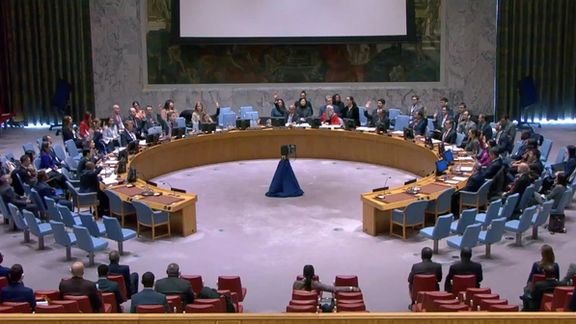
The UN Security Council is set to vote on extending the mandate of the monitoring team supporting the Afghanistan 1988 Sanctions Committee, a move that would keep Taliban-linked individuals and entities under UN sanctions.

The monitoring team’s mandate expires on February 17. If renewed, the existing sanctions regime including asset freezes, travel bans and an arms embargo will remain in place.

The 1988 sanctions apply to individuals and entities associated with the Taliban who are involved in violence, arms supply, recruitment or other activities seen as threatening peace and stability in Afghanistan. Apart from a humanitarian exemption approved in late 2021, the regime has seen no major changes since the Taliban returned to power.

The United States has rejected most requests this year for exemptions from travel bans, according to diplomatic correspondence. In a letter to committee members last summer, Washington said it would review exemption requests on a case-by-case basis with increased scrutiny, arguing that the Taliban continued to use what it described as hostage diplomacy and had failed to meet counterterrorism commitments.

Following that stance, some countries have opted to notify the committee of travel by sanctioned Taliban members rather than formally request exemptions.

The Afghanistan 1988 Sanctions Committee is a subsidiary body of the Security Council responsible for overseeing implementation of the measures. It designates sanctioned individuals and entities, decides on exemption requests and reports to the council. The monitoring team assists the committee by preparing reports, making recommendations and reviewing the sanctions list.

The latest negotiations on the monitoring team’s mandate were held in December 2024 and resulted in an extension of the mandate, keeping the Taliban under sanctions.

Issues cited by diplomats as factors in favour of extending the sanctions include the Taliban’s reported links to groups such as Tehreek-e-Taliban Pakistan, al-Qaida and the East Turkestan Islamic Movement; policies restricting women’s rights, including bans on girls’ education; and the absence of what critics describe as an inclusive government.

The monitoring team also supports the ISIL and al-Qaida sanctions committee. Under Resolution 2734, adopted in June 2024, that mandate runs until June 2027.

Most Viewed

Taliban Ignore Afghanistan’s Interests By Backing Militants, Says Pakistan Army Chief
1

Taliban Ignore Afghanistan’s Interests By Backing Militants, Says Pakistan Army Chief

2

United Nations Delivers Education Kits To Four Million Afghan Children

3

Taliban Renews Call For China To Launch Aynak Copper Mine

4

Taliban Leaders In South-West Hold Security Meet In Kandahar

5

Afghan Deportations Is Strategic Mistake, Says European Parliament Member

•
•
•

More Stories

Afghanistan Among Top Security Issues For CSTO, Says Russian FM

Feb 3, 2026, 10:15 GMT+0

Russian Foreign Minister Sergei Lavrov said developments in Afghanistan and security risks in Central Asia are among the main concerns for the Collective Security Treaty Organization.

Lavrov made the remarks Monday during a meeting in Moscow with Talatbek Masadykov, secretary-general of the CSTO. He said new security challenges and threats, particularly those emerging in Central Asia and Afghanistan, are at the top of the bloc’s agenda.

The Collective Security Treaty Organization is a regional military alliance whose members include Russia, Armenia, Belarus, Kazakhstan, Kyrgyzstan and Tajikistan. Under its framework, an attack on one member is considered an attack on all.

The situation in Afghanistan since the Taliban’s return to power remains a sensitive security issue for neighbouring countries and the broader region.

Taliban’s Narrative Faces Growing Challenges Online, Says Group Official

Feb 3, 2026, 09:34 GMT+0

A Taliban official said the group’s messaging channels are weak and warned that failing to compete on social media would allow opposing narratives to gain ground.

Saeed Khosti, head of the Department for the Registration of Jihadi Works and Documents at the Taliban’s Ministry of Information and Culture, said the “social media battlefield” could not be abandoned. “If we leave this field empty, the enemy’s narrative will grow stronger and the Taliban will be defeated,” he said.

Khosti, who previously headed the propaganda wing of the Haqqani network, was appointed earlier this week to the ministry post. Speaking to online supporters of the Taliban, he said users often first encounter content from media outlets opposed to the group when they log on to social media.

According to him, such messages are repeated frequently throughout the day and influence young people and the broader public.

As an example, he cited criticism of the Taliban’s recently published penal code, saying opponents portray it as lacking justice or equality. He said repeated exposure to such content shapes public perceptions.

Khosti argued that remaining silent would strengthen what he described as the enemy’s narrative and said the Taliban should take the initiative in the media sphere rather than remain defensive.

He also said media outlets opposed to the Taliban exaggerate minor stories to undermine the group’s messaging and described social media as a “live battlefield” requiring sustained attention similar to a military front.

Khosti has previously served as a spokesperson for the Taliban’s Interior Ministry and later as an adviser at the Ministry of Information and Culture.

He has also faced accusations of sexually assaulting a female university student, allegations that have circulated publicly but have not been addressed in detail by Taliban authorities.

Kabul Medical University To Add Islamic Medicine Faculty, Says Taliban

Feb 2, 2026, 17:22 GMT+0

The Taliban’s Ministry of Higher Education said a faculty of what it described as “Prophetic Traditional Medicine” will be established at Kabul Medical University under a decree by the group’s leader, Hibatullah Akhundzada.

In a statement posted on its X account Monday, the ministry said the new faculty aims to strengthen scientific, educational and research activities in the field of Prophetic traditional medicine.

The ministry said the faculty would “play an important role in the development of medical sciences, the enhancement of professional capacity and the expansion of health services” in Afghanistan.

Prophetic medicine, sometimes referred to as Islamic medicine, is a body of traditional medical practices used by some Muslim communities over centuries, often as an alternative to classical Greek-influenced medical systems.

Based on traditions and recommendations attributed to the Prophet of Islam, the approach seeks to treat illnesses and preserve health.

New Polio Vaccination Drive Launched In 18 Afghan Provinces

Feb 2, 2026, 15:59 GMT+0

A new round of polio vaccination began Monday in 18 provinces of Afghanistan, a spokesperson for the Taliban-run Ministry of Public Health said.

Sharafat Zaman Amarkhel said the campaign will run until Thursday, February 5, and aims to vaccinate 7.3 million children under the age of five.

The drive is being carried out in Kabul, Nangarhar, Laghman, Kunar, Nuristan, Paktia, Paktika, Khost, Ghazni, Kandahar, Helmand, Uruzgan, Zabul, Balkh, Faryab, Kunduz, Herat and Badghis.

The World Health Organization said in a report published in November 2025 that despite a decline in polio cases in Afghanistan, the risk of virus transmission remains high in southern areas bordering Pakistan.

According to official reports, nine positive polio cases were recorded in Afghanistan in 2025.

Afghanistan and Pakistan are the only two countries in the world where polio cases are still being reported.

Taliban Envoy Seeks Participation In SCO Meetings

Feb 2, 2026, 12:10 GMT+0

The Taliban’s ambassador to Russia said Afghanistan, as an observer member of the Shanghai Cooperation Organisation, should be allowed to participate in the bloc’s meetings.

In an interview with Russia’s state news agency TASS, Gul Hassan expressed hope that a Taliban representative would be invited to future meetings of the SCO.

Asked whether the Taliban administration sees cooperation with the organisation as possible, he said Afghanistan holds observer status and, in line with that, should attend its meetings.

The Shanghai Cooperation Organisation, founded in 2001, is a regional political and security bloc. Its full members include Russia, China, India, Kazakhstan, Kyrgyzstan, Tajikistan, Pakistan, Iran and Uzbekistan. Belarus joined the organisation in July 2024.

Afghanistan and Mongolia are observer states. Dialogue partners include Azerbaijan, Armenia, Bahrain, Egypt, Cambodia, Qatar, Kuwait, the Maldives, Myanmar, Nepal, the United Arab Emirates, Saudi Arabia, Türkiye and Sri Lanka.

Unlike the Taliban authorities, Mongolia’s representatives have attended SCO meetings in recent years.

Despite diplomatic engagement with Moscow, the Taliban were not invited to the 24th meeting of the SCO Council of Prime Ministers, held in Moscow in November 2025.

The Taliban’s foreign ministry said in April 2025 that China had invited representatives of the group to SCO meetings. However, a Taliban representative was not invited to the SCO foreign ministers’ meeting held in China in July 2025.

Following the absence of invitations, Gul Hassan met in November 2025 with Bakhtiyor Khakimov, Russia’s presidential special representative for SCO affairs, and asked that Afghanistan’s observer status be taken into account.

Russia maintains relations with the Taliban authorities, though the administration has not been widely recognised internationally.