New Polio Vaccination Drive Launched In 18 Afghan Provinces
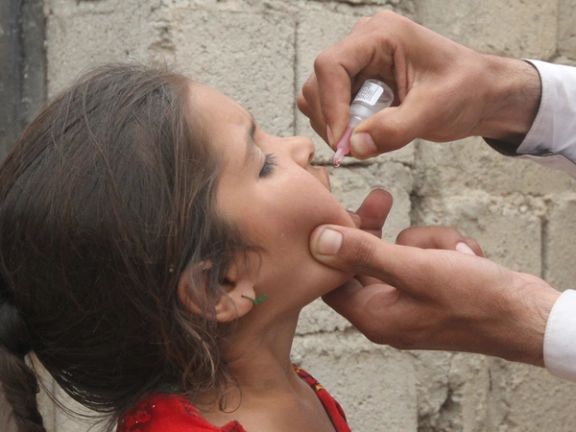
A new round of polio vaccination began Monday in 18 provinces of Afghanistan, a spokesperson for the Taliban-run Ministry of Public Health said.
A new round of polio vaccination began Monday in 18 provinces of Afghanistan, a spokesperson for the Taliban-run Ministry of Public Health said.
Sharafat Zaman Amarkhel said the campaign will run until Thursday, February 5, and aims to vaccinate 7.3 million children under the age of five.
The drive is being carried out in Kabul, Nangarhar, Laghman, Kunar, Nuristan, Paktia, Paktika, Khost, Ghazni, Kandahar, Helmand, Uruzgan, Zabul, Balkh, Faryab, Kunduz, Herat and Badghis.
The World Health Organization said in a report published in November 2025 that despite a decline in polio cases in Afghanistan, the risk of virus transmission remains high in southern areas bordering Pakistan.
According to official reports, nine positive polio cases were recorded in Afghanistan in 2025.
Afghanistan and Pakistan are the only two countries in the world where polio cases are still being reported.

The Taliban’s ambassador to Russia said Afghanistan, as an observer member of the Shanghai Cooperation Organisation, should be allowed to participate in the bloc’s meetings.
In an interview with Russia’s state news agency TASS, Gul Hassan expressed hope that a Taliban representative would be invited to future meetings of the SCO.
Asked whether the Taliban administration sees cooperation with the organisation as possible, he said Afghanistan holds observer status and, in line with that, should attend its meetings.
The Shanghai Cooperation Organisation, founded in 2001, is a regional political and security bloc. Its full members include Russia, China, India, Kazakhstan, Kyrgyzstan, Tajikistan, Pakistan, Iran and Uzbekistan. Belarus joined the organisation in July 2024.
Afghanistan and Mongolia are observer states. Dialogue partners include Azerbaijan, Armenia, Bahrain, Egypt, Cambodia, Qatar, Kuwait, the Maldives, Myanmar, Nepal, the United Arab Emirates, Saudi Arabia, Türkiye and Sri Lanka.
Unlike the Taliban authorities, Mongolia’s representatives have attended SCO meetings in recent years.
Despite diplomatic engagement with Moscow, the Taliban were not invited to the 24th meeting of the SCO Council of Prime Ministers, held in Moscow in November 2025.
The Taliban’s foreign ministry said in April 2025 that China had invited representatives of the group to SCO meetings. However, a Taliban representative was not invited to the SCO foreign ministers’ meeting held in China in July 2025.
Following the absence of invitations, Gul Hassan met in November 2025 with Bakhtiyor Khakimov, Russia’s presidential special representative for SCO affairs, and asked that Afghanistan’s observer status be taken into account.
Russia maintains relations with the Taliban authorities, though the administration has not been widely recognised internationally.
The Taliban’s ambassador to Russia said the number of direct flights between Afghanistan and Russia is expected to increase.
Gul Hassan told Russia’s state news agency TASS that, in addition to weekly flights operated by Ariana Afghan Airlines, direct Kabul–Moscow services by Kam Air are set to be launched in the near future.
He said Ariana Afghan Airlines has operated one direct flight per week between Afghanistan and Russia over the past four years and that preparations are under way to begin Kam Air flights on the Kabul–Moscow route.
Gul Hassan added that efforts are under way to boost reciprocal travel by citizens of the two countries, which he said would lead to an increase in flight frequency.
He arrived in Moscow in July 2025 and began his mission as the Taliban’s ambassador to Russia.
Russia has maintained diplomatic engagement with the Taliban authorities, though their administration has not been widely recognised internationally.
Pakistan’s ambassador to the United Nations said militant attacks from Afghanistan into Pakistan have increased sharply and described the situation as “intolerable”.
Asim Iftikhar Ahmad accused the Taliban authorities of failing to rein in armed groups operating from Afghan territory.
His remarks follow a wave of attacks by Baloch separatists in different parts of Pakistan’s Balochistan province. In response, the Pakistan Army launched military operations over the past two days, saying it killed 145 militants.
Pakistan’s military has again accused India of supporting Baloch militants, an allegation New Delhi denies.
Speaking to the newspaper Dawn, Ahmad said the Afghan Taliban were sheltering Pakistani militants and that those groups were also backed by India.
He referred to recent remarks by UN Secretary-General António Guterres, who called on the Taliban to prevent Pakistani militants from using Afghan territory.
At a news conference on January 30, Guterres said the United Nations was concerned about militant attacks in Pakistan, including those linked to the Pakistani Taliban.
Ahmad said the Taliban had failed to uphold commitments made to the United States under the 2020 Doha agreement, in which they pledged to prevent militants from using Afghan soil.
He said a UN monitoring team had also reported a significant presence of Tehreek-e-Taliban Pakistan in Afghanistan alongside the Balochistan Liberation Army, and their activities against Pakistan from Afghan territory.
Ahmad added that Pakistan would take all necessary measures to confront and eliminate the threat and was determined to achieve that goal.
A Saudi company has expressed interest in investing in the TAPI gas pipeline project, Taliban officials said after talks with Turkmenistan’s foreign minister.
Abdul Ghani Baradar Taliban Deputy Prime Minister met Turkmenistan’s Deputy Prime Minister and Foreign Minister Rashid Meredov in Herat on Sunday to discuss the Turkmenistan–Afghanistan–Pakistan–India (TAPI) pipeline, related energy projects, rail links and electricity cooperation.
Baradar said the Saudi firm Delta International was interested in investing in gas purchases under the TAPI project, expanding capacity at Turkmenistan’s major gas fields and developing the pipeline route from Guzara district in Herat to Spin Boldak in Kandahar, with a further extension to the Indian border.
He added that the company was also interested in investing in the construction of a large gas hub at Pakistan’s Gwadar port.
The meeting was attended by Taliban ministers for mines and petroleum and for energy and water, as well as Turkmenistan’s transport and railways minister and the head of the state gas company Turkmengaz.
Baradar urged Turkmenistan to clarify its position on the Torghundi–Herat railway project, saying Kazakhstan had also shown strong interest in implementing it.
According to Taliban officials, Meredov said Turkmenistan was fully prepared to invest in the railway and that construction had already begun in Torghundi.
He also said the TAPI pipeline would be extended to the centre of Herat province by the end of the current year and noted that electricity would be supplied to Afghanistan through five routes.
More than two-thirds of Afghanistan’s provinces are facing drought and water shortages, with about 16 million people in urgent need of safe drinking water, the UN Office for the Coordination of Humanitarian Affairs said.
OCHA said demand for clean water, sanitation and hygiene services has risen sharply due to mass returns of Afghan migrants from neighbouring countries, prolonged drought, disease outbreaks and repeated floods and earthquakes.
A nationwide assessment found that about 85% of households have experienced at least one environmental hazard. The proportion of families needing safe drinking water and sanitation rose from 26 percent in 2024 to 37 percent in 2025, the agency said.
OCHA highlighted a widening gap between urban and rural areas in access to clean water. While infrastructure is improving in cities, rural households face barriers including high costs and long distances to safe water sources.
Female-headed households are among those most in need, and only 41 percent of households with a member with disabilities have access to adequate sanitation, according to the assessment.
Water sources in rural Afghanistan are drying up because of worsening drought, reducing incomes for agriculture-dependent households by 13 percent and increasing their debt levels by 30 percent, OCHA said.
The agency also pointed to cultural restrictions on female staff that have disrupted programme implementation and limited safe access to clean water for vulnerable women and girls.
Many women travel long distances at night to collect water, exposing them to risks, while adolescent girls are dropping out of school due to a lack of sanitation facilities, the report said.
OCHA said the overlap of drought and disease risks has intensified the humanitarian crisis in areas hosting returnees, including Herat, Nangarhar, Nimroz and Khost.
UN assessments show at least 18 Afghan provinces are classified as being at very high risk because of climate vulnerability.
OCHA is seeking $163 million in funding to rehabilitate water systems, support returning migrants, respond to disease outbreaks, prepare for winter and stockpile essential supplies.