• العربية
  • پښتو
  • فارسی
Brand
  • Afghanistan
  • Sport
  • Markets
  • Afghanistan
  • Sport
  • Markets
  • Theme
  • Language
    • العربية
    • پښتو
    • فارسی
  • Afghanistan
  • Sport
  • Markets
All rights reserved for Volant Media UK Limited
volant media logo

Saudi Interest Emerges In TAPI During Taliban-Turkmen Officials Meet
Feb 1, 2026, 17:56 GMT+0

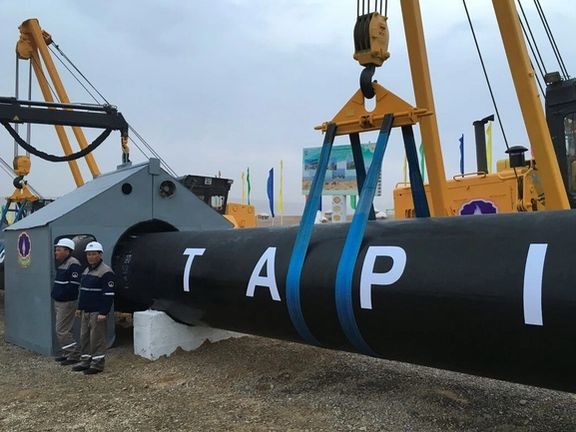
A Saudi company has expressed interest in investing in the TAPI gas pipeline project, Taliban officials said after talks with Turkmenistan’s foreign minister.

Abdul Ghani Baradar Taliban Deputy Prime Minister met Turkmenistan’s Deputy Prime Minister and Foreign Minister Rashid Meredov in Herat on Sunday to discuss the Turkmenistan–Afghanistan–Pakistan–India (TAPI) pipeline, related energy projects, rail links and electricity cooperation.

Baradar said the Saudi firm Delta International was interested in investing in gas purchases under the TAPI project, expanding capacity at Turkmenistan’s major gas fields and developing the pipeline route from Guzara district in Herat to Spin Boldak in Kandahar, with a further extension to the Indian border.

He added that the company was also interested in investing in the construction of a large gas hub at Pakistan’s Gwadar port.

The meeting was attended by Taliban ministers for mines and petroleum and for energy and water, as well as Turkmenistan’s transport and railways minister and the head of the state gas company Turkmengaz.

Baradar urged Turkmenistan to clarify its position on the Torghundi–Herat railway project, saying Kazakhstan had also shown strong interest in implementing it.

According to Taliban officials, Meredov said Turkmenistan was fully prepared to invest in the railway and that construction had already begun in Torghundi.

He also said the TAPI pipeline would be extended to the centre of Herat province by the end of the current year and noted that electricity would be supplied to Afghanistan through five routes.

Most Viewed

Taliban Ignore Afghanistan’s Interests By Backing Militants, Says Pakistan Army Chief
1

Taliban Ignore Afghanistan’s Interests By Backing Militants, Says Pakistan Army Chief

2

United Nations Delivers Education Kits To Four Million Afghan Children

3

Taliban Renews Call For China To Launch Aynak Copper Mine

4

Taliban Leaders In South-West Hold Security Meet In Kandahar

5

Afghan Deportations Is Strategic Mistake, Says European Parliament Member

•
•
•

More Stories

2 In 3 Afghan Provinces Hit By Drought, Says UN

Feb 1, 2026, 15:47 GMT+0

More than two-thirds of Afghanistan’s provinces are facing drought and water shortages, with about 16 million people in urgent need of safe drinking water, the UN Office for the Coordination of Humanitarian Affairs said.

OCHA said demand for clean water, sanitation and hygiene services has risen sharply due to mass returns of Afghan migrants from neighbouring countries, prolonged drought, disease outbreaks and repeated floods and earthquakes.

A nationwide assessment found that about 85% of households have experienced at least one environmental hazard. The proportion of families needing safe drinking water and sanitation rose from 26 percent in 2024 to 37 percent in 2025, the agency said.

OCHA highlighted a widening gap between urban and rural areas in access to clean water. While infrastructure is improving in cities, rural households face barriers including high costs and long distances to safe water sources.

Female-headed households are among those most in need, and only 41 percent of households with a member with disabilities have access to adequate sanitation, according to the assessment.

Water sources in rural Afghanistan are drying up because of worsening drought, reducing incomes for agriculture-dependent households by 13 percent and increasing their debt levels by 30 percent, OCHA said.

The agency also pointed to cultural restrictions on female staff that have disrupted programme implementation and limited safe access to clean water for vulnerable women and girls.

Many women travel long distances at night to collect water, exposing them to risks, while adolescent girls are dropping out of school due to a lack of sanitation facilities, the report said.

OCHA said the overlap of drought and disease risks has intensified the humanitarian crisis in areas hosting returnees, including Herat, Nangarhar, Nimroz and Khost.

UN assessments show at least 18 Afghan provinces are classified as being at very high risk because of climate vulnerability.

OCHA is seeking $163 million in funding to rehabilitate water systems, support returning migrants, respond to disease outbreaks, prepare for winter and stockpile essential supplies.

Afghan Taliban Supports Terrorists, Says Pakistan Religious Leader

Feb 1, 2026, 14:12 GMT+0

The head of the Pakistan Ulema Council accused the Taliban authorities in Afghanistan of supporting militants and failing to act against armed groups targeting Pakistan.

Tahir Mehmood Ashrafi said enemies of Pakistan were present in Afghanistan and plotting to destabilise the country, urging the Muslim world and the international community to take Islamabad’s concerns seriously.

He said the Pakistani public and armed forces would stand together against what he described as a wave of terrorism and would defeat it again, as in the past.

Ashrafi made the remarks in response to a series of militant attacks attributed to the Baloch Liberation Army.

The group carried out a series of coordinated assaults across multiple cities in Pakistan’s Balochistan province on Saturday, according to officials and media reports.

Ashrafi said the Taliban’s interim administration in Afghanistan was supporting militants instead of eliminating them and had taken no effective action. He called the situation unacceptable and urged what he described as responsible figures in Afghanistan to address the issue.

He also said the people of Pakistan stood alongside their armed forces and that both the Pakistani Taliban and the Baloch Liberation Army would be defeated.

The violence followed an earlier attack on the Jaffar Express train on the Quetta–Peshawar route in March 2025 and is considered one of the largest actions by Baloch separatists in recent years.

According to Agence France-Presse, armed attackers using firearms and hand grenades carried out nearly a dozen coordinated assaults early Saturday in southern Pakistan, targeting a high-security prison, police posts and paramilitary facilities.

Cannabis, Opium Still Dominate Drug Use Among Afghan Men, Says UN

Feb 1, 2026, 12:41 GMT+0

Cannabis and opium remain the most widely used drugs among men in Afghanistan, the United Nations Office on Drugs and Crime said in its latest assessment.

According to the report, cannabis accounts for 46 percent of drug use among Afghan men, followed by opium at 19 percent, K-tablets at 11 percent and methamphetamine, also known as crystal meth, at 7 percent.

In the report published Sunday, UNODC said patterns of drug use in Afghanistan continue to be dominated by traditional narcotics, while the use of synthetic drugs and the misuse of opioid medicines are also increasing.

The findings form the third and final volume of the National Drug Use Survey in Afghanistan, prepared by UNODC with support from the United Nations Development Programme.

The report said that for many users, the cost of obtaining drugs exceeds their daily income.

The assessment comes as the Taliban have repeatedly claimed they have eliminated drug cultivation, production and trafficking in Afghanistan and reduced them to near zero. The United Nations has previously confirmed a decline in drug cultivation but said the use of synthetic drugs has increased by about 50 percent.

In April 2022, the Taliban announced a ban on the cultivation, purchase and sale of poppy under a decree attributed to their leader, Hibatullah Akhundzada.

UN Flags Gaps in Treatment Services

While Taliban authorities regularly report on efforts to treat people with drug addiction, the United Nations says serious gaps remain in the availability, access, quality and gender coverage of treatment services.

UNODC said nearly two-thirds of treatment centres in Afghanistan provide services only to men. Just 17.1 percent of centres are dedicated to women, and in the 32 provinces surveyed, only slightly more than one-third offer services for women.

The United Nations has previously estimated there are about 4 million drug users in Afghanistan, including women, who make up around 35 percent of users.

The report also pointed to shortages of trained specialists and infrastructure for treating people with drug addiction.

The Taliban periodically publish figures saying addicts have been discharged from treatment centres after recovery.

The UN report said many people struggling with addiction link continued drug use to poverty, unemployment and severe economic pressure.

The Taliban have banned drug cultivation and trafficking and have rounded up people with addiction. Reports indicate that many resume drug use after leaving treatment centres.

According to reports, some people have been forced into treatment without consent or psychological counselling, with allegations of harsh conditions, food deprivation and a lack of specialised services. Taliban officials have not yet commented on the latest UN findings.

Taliban Minister Defends Panel Code, Says No One Can Block Rule

Feb 1, 2026, 10:36 GMT+0

A Taliban minister said the group’s administration would implement its policies without obstruction and that no one could prevent it from doing so.

Neda Mohammad Nadeem, the Taliban’s minister of higher education, made the remarks while addressing a graduation ceremony for students at a religious school in Paktia province. He said all laws and rulings issued by the Taliban administration are “religious and Islamic”.

His comments come amid widespread reactions to the Taliban’s new penal code.

Critics say the code is among the group’s latest efforts to institutionalise its preferred judicial system, which they warn could expand discrimination, repression and human rights violations in Afghanistan.

Nadeem, however, said the code is based on “Islamic law and Quranic rulings”. He added that anyone who questions the code could ask a mosque imam whether the law is rooted in Hanafi jurisprudence and the Quran.

Under the penal code, the Taliban describe their opponents as “rebels” and provide for the death penalty in such cases. The code also includes references to “slaves” in several provisions, which critics say amounts to recognition of slavery under Taliban rule. Articles 4 and 15 of the code address issues related to slavery and associated rights.

Drug Smuggling From Afghanistan To Tajikistan Continues, Says Taliban

Feb 1, 2026, 09:57 GMT+0

Taliban spokesperson Zabihullah Mujahid said that despite efforts to curb narcotics trafficking, drugs are still being smuggled from Afghanistan into Tajikistan.

He said the long shared border between the two countries allows traffickers to “sometimes take advantage”.

Tajik border authorities said on January 30 that they had clashed with a group of armed individuals along the border with Afghanistan. Tajik officials said the men were smugglers and that three of them were killed in the confrontation.

Speaking to Afghanistan’s state-run Radio and Television, which is under Taliban control, Mujahid said the Taliban is trying to address border issues and prevent drug trafficking.

He added that the Taliban authorities and Tajikistan are “coordinated” and that smuggling would be prevented in the future.

Tajikistan’s State Committee for National Security said several weapons were seized from the smugglers in the recent clash, along with four bags containing 73 packages of hashish and opium.