Taliban Declares Cryptocurrency Banned in Badghis

A resident of Badghis province shared a video with Afghanistan International, capturing a Taliban herald denouncing cryptocurrency as un-Islamic.

A resident of Badghis province shared a video with Afghanistan International, capturing a Taliban herald denouncing cryptocurrency as un-Islamic.
The herald in the video asserts that cryptocurrency is considered gambling and haram (forbidden) according to Islam.
The footage shows two Taliban members on a motorbike, using a loudspeaker to campaign against the use of digital currencies.
The individual who shared the video mentioned it was filmed in the Sang Atash district of Badghis province.
Additionally, in a separate audio message, Abdul Samad Jawid, the Taliban-appointed governor of Badghis, announced a ban on digital and online currency transactions within the province.
He emphasised that individuals defying this ban would face legal repercussions.
The Taliban-led Central Bank had previously prohibited online trading in foreign currencies across Afghanistan.
The economic downturn following the Taliban's takeover in August 2021 has prompted many Afghans to explore online trading and digital currencies as a means to preserve their assets.
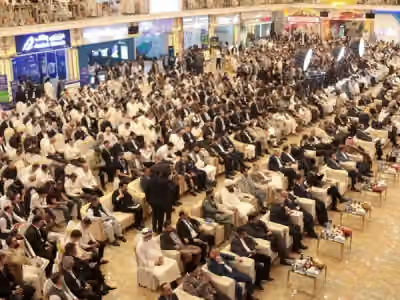

At the end of the second day of the Doha conference on Afghanistan, UN Secretary-General Antonio Guterres stated in Qatar that the UN aims for a peaceful Afghanistan.
He stressed on the importance of Afghanistan's role in the international community.
Guterres revealed that he received a letter from the Taliban with "unacceptable" demands before the Doha meeting. This letter sought to limit the UN's engagement with other Afghan representatives.
He noted the Taliban's failure to address global concerns yet expecting recognition. This stance, according to Guterres, has stalled resolution of the Afghan situation. He highlighted the deteriorating conditions for Afghan women, unresolved terrorism, and the lack of an inclusive government.
He emphasised that Afghanistan must not become a terrorist haven and called for a government that represents all ethnicities.
Guterres also said the voices of all Afghan society segments, beyond the Taliban, need to be heard. He regretted Russia's absence from an Afghan civil society meeting and disagreed with Moscow's position.
Describing the second Doha meeting as beneficial, Guterres noted that the Taliban's absence didn't detract from its success. He praised the constructive nature of discussions with special representatives, which reached a consensus on major issues.
Guterres announced plans for a third Doha meeting on Afghanistan and immediate consultations for a new UN representative. He proposed that this representative should provide a lasting framework for Afghan issues.

Pakistani Newspaper, The Express Tribune, quoted sources and reported that the country supports the appointment of a UN special envoy for Afghanistan at the Doha meeting.
A source said that Pakistan does not consider itself obliged to defend the positions of the Taliban.
The two-day Doha meeting for Afghanistan has been initiated with the participation of the UN Secretary-General and special representatives of more than 20 countries to find a solution for the critical situation in Afghanistan and the world's interaction with the Taliban.
Asif Durrani, Pakistan's special envoy for Afghanistan affairs, led the Pakistani delegation in Doha.
The Express Tribune newspaper wrote that despite previous concerns of Pakistan regarding the appointment of a UN special envoy, now the country backs the proposal.
Islamabad has said that the UN special envoy should be a "Muslim, experienced diplomat, and from the region".
Pakistan's change of position regarding the UN special envoy is a direct contradiction to the Taliban's position, which has repeatedly expressed its opposition to the appointment of the Secretary-General's special representative.
Quoting a Pakistani official, this newspaper wrote that “this was because Islamabad was no longer advocating the Taliban’s case.”
If officially confirmed, it seems that Pakistan’s support for the appointment of a special representative reflects the country’s continued dissatisfaction with the Afghan Taliban for supporting the militants of the Tehreek-e-Taliban Pakistan, which has claimed responsibility for violent attacks on Pakistani military forces in the past year.

On the first day of the Doha meeting, a group of Afghan protestors in the city of Calgary in Canada gathered to protest against the invitation of the Taliban to the meeting and the United Nations' focus on interaction with the Taliban.
One of the organisers of this gathering said that the world cannot change the policies of the Taliban through interaction.
These demonstrators voiced their opposition to human rights violations, gender apartheid imposed by the Taliban in Afghanistan, and the targeted attacks on the Hazara community.
Sediqullah Tawhidi, one of the organisers of the protest, told Afghanistan International that despite the interaction of several countries with the Taliban, the group has not changed its policies.
He highlighted numerous instances of human rights violations in Afghanistan, specifically emphasising on the widespread denial of women's social and economic rights by the Taliban, persisting despite international appeals.
"Why does the world interact with a terrorist group? Diplomacy and interaction will not lead to the group’s alteration of policies. The world should support the efforts of the Afghan people to overthrow the Taliban," he said.
The United Nations invited the Taliban to participate in the Doha meeting, however, the group declined to attend, citing the non-acceptance of their demands by the United Nations as the reason for their refusal.
Several nations, including the United States, China, and Russia, have expressed their expectation that diplomatic engagement with the Taliban will prompt a positive shift in the group's behaviour. However, Tawhidi said that the Taliban had two years to change, yet they did not alter their stance.

Sources informed Afghanistan International that the United Nations Security Council will hold a meeting on Afghanistan on February 26.
The UN hopes that the countries participating at the Doha meeting will agree on the special representative until the Security Council meeting.
During this meeting, Antonio Guterres, the Secretary-General of the United Nations, is expected to brief the members of the Security Council on the outcomes of the Doha meeting. Additionally, he will introduce the special envoy appointed for the matter.
The official date for this meeting had not been formally disclosed by the Security Council. Aref Yaqubi, a correspondent for Afghanistan International quoting sources from the Doha Meeting, said that the meeting is likely to take place on February 26.
The appointment of a special representative has become a contentious issue at the Doha meeting. China, Russia, and Iran express disagreement with the proposal to appoint a new representative for Afghanistan. Similarly, the Taliban has voiced opposition to the appointment of a special representative.
The United Nations had previously appointed Feridun Sinirlioğlu as a special coordinator to review the situation in Afghanistan and to present proposals to the Security Council.
Afghanistan International’s reporter said that the UN if deemed necessary, can appoint a representative for Afghanistan without the agreement of the members of the Security Council.
Due to conflicting perspectives among the permanent members, the Security Council has many differences of opinion regarding the approach towards Afghanistan and the Taliban.
China and Russia have generally supported interaction with the Taliban and not isolating the group, while Western countries have prioritised the issue of human rights, especially women's rights, in their engagement with the Taliban.
Russia and China agree with the United States and Europe on the concerns raised by Western countries regarding the presence of terrorist groups in Afghanistan and the importance of upholding women's rights. They have jointly called upon the Taliban to take concrete action in response to these demands.

The Afghanistan Freedom Front (AFF) reported on Sunday that in two separate attacks on Taliban outposts, seven Taliban fighters had been killed, and four others were wounded in Kabul.
The AFF said that these attacks took place at Gol Sorekh roundabout and Panjshir Watt area.
On X social media platform, the Afghanistan Freedom Front (AFF) reported that the Taliban targeted multiple passenger cars at the Gol Sorekh checkpoint last week and engaged in harassment of women and girls under the guise of a security inspection.
Furthermore, the front stated that in another incident at the Panjshir Watt checkpoint, the Taliban opened fire at a car carrying several young people from Panjshir province last week, resulting in casualties.
This marks the third assault by the AFF on Taliban outposts in Kabul within the past three days.