• العربية
  • پښتو
  • فارسی
Brand
  • Afghanistan
  • Sport
  • Markets
  • Afghanistan
  • Sport
  • Markets
  • Theme
  • Language
    • العربية
    • پښتو
    • فارسی
  • Afghanistan
  • Sport
  • Markets
All rights reserved for Volant Media UK Limited
volant media logo

UN Security Council To Hold Meeting On Afghanistan, Sources Tell Afghanistan International
Feb 19, 2024, 10:37 GMT+0

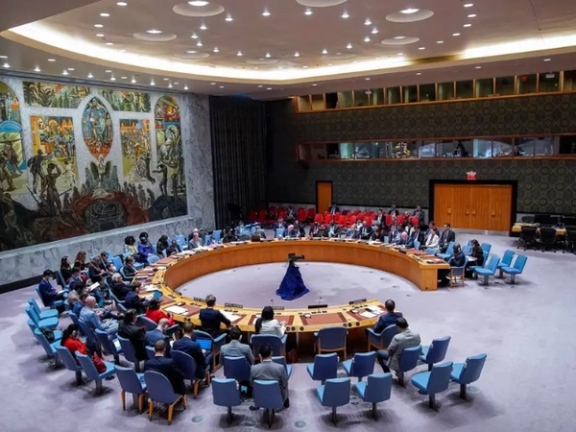
Sources informed Afghanistan International that the United Nations Security Council will hold a meeting on Afghanistan on February 26.

The UN hopes that the countries participating at the Doha meeting will agree on the special representative until the Security Council meeting.

During this meeting, Antonio Guterres, the Secretary-General of the United Nations, is expected to brief the members of the Security Council on the outcomes of the Doha meeting. Additionally, he will introduce the special envoy appointed for the matter.

The official date for this meeting had not been formally disclosed by the Security Council. Aref Yaqubi, a correspondent for Afghanistan International quoting sources from the Doha Meeting, said that the meeting is likely to take place on February 26.

The appointment of a special representative has become a contentious issue at the Doha meeting. China, Russia, and Iran express disagreement with the proposal to appoint a new representative for Afghanistan. Similarly, the Taliban has voiced opposition to the appointment of a special representative.

The United Nations had previously appointed Feridun Sinirlioğlu as a special coordinator to review the situation in Afghanistan and to present proposals to the Security Council.

Afghanistan International’s reporter said that the UN if deemed necessary, can appoint a representative for Afghanistan without the agreement of the members of the Security Council.

Due to conflicting perspectives among the permanent members, the Security Council has many differences of opinion regarding the approach towards Afghanistan and the Taliban.

China and Russia have generally supported interaction with the Taliban and not isolating the group, while Western countries have prioritised the issue of human rights, especially women's rights, in their engagement with the Taliban.

Russia and China agree with the United States and Europe on the concerns raised by Western countries regarding the presence of terrorist groups in Afghanistan and the importance of upholding women's rights. They have jointly called upon the Taliban to take concrete action in response to these demands.

Most Viewed

Female Ismaili Entrepreneur Shot Dead In Badakhshan
1

Female Ismaili Entrepreneur Shot Dead In Badakhshan

2

Afghanistan May Not Remain Intact In Future, Says Pakistani Analyst

3

French Parliament Hosts Two-Day Meeting On Afghanistan

4

Taliban Renews Call For China To Launch Aynak Copper Mine

5

Taliban, Iran Working On Surveillance App For Afghan Users, Say Sources

•
•
•

More Stories

7 Taliban Members Killed in AFF Attacks in Kabul

Feb 19, 2024, 09:54 GMT+0

The Afghanistan Freedom Front (AFF) reported on Sunday that in two separate attacks on Taliban outposts, seven Taliban fighters had been killed, and four others were wounded in Kabul.

The AFF said that these attacks took place at Gol Sorekh roundabout and Panjshir Watt area.

On X social media platform, the Afghanistan Freedom Front (AFF) reported that the Taliban targeted multiple passenger cars at the Gol Sorekh checkpoint last week and engaged in harassment of women and girls under the guise of a security inspection.

Furthermore, the front stated that in another incident at the Panjshir Watt checkpoint, the Taliban opened fire at a car carrying several young people from Panjshir province last week, resulting in casualties.

This marks the third assault by the AFF on Taliban outposts in Kabul within the past three days.

Women's Rights’ Advocates Mahbouba Seraj, Shahgul Rezai to Attend Doha Conference

Feb 17, 2024, 16:22 GMT+0

According to Afghanistan International's correspondent in Doha, women's rights activists Mahbouba Seraj and Shahgul Rezai have been extended invitations to participate in the Doha conference.

As of now, detailed information regarding the full roster of civil society members expected to attend the Doha conference remains undisclosed.

The precise number of representatives from Afghan civil society set to participate in the conference is yet to be determined. Nonetheless, it has been reported that women will comprise half of these civil society delegates.

The conference, convened by Antonio Guterres, the Secretary-General of the United Nations, is scheduled for February 18 and 19. It aims to gather representatives from various countries to discuss issues related to Afghanistan.

The Taliban has stipulated certain conditions for its attendance at the conference. The Foreign Ministry of the Taliban previously declared that Amir Khan Muttaqi would only attend the Doha conference if the group's conditions were met.

Kyrgyzstan's President Highlights Threat Of Terrorist Alliances In Afghanistan

Feb 17, 2024, 15:07 GMT+0

Kyrgyzstan's President Sadyr Japarov has raised concerns about the presence and potential alliances among over 20 terrorist organisations in Afghanistan, with ISIS being identified as the most prominent and hazardous.

During the sixth Afghanistan security meeting held in Bishkek, Japarov highlighted the possibility of these groups, despite their differences, forming coalitions that could pose significant threats.

The meeting, attended by senior security officials from various regional countries, served as a platform for Japarov to express his worries about the complex security situation in Afghanistan. He emphasised the risk of factions opposing the Taliban potentially joining forces with terrorist groups to seize control of the country.

Officials from Iran, Russia, China, India, Pakistan, Tajikistan, Kyrgyzstan, Kazakhstan, Uzbekistan, and Turkmenistan were present at this crucial gathering.

Japarov pointed out that the current state of affairs in Afghanistan should be viewed as a warning sign for Central Asia, with the potential for terrorist groups to recruit young individuals from across the Asian continent.

Adding to the discussion, Nikolay Patrushev, the Secretary of the Russian Security Council, noted that Afghanistan is currently home to 20 terrorist organisations, which collectively include over 23,000 militants, all operating under the Taliban's rule.

India Calls On Taliban To Block Activities Of Terror Outfits In Afghanistan

Feb 17, 2024, 13:38 GMT+0

An Indian security official has urged the Taliban to prevent Lashkar-e-Taiba and Jaish-e-Mohammed from operating within Afghanistan.

Vikram Misri, India's Deputy National Security Advisor, at a regional security meeting in Bishkek, advocated that the Taliban should deny these organisations the opportunity to train and establish sanctuaries in Afghanistan.

"News18," an Indian news platform, reported that Misri, during the regional national security advisors' meeting in Bishkek, stressed on the necessity for the Taliban to disallow terrorists, particularly those affiliated with Lashkar-e-Taiba and Jaish-e-Mohammed, from maintaining training sites and safe havens within Afghanistan.

Lashkar-e-Taiba and Jaish-e-Mohammed, identified as Pakistani religious factions, are labelled as terrorist organisations by India. Lashkar-e-Taiba has been implicated by India in numerous fatal assaults on its soil, notably the 2001 attack on the Indian Parliament and the 2008 Mumbai Taj Hotel attack.

These entities strive for the secession of Kashmir from India and are recognised as "terrorist" organisations by various Western nations, including the United States.

Misri issued this plea during the regional national security advisors' assembly on Friday in Bishkek, the capital of Kyrgyzstan.

He underscored India's enduring and future role as a pivotal player in Afghanistan, advocating for a "consensus approach" to address the Afghan predicament.

Representatives from Iran, Russia, China, India, Pakistan, Tajikistan, Kyrgyzstan, Kazakhstan, Uzbekistan, and Turkmenistan participated in the conference.

Pakistan Rejects Senior Taliban Official’s Statement On Durand Line, Calls It Fanciful

Feb 17, 2024, 11:40 GMT+0

Pakistan’s foreign ministry has reacted to the comments made by Abbas Stanekzai, the Taliban's Deputy Foreign Minister, regarding the non-recognition of the border between Afghanistan and Pakistan as "self serving and fanciful.”

The ministry urged the Taliban to address Pakistan's security concerns instead of focusing on this issue.

In a statement released on Friday, the Foreign Ministry of Pakistan stated, "Any self-serving and fanciful claims regarding the legality and sanctity of the Pak-Afghan border cannot change the facts of geography, history and international law."

Previously, Stanekzai had stated at a conference commemorating the anniversary of the former Soviet army's withdrawal from Afghanistan in Logar that internal disputes among Afghans during the reign of Ahmad Shah Durrani's descendants led to the British invasion of Afghanistan.

Stanekzai also mentioned that as a result of these internal conflicts, Britain divided half of Afghanistan by drawing the "imaginary Durand Line," and now Pakistan is "unjustly" expelling Afghan migrants from there.

He emphasised, "We have never recognised the Durand Line in our lifetime, and we do not recognise it."

Reacting to the Taliban’s Deputy Foreign Minister's remarks, the Foreign Ministry of Pakistan advised the group to focus on the real security concerns of Pakistan instead of "divert[ing] public attention by such unfortunate public pronouncements.” The ministry stated its commitment to facilitating the regulated movement of people and commercial goods across the border, based on intergovernmental standards.

The dispute over the border between the two countries is not a new issue. Almost all Afghan governments in recent decades have not recognised this border. During Hamid Karzai's presidency, government agencies were instructed to refer to it as the "imaginary Durand Line," but Pakistan asserts that this line is the official border between the two countries, recognised internationally.