Islamic Republic Executes Four Afghan Prisoners, Human Rights Group Reports

The human rights organisation Haalvsh has reported that on early Thursday morning, four Afghan prisoners were executed at Vakilabad Prison in Mashhad.

The human rights organisation Haalvsh has reported that on early Thursday morning, four Afghan prisoners were executed at Vakilabad Prison in Mashhad.
According to Haalvsh, the prisoners were arrested in 2019 on charges related to drug trafficking and were later sentenced to death by a court.
The executed individuals have been identified by the organisation as Zaman Taheri, Salam Taheri, Gholam Qader Samani, and Ebrahim Norzehi. Notably, Zaman Taheri and Salam Taheri were brothers.
Sources referenced by Haalvsh indicated that the prisoners were moved from a general ward dealing with drug crimes to solitary confinement in Vakilabad Prison on Wednesday, with their executions carried out at dawn the following day.
Additional details regarding these individuals have not been disclosed.
As of now, Iranian officials have not commented on the executions.
Historically, the Islamic Republic has executed several Afghan prisoners for drug-related offences and other crimes.
Haalvsh also reported last Monday that another Afghan prisoner was executed at the same facility for drug-related offences.
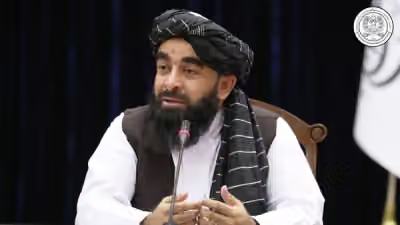

Abdul Rahman Sasanian, an Iranian military commander, announced that Iranian army forces are currently involved in sealing the border strip between Iran and Afghanistan.
Sasanian emphasised that all necessary infrastructure for this project has been established at various border points between the two countries.
On Friday, the Islamic Republic News Agency (IRNA) reported that Sasanian called the sealing of the border strip between Iran and Afghanistan as one of Iran's most significant projects. According to statements from this Iranian official, the project is being executed by engineers from Iran’s Army’s Ground Forces.
IRNA's report outlined that this project extends from the Dogharon border to Khaf city, with the project including a four-metre-high wall and fencing on its upper part.
In February 2024, Kioumars Heydari, the commander of the Iranian Army’s Ground Forces, had stated that the presence of the army at the borders is not indicative of insecurity; rather, it signifies military preparedness.
Previously, Zabihullah Mujahid, the Taliban spokesperson, had remarked that the sealing of the Afghanistan-Iran border should be achieved through agreement.
Since the Taliban took over power in 2021, there have been multiple clashes between the group's forces and Iranian border guards.

Zabihullah Mujahid, the Taliban spokesperson, confirmed the death of Mohammad Omar Jan Akhundzada, a member of the Taliban's oversight office.
According to sources, Akhundzada had travelled to a village in Quetta, Pakistan, to visit his family during the Eid al-Fitr days, where he was killed by unknown individuals.
Mujahid expressed condolences on Akhundzada's death in a note posted on X social media platform on Friday.
The Taliban spokesperson and other officials of the group have not provided any explanation regarding how he was killed or by whom.
The Taliban have condemned the killing of Omar Jan Akhundzada and labelled his death a "big crime”.
So far, no individual or group has claimed responsibility for his killing.
Radio Television Afghanistan (RTA), under Taliban control, reported that Akhundzada was a member of the Taliban's oversight office and a teacher at a jihadist school in Kandahar.
However, sources from Kandahar told Afghanistan International that he was an advisor to Hibatullah Akhundzada, leader of the group. According to sources, he led a Taliban jihadist school in Kandahar.
Sources said that this Taliban official was killed in Quetta by unidentified individuals on Thursday evening.

Ishaq Dar, Pakistan's Foreign Minister, extended an invitation to Amir Khan Muttaqi, the Taliban's Foreign Minister, to visit Islamabad.
Dar mentioned that Muttaqi congratulated him on his appointment as the foreign minister during a phone call.
Since the Taliban's takeover of power in Afghanistan in 2021, Islamabad has hosted Taliban officials on numerous occasions. Pakistani officials have also made several visits to Kabul for discussions on various issues.
Although Islamabad has not officially recognised the Taliban as a legitimate government, it has expressed support for the group's inclusion in international organisations such as the United Nations.
Initially, senior Pakistani officials displayed optimism about the Taliban's broad victory following the collapse of the former Afghan government. However, this optimism has since transformed into harsh criticism of the Taliban.
Senior Pakistani officials hold the Taliban responsible for the surge in attacks by insurgent groups, particularly the Tehreek-e-Taliban Pakistan.
Islamabad has consistently urged the Taliban not to permit insurgents to operate from Afghan territory against Pakistan. However, the Taliban responded to Islamabad's criticisms by alleging that Pakistan seeks to deflect responsibility for its security lapses onto Kabul.

The third session of the China-Taliban Liaison Mechanism took place in Beijing.
During this meeting, the head of the Asian Department of the Chinese Ministry of Foreign Affairs informed the Taliban delegation that China does not intend to interfere in Afghan affairs, but hopes the Taliban will address some of the reasonable concerns of the global community regarding the formation of an inclusive government.
A joint delegation from the Taliban's ministries of foreign affairs, commerce, mines, refugees, and disaster management engaged in discussions with representatives of the Chinese Ministry of Foreign Affairs.
The Chinese Foreign Ministry announced on the WeChat social media platform that this session, with the participation of Liu Jinsong, Director-General of the Department of Asian Affairs of the Foreign Ministry, and Taliban representatives, took place on Tuesday in Beijing.
The ministry expressed China's expectation for the main countries responsible for the current situation in Afghanistan to fulfil their responsibilities earnestly and return Afghanistan’s frozen funds to the Afghan people.
Discussions also encompassed trade relations, economic cooperation, and humanitarian assistance.
According to information provided by Chinese representatives at the meeting, trade between China and the Taliban amounted to $1.33 billion in the past year.
The Taliban's Ministry of Foreign Affairs, in a press release concerning this meeting, said that discussions encompassed the mechanisms for economic reconstruction in Afghanistan, enhancing trade, capacity building, and fostering cooperation in the mining and trade sectors.
The Taliban reported that China has expressed willingness to offer assistance of 100 million yuan (approximately $13 million) for the resettlement of displaced Afghans.
According to this press release, discussions also touched upon the potential opening of the Hairatan-Delaram corridor and the commencement of mining operations in Logar province.
Although China has not officially recognised the Taliban government as the legitimate authority in Afghanistan, it has accepted the group's ambassador.

Vadent Patel, the Deputy Spokesperson for the US State Department, refrained from commenting on reports of the US using Pakistani airbases to attack terrorist groups in Afghanistan and requested clarification from the Pentagon on the matter.
The Taliban has claimed that American drones enter Afghanistan from neighbouring countries' airspace.
On Wednesday, Sher Afzal Marwat, a member of the Pakistani National Assembly, stated that Pakistan has handed over two of its airbases in Balochistan, near the borders with Afghanistan and Iran, to the United States.
Patel, on Thursday, in response to a question from Aref Yaqubi, a reporter of Afghanistan International, regarding these reports and security cooperation between Pakistan and the US, stated that he would defer this matter to the Defence Department for an explanation.
In recent weeks, unmanned aircraft have been spotted in the skies of various Afghan cities, including Kandahar. These drones are part of United States’ efforts to monitor terrorist groups in Afghanistan and conduct targeted attacks against them.
While not explicitly naming Pakistan, the Taliban has accused neighbouring countries of Afghanistan of allowing these drones to traverse their airspace.
According to the EurAsian Times, rumours and reports of the US using Pakistani bases escalated after General McKenzie, the former CENTCOM commander, told a US Senate committee regarding the necessity for the Biden administration to engage with Afghanistan's neigh-boring countries to prevent quasi-militants of ISIS and Al-Qaeda from operating outside Afghanistan.
Pakistan, among Afghanistan's neighbours, maintains close military ties with the US and has previously granted permission for the US to utilise its territory against al-Qaeda.
The issue of handing over Pakistani airbases to the US has been contentious in recent years within Pakistan. Following the US attack on Afghanistan, Pakistan allowed its airbases, including the Shamsi Airfield in Balochistan, to be used by the US forces in their fight against the Taliban. However, the US later evacuated the base.
With the withdrawal of US forces from Afghanistan and the conclusion of their military presence in the country, the debate over the United States' use of Pakistani airbases had been raised again. During this time, Imran Khan's government has refrained from granting access to these bases to the US.