Taliban’s Education Minister In Russia For Ministerial Meeting
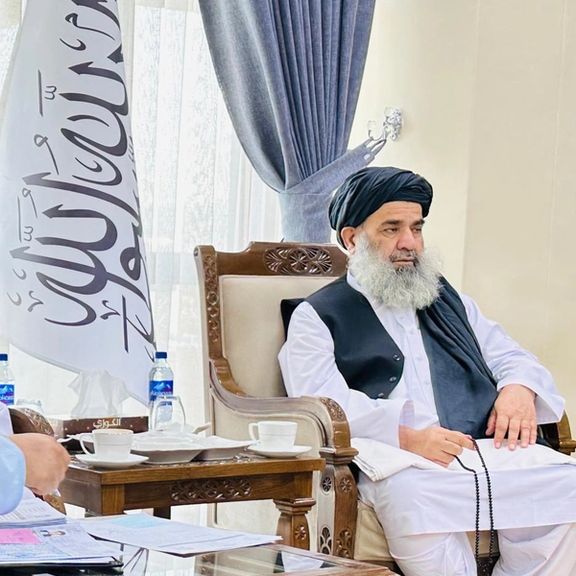
Habibullah Agha, the Taliban's Minister of Education, traveled to Russia on Saturday, to attend the Education Ministers' meeting in Kazan.
Habibullah Agha, the Taliban's Minister of Education, traveled to Russia on Saturday, to attend the Education Ministers' meeting in Kazan.
The Taliban's Ministry of Education stated that Habibullah Agha will speak at the meeting about the opportunities and challenges of education in Afghanistan.
According to the statement from the Taliban's Ministry of Education, he will also hold discussions with education ministers from several countries.
The Taliban's Minister of Education is traveling to Russia to discuss the state of education in Afghanistan even though the group has closed schools to girls above the sixth grade.

Mumtaz Zahra Baloch, the spokesperson for Pakistan's Ministry of Foreign Affairs, has said that regional consultations help ensure that Afghanistan does not become a hub for terrorist activities.
The meeting of the Regional Contact Group for Afghanistan will be held on Saturday with representatives from Iran, Pakistan, China, and Russia in Tehran.
At a press conference in Islamabad on Friday, Baloch said that the Contact Group meeting is an important step towards close cooperation among Afghanistan's neighbours to ensure peace, security, and stability in this country.
According to her, Asif Durrani, Pakistan's Special Representative for Afghanistan, will attend the Contact Group meeting in Tehran.
Rasoul Mousavi, General Director of the Iranian Foreign Ministry's West Asia Department, described the Contact Group meeting in Tehran as "a harbinger of peace, stability, and development for Afghanistan and the region through regional cooperation and convergence”.
Mohammad Jawad Mohseni, the head of Tamadon TV, has denied the Taliban Ministry of Justice's accusations that this private media outlet is affiliated with a political party and has usurped government land.
Mohseni stated that the land for Tamadon TV "was purchased from a private owner and is not government-owned”.
He also mentioned that Asif Mohseni, the former head of Harakat e Islami, resigned from the party before Tamadon TV was established in 2005.
Mohseni, the current head of Tamadon TV, is the grandson of Asif Mohseni, the founder of this private media outlet.
In a text published by Tamadon TV on X social media platform, Mohseni is quoted as saying, "The land for Tamadon TV was purchased from a private owner and has a legitimate and legal title deed, and it is not and has never been government property."
The text also requests the Taliban to appoint a committee to review their documents and evidence.
Previously, Barakatullah Rasouli, the spokesperson for the Taliban's Ministry of Justice had stated that "Tamadon TV, Khatam al-Nabieen madrassa, and Khatam al-Nabieen University belong to Harakat e Islami party."
This Taliban official had claimed that the buildings of all these institutions were constructed on usurped government lands.
However, Mohseni said that the Khatam al-Nabieen University building is rented and that the land for the Khatam al-Nabieen madrassa was legally acquired by Asif Mohseni during the previous government.
Previously, the Taliban had shut down two private TV channels, "Noor" and "Barya”.
Reports indicate that these two private media outlets were shut down due to their affiliations with the Jamiat-e Islami Party and the Hezb-e Islami Party of Afghanistan.
The Taliban Ministry of Justice has announced that political party activities are prohibited in Afghanistan.
The Afghanistan Journalists Centre described the Taliban's action to close Tamadon TV as an instance of suppressing media and freedom of expression in Afghanistan.
The Taliban’s Ministry of Foreign Affairs announced on Friday that Amir Khan Muttaqi, the group's Foreign Minister, met with Roza Otunbayeva, the UN Secretary-General's Special Representative, in Kabul.
The statement quoted Otunbayeva as saying, "Work is ongoing to prepare the agenda for the third Doha meeting."
The Taliban’s Ministry of Foreign Affairs' statement further quoted the UNAMA chief as stating, "Efforts will be made to prepare an agenda that is acceptable to all parties."
No details about the agenda of the third Doha meeting were provided in the statement.
Abdul Qahar Balkhi, the spokesperson for the Taliban’s Ministry of Foreign Affairs, wrote in a statement shared on social media platform X on Saturday that Muttaqi discussed the details of the third Doha meeting and necessary coordination with the UN envoy.
The UNAMA chief expressed her desire to hear the Taliban's views on the final draft of the third Doha meeting's agenda. She added that after the agenda is finalised, the UN will send official invitations to all participants.
The statement also quoted Muttaqi as saying that it is important to prepare an agenda that is acceptable to all parties.
Muttaqi emphasised that the Taliban have shared their views on the third Doha meeting with all parties and will work closely with everyone on this matter.
Manan Omari, the Taliban's Minister of Labour and Social Affairs, stated that the group's relationship with Moscow is based on mutual interests and that they have no other expectations from Russia.
On Wednesday, Omari traveled to Russia to participate in the 27th Saint Petersburg Economic Forum.
On the sidelines of the forum, a Sputnik Russia journalist asked Omari, "What do the Taliban want or hope from Moscow?"
In response, he said, "Interests are always mutual. Both parties should consider their own interests and proceed based on those interests."
These remarks follow the Russian President's earlier statement that establishing relations with the Taliban is a necessity.
Zamir Kabulov, Russia's special envoy for Afghanistan, recently mentioned that the possibility of Russia recognising the Taliban government is more likely than ever.
However, on Thursday, the Russian Deputy Foreign Minister stated that the Taliban must form an inclusive government and fulfil their promises.
Enayatullah Sahar, Taliban’s Director of Education in Bamiyan, has instructed district education departments to collect and remove "Shia Jurisprudence" textbooks from "schools where students follow both Hanafi and Jafari jurisprudence”.
Sahar stated that a new book is being prepared and will be distributed to teach both forms of jurisprudence.
In an official letter addressed to the education departments of seven districts in Bamiyan, it has not been specified which jurisprudence textbooks should be collected. However, sources from Bamiyan told Afghanistan International that the process of collecting Shia jurisprudence books from schools began in recent days.
Similarly, sources from Balkh province in northern Afghanistan reported that the process of collecting Jafari jurisprudence educational books from schools in parts of this province has also started.
Previously, the Taliban halted the teaching of Jafari jurisprudence in universities and higher education institutions in Afghanistan.
In the past three years, resuming the teaching of Jafari jurisprudence in educational and higher education centres has been one of the main demands of the Shia Ulama Council from the Taliban.
However, in March 2023, the Taliban's Ministry of Higher Education formally rejected the Shia Ulama Council of Afghanistan's request to include Jafari jurisprudence in the educational curriculum.
The Taliban ministry justified its decision in a leadership council meeting resolution, stating that accepting this request would lead other sects in Afghanistan to also demand separate curriculums.