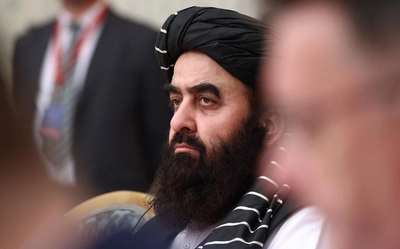
Zabihullah Mujahid, the Taliban spokesperson, made the remarks in response to a meeting of the United Nations Security Council, where several countries voiced concern about militant activity in Taliban-controlled Afghanistan.
Mujahid said Afghanistan is secure and that “no foreign or rogue groups exist” in the country. He claimed that Islamic State (ISIS), which he said had been defeated in Afghanistan, has “unfortunately established bases in our neighbouring countries.”
He described the security concerns raised at the United Nations as “unfounded” and said they stem from the absence of Taliban representation at the UN.
He did not name the neighbouring countries where he alleged Islamic State Khorasan had taken refuge. Taliban officials have previously said Islamic State fighters are based and trained in parts of Pakistan.
At the Security Council session on Wednesday, Alexandre Zouev, a senior UN official, warned that Islamic State Khorasan in Afghanistan remains a serious threat to the region and beyond, a view at odds with the Taliban’s assertion that the group has been contained.
Mike Waltz, the US ambassador to the United Nations, said the Islamic State threat in Afghanistan persists and requires coordinated international action. He added that the threat is expanding beyond Afghanistan to parts of Africa, the Middle East and South Asia.
Pakistan’s representative, Asim Iftikhar Ahmad, told the Council that since the Taliban returned to power, groups including Tehreek-e-Taliban Pakistan and Baloch separatists have gained renewed strength. He said these groups operate freely from Afghan territory and are responsible for major attacks in Pakistan.
Ahmad said Pakistan is on the frontline in the fight against terrorism, has suffered more than 90,000 casualties and endured heavy economic losses.
China’s representative also expressed concern about the presence and activities of militant groups such as al-Qaida, Islamic State and Uyghur militants in Afghanistan, and urged the Taliban to take action.
Referring to an ISIS attack on a Chinese restaurant in Kabul’s Shahr-e-Naw district, China’s envoy said militant activity on Afghan soil must be treated seriously.