Over 4,000 Afghan Migrants Return From Pakistan & Iran

The Taliban’s Ministry of Refugees and Repatriation announced that in the past three days, 4,233 migrants have returned to Afghanistan from Pakistan and Iran.

The Taliban’s Ministry of Refugees and Repatriation announced that in the past three days, 4,233 migrants have returned to Afghanistan from Pakistan and Iran.
On Saturday, July 20, the ministry stated that among these returnees, 729 were from Pakistan and 3,504 from Iran.
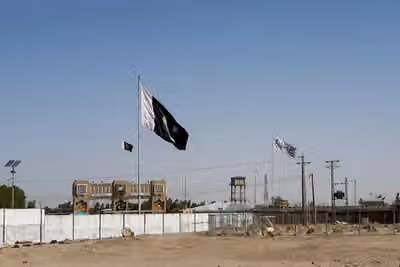
According to the Taliban’s Ministry of Refugees, these migrants returned to Afghanistan through the Torkham, Spin Boldak, Islam Qala, and Pul-e-Abrisham crossings.
The information provided by the Taliban indicates that most of these returnees are Afghan families residing in Iran and Pakistan, including children and women.
While the Taliban’s Ministry of Refugees claims that these migrants returned to Afghanistan voluntarily or under coercion from Pakistan and Iran, Afghan migrants have previously reported to Afghanistan International that they were detained by police in these countries before being forcibly returned.
This comes amid reports that both Pakistan and Iran have intensified the expulsion of undocumented Afghan migrants, with the Taliban Ministry reporting the return of over a thousand Afghan migrants from these countries each week.
Michael George Vickers, the former US Assistant Secretary of Defence, told the commission investigating the US war in Afghanistan that Pakistan cooperated in the fight against al-Qaeda but played a double game when it came to destroying Taliban safe havens.
He emphasised that the Pakistanis played a double game in the fight against the Taliban; part ally and part hidden enemy.
He testified on Friday, July 19, at the first meeting of the commission investigating the US war in Afghanistan.
He stated that the US successfully defeated al-Qaeda and its safe havens in Pakistan with the help of the Pakistani military, but lost the war to the Taliban.
According to him, the main reason for this loss was the US' failure to eliminate Taliban safe havens in Pakistan.
Vickers explained that while the Pakistani military leadership supported the US in destroying al-Qaeda, they viewed the Taliban as a strategic tool to establish a government in Afghanistan that would serve Pakistan's interests.
Vickers also criticised the US counterterrorism strategy in Afghanistan, stating that it was flawed.
He said that the US failed to focus on its primary goal of combating terrorism while trying to build a nation in Afghanistan. He acknowledged that the US acted too late in creating a reliable and effective security force and subsequently wasted significant funds on building "wrong" security forces.
Vickers stated that the US transferred security responsibilities to the Afghan government too late.
In another part of his testimony, Vickers claimed that both Trump and Biden preferred failure over supporting the Afghan government.
According to Vickers, the Afghanistan war was a long conflict that needed to continue with support for the Afghan government.
He added that in the short term, it would have been impossible to win with 150,000 troops alone, but with a few thousand military advisors, support for the Afghan government, and continued air strikes to prevent the Taliban from growing and capturing cities, failure could have been avoided. Instead, he said, they chose to accept failure.
The first meeting of the commission investigating the US war in Afghanistan took place on Friday, July 19, at the US Veterans Administration in Washington.
The meeting was attended by several diplomats, former US and Afghan officials, and researchers, including Nader Nadery and Halima Kazem from Afghanistan.
The commission, comprising 16 commissioners, emphasised that it will engage with all those involved in the Afghanistan war to provide a comprehensive overview and recommendations for future US policy and strategies.
Established by the US Congress in December 2021, the commission is tasked with conducting a thorough review of key US decisions in various areas, including the military, intelligence, foreign aid, and diplomatic involvement in Afghanistan from June 2001 to August 2021.

Mostafa Rezaei, CEO of the Afghanistan Rail Development Consortium, says connecting Kandahar to Chabahar is a priority for the Taliban.
This Iranian official stated that the Chabahar to Milak railway will be operational by mid-next year.
In May 2016, the leaders of the previous Afghan government, India, and Iran signed a trilateral agreement to develop the Chabahar port.
The aim of this agreement was to create a trade and transit corridor among the regional countries.
The Afghanistan Rail Development Consortium consists of several private Iranian companies. Iranian officials have stated that this consortium does not operate under the Iranian government.
In an interview with the IRAF, Rezaei said, "Of course, connecting Kandahar to Chabahar is a top priority for the Taliban, besides this Herat will also be connected with the construction of the Milak to Chabahar railway."
He added that aside from the Afghanistan railway network connecting Uzbekistan and Pakistan, other Afghan railways have been designed to meet standards. Additionally, the Herat to Turkmenistan railway will also be upgraded to meet these standards.
The CEO of the Afghanistan Rail Development Consortium emphasised that the Kandahar to Milak and Chabahar railway will be constructed to standards within Afghan territory and will cover part of Afghanistan's exports, including minerals, dried fruits, and oilseeds to countries other than Iran.
The Chabahar port reduces Afghanistan's dependence on Pakistani ports and facilitates India's access to Afghanistan and Central Asia.
Abdul Ghani Baradar, the Taliban's deputy economic chief, recently said at a meeting in Kabul that expanding regional relations prevents trade dependence on specific countries.
After the relations between the Taliban and Pakistan soured, Mullah Baradar led a Taliban delegation to Tehran and signed agreements.
Additionally, Indian Prime Minister called Chabahar the "corridor of peace and prosperity" and emphasised on its capacity to increase trade and commerce across the region.

Dmitriy Zhirnov, the Russian ambassador in Kabul, said that his country will focus on its interests in removing the Taliban from the list of terrorist organisations.
Zhirnov stated that every country has its own motivations for relations with Afghanistan.
Zamir Kabulov, Russia's special envoy to Afghanistan, had said in June that the proposal to remove the Taliban from the list of banned organisations in Russia had been submitted to Vladimir Putin for a final decision.
Kabulov mentioned that there are still issues concerning the Taliban, and a decision will be made after those are resolved.
The Russian ambassador also stated that cooperation between Moscow and Kabul in supplying oil products has begun.
According to him, given that both Russia and the Taliban are under sanctions, the dollar currency has been removed from trade transactions, and traders from both countries are using rubles and afghanis.
Zhirnov also noted that Russia's exports to Afghanistan have increased, with more food and fuel being exported to Afghanistan.

Yaqub Rezazadeh, a member of the Iranian Parliament, has stated that Afghanistan and Pakistan do not have control over their borders and "bandits and terrorists" dominate the borders of these two countries.
Rezazadeh warned of the infiltration of terrorists into Iranian territory and emphasised that arms smuggling is ongoing at the Iranian border.
In an interview with the Iranian news agency Shafaqna, he said, "The Islamic Republic of Iran shares approximately 1,950 kilometres of border with Afghanistan and Pakistan; in other words, our provinces of South Khorasan, Razavi Khorasan, North Khorasan, Sistan and Baluchestan, and even Hormozgan are bordering the two countries of Afghanistan and Pakistan. Given my understanding of these two borders, unfortunately, the authorities of Afghanistan and Pakistan do not have full control over their borders."
He emphasised that "bandits and terrorist elements" dominate the borders of Afghanistan and Pakistan, and that arms traffickers are present across these borders.
The Iranian parliament member stated that Iran's forces are making significant efforts to maintain border security and have full oversight of the borders, but according to him, the topography of the border makes human control very difficult.
Rezazadeh said that Iran needs electronic tools, cameras, and modern equipment to maintain the security of its borders.
He called on the Iranian Ministry of Interior to devise a special plan for border control.
Rezazadeh further stated that the inability to control the borders has resulted in several thousand Afghans, Pakistanis, and Bangladeshis entering Iran illegally each year.
He said, "It is possible that among the illegal entrants, there are also terrorists."
These remarks come as Masoud Pezeshkian, Iran's president-elect, said during his election campaign that he would close the border with Afghanistan if elected.
He said that Western countries must take responsibility for their actions in Afghanistan, which have led to the migration of millions of Afghans.

On Friday, Mumtaz Zahra Baloch, spokesperson for Pakistan's Ministry of Foreign Affairs said that the Hafiz Gul Bahadur group consistently uses Afghan soil against Pakistan.
Baloch emphasised that the Afghan Taliban must take serious action against groups involved in "terrorist attacks" in Pakistan.
In her weekly press conference, she said that the Pakistani government is engaged in combating terrorist activities within the country, but the terrorist group Hafiz Gul Bahadur has been given refuge in Afghanistan.
Hafiz Gul Bahadur is one of the key commanders of Tehrik-e-Taliban Pakistan (TTP). Pakistani officials say that this militant commander opposing the Pakistani government resides in Afghanistan.
The spokesperson also acknowledged that the Pakistani government has shared its concerns about the Bannu attack in Khyber Pakhtunkhwa with Taliban officials.
Baloch added that "terrorist activities" are a major threat to the bilateral relations between the two countries, endangering Pakistan's stability. She said that terrorists using Afghan soil threaten global peace.
In recent months, the group led by Hafiz Gul Bahadur has claimed responsibility for several bloody attacks in Pakistan.
In the latest incident, the Pakistani army said that on Monday, fighters from the Hafiz Gul Bahadur group attacked a military base in Bannu, Khyber Pakhtunkhwa. This attack resulted in the deaths of eight Pakistani soldiers.
Pakistani officials said that two of the attackers were Afghans. The Taliban have consistently denied the allegations.
