Militants Attack Government Facilities In Pakistan’s Balochistan

Militants attacked government facilities in Pakistan’s southwestern Balochistan province, setting buildings on fire and seizing vehicles, local officials said Monday.

Militants attacked government facilities in Pakistan’s southwestern Balochistan province, setting buildings on fire and seizing vehicles, local officials said Monday.
The attacks took place in the Washuk area, near the Iran–Pakistan border. Reports said heavy clashes between security forces and the attackers were continuing.
Officials attributed the assaults to the Baloch Liberation Army, saying its fighters also raided the residence of the deputy commissioner of Washuk. About 15 militants forced their way into the house after breaking down the gate, according to officials.
Two days earlier, the group carried out coordinated explosions and attacks in several cities across Balochistan, leaving dozens dead.
Early Saturday, fighters launched coordinated assaults using firearms and explosives in more than 10 areas of the province, targeting Pakistani military and paramilitary facilities.
The group released images of the attacks showing fighters armed with US-made weapons.
Pakistan said Monday that 145 Baloch Liberation Army fighters had been killed in recent clashes.
Balochistan Chief Minister Sarfraz Bugti said the bodies of the 145 militants were in government custody and that some of those killed were Afghan nationals.
He said the recent attacks across Balochistan had also killed 17 security personnel and 31 civilians.
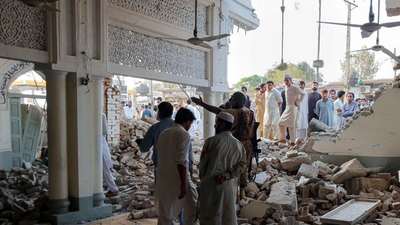
Pakistan’s chief minister of Balochistan said security forces killed 145 militants within 40 hours following coordinated attacks across the province.
Sarfraz Bugti told a news conference in Quetta on Sunday that the bodies of those killed were in the custody of security agencies. Pakistani media described the figure as the highest number of militants killed in such a short period since Pakistan began its campaign against militancy.
Bugti said 17 security personnel, including police, border police and a member of the Pakistan Navy, were killed in the attacks. The civilian death toll has risen to 31, he said.
Earlier, the military’s media wing said 15 security personnel and 18 civilians, including women and children, had been killed.
The separatist group known as the Baloch Liberation Army claimed responsibility for the attacks.
Bugti said security agencies had prior intelligence and had launched preventive operations, during which about 40 militants were killed in the areas of Shaban and Panjgur.
Pakistan’s defence minister, Khawaja Asif, said security in Balochistan was under control following Saturday’s attacks and that forces were carrying out clearance operations.
The United States, the United Kingdom, Qatar and Saudi Arabia have condemned the attacks. The US chargé d’affaires in Pakistan said Washington stands with Pakistan in ensuring peace and stability.
Taliban authorities in Afghanistan have not issued an official response or condemnation of the attacks.

Pakistan’s interior minister said Saturday that 10 security personnel and 37 militants were killed in clashes across cities in Balochistan province.
Police said insurgents also attacked a prison and freed more than 30 inmates.
Pakistani media reported that telecommunications services were suspended in Quetta, Sibi and Chaman following coordinated attacks by the Baloch Liberation Army in several areas, with some outlets saying the shutdown was ordered by provincial authorities.
The violence follows an attack on the Jaffar Express train on the Quetta–Peshawar route in March 2025 and is being described as one of the largest attacks by Baloch separatists in recent years.
According to Agence France-Presse, armed attackers carried out nearly a dozen coordinated assaults early Saturday in southern Pakistan, using firearms and hand grenades. Targets included a high-security prison, police posts and paramilitary facilities.
At the same time, the Balochistan health department declared an emergency at government hospitals across the province to treat the wounded.
Balochistan’s health minister, Bakht Muhammad Kakar, instructed health officials and hospitals to ensure immediate medical care for those injured and to closely monitor treatment. Operating theatres in Quetta health facilities were placed on high alert and additional doctors deployed, officials said.
The Baloch Liberation Army had earlier announced the launch of what it called the second phase of its campaign, referred to as “Operation Hero”. Its spokesperson, Jeeyand Baloch, described the phase as resistance against what he termed an occupying state and its military structures.
The group is banned in Pakistan and is designated a terrorist organisation by the United States.
The Baloch Liberation Army has claimed responsibility for numerous attacks in recent years. Pakistan accuses the group of receiving support from India, a charge New Delhi denies.
Pakistani officials have also said Baloch separatists, the Pakistani Taliban and other militants use Afghan territory to carry out attacks inside Pakistan, allegations rejected by Taliban authorities.
The group launched the first phase of its campaign in August 2024 as part of what it described as a multi-stage effort to “reclaim Balochistan”, claiming it killed at least 130 Pakistani security personnel and briefly seized control of highways and key facilities, including a military base.

Telecommunications services were suspended in Quetta, Sibi and Chaman after coordinated attacks by the Baloch Liberation Army across parts of Pakistan’s Balochistan province, local media reported.
Some outlets said the shutdown was ordered by provincial authorities.
At the same time, the Balochistan health department declared an emergency at government hospitals to treat the wounded.
Balochistan’s health minister, Bakht Muhammad Kakar, instructed health officials and hospitals on Saturday to ensure immediate medical care for those injured in the shootings and to closely monitor treatment. Operating theatres in Quetta health facilities were placed on high alert and additional doctors deployed, officials said.
The Baloch Liberation Army earlier announced what it described as the second phase of its attacks, referred to as “Operation Hero”. Its spokesperson, Jeeyand Baloch, said the campaign represented what he called firm resistance against the state and its military structures.
Media reports said the attacks left dozens dead and wounded, though officials have not released casualty figures.
The Express Tribune reported that 37 Baloch Liberation Army fighters were killed and that at least 10 security personnel also died. The figures could not be independently verified.
The assaults on checkpoints, military vehicles and government facilities began around midnight and were continuing, according to reports. The attacks were described as among the group’s largest operations in Pakistan in recent years.
Shahid Rind, media aide to the Balochistan chief minister, said early Saturday that security forces had foiled attacks in several areas. He added that more than 70 militants had been killed in security operations over the past two days, and that further attacks followed those operations in multiple locations.

A spokesperson for Pakistan’s president referred to the Taliban as “brainless beasts” in a social media post reacting to a report on killings in Afghanistan.
Murtaza Solangi shared the comment on his X account on Friday, alongside an Afghanistan International special report, without further explanation.
The report said 6,660 people have been killed in Afghanistan over nearly four years under Taliban rule. It said Ismaili citizens had been systematically targeted in northern Afghanistan, particularly in Badakhshan, since the Taliban returned to power. Taliban authorities have classified most of the cases as criminal incidents.
According to the report, which cited documents from the Taliban-controlled statistics authority, criminal offences have risen by about 60 percent under Taliban rule compared with the previous government, despite Taliban claims of nationwide security.
The data also indicate that theft has doubled in Afghanistan during the Taliban’s period in power, marking a 100 percent increase, the report said.

European Union foreign ministers have designated Iran’s Islamic Revolutionary Guard Corps as a terrorist organisation, EU foreign policy chief Kaja Kallas said Thursday.
In a post on X, Kallas said repression “could not go unanswered” and described the decision by EU foreign ministers as a “decisive action” to place the Revolutionary Guard on the bloc’s terrorist list.
She added: “Any regime that kills thousands of its own people is working toward its own demise.”
The move marks a significant escalation in the EU’s response to Tehran’s human rights record and the role of the Revolutionary Guard, a powerful military and security force that has been accused of involvement in domestic repression and regional conflicts.
The designation will allow EU member states to impose tighter sanctions and expand cooperation on counter-terrorism measures, although it could also complicate diplomatic and economic relations with Iran.
Iran’s government has not yet issued an official response to the announcement.
