Pakistan Reiterates Call for Taliban to Hand Over TTP Leaders
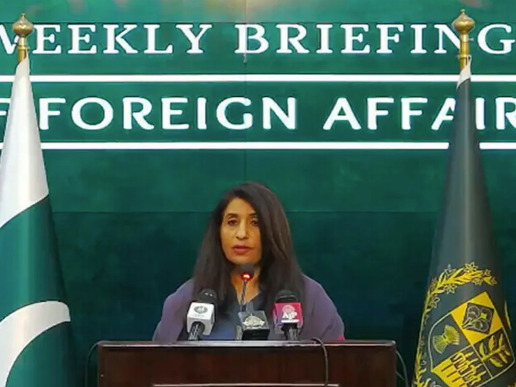
Mumtaz Zahra Baloch, spokesperson for Pakistan's Ministry of Foreign Affairs, stated that Pakistan maintains good political relations with the Taliban.
Mumtaz Zahra Baloch, spokesperson for Pakistan's Ministry of Foreign Affairs, stated that Pakistan maintains good political relations with the Taliban.
However, she once again urged the Taliban to hand over members of Tehreek-e-Taliban Pakistan (TTP) to Pakistan.
Pakistan has repeatedly emphasised that TTP militants find safe haven in Taliban-controlled Afghanistan.
During a press briefing, Baloch reiterated that the Taliban should hand over the militants who have sought refuge in Afghanistan.
General Asim Munir, Pakistan's Chief of Army Staff, also recently urged the Taliban not to oppose Islamabad by supporting TTP.
Following a surge in deadly attacks in Pakistan, officials in the country have stated that TTP orchestrates these attacks from within Afghanistan. The Taliban, however, claim that no foreign forces are present in Afghanistan.

Taliban and Uzbek officials held a bilateral meeting in Kabul to discuss the establishment of a chambers of commerce in Afghanistan and Uzbekistan, as well as investment in the Termez International Trade Centre.
A high-level delegation from Uzbekistan arrived in Kabul on Thursday, August 15. Following their arrival, a trilateral meeting was also held between officials from the Taliban, Uzbekistan, and Azerbaijan.
During the meeting, discussions focused on regional cooperation and the potential re-entry of Afghanistan into the Economic Cooperation Organisation (ECO).
The Taliban also mentioned that during the economic and trade talks with Uzbekistan and Azerbaijan, agreements were made regarding the trilateral development of transportation, logistics, and mineral sectors.
However, the Taliban have not yet provided details on the agreements signed during these meetings.
Germany's Foreign Minister, Annalena Baerbock, has delivered a strong condemnation of Taliban, stating that their "inhumane regime" has destroyed aspirations of millions of Afghan women and girls, denying them the ability to lead normal lives.
Baerbock described the situation of Afghan women and girls as akin to living under house arrest.
In a statement released on Thursday, the German Foreign Minister emphasised the drastic changes that have occurred in Afghanistan, particularly for women, since the Taliban's return to power. She stated, "Since the seizure of power by the Taliban, with their radical Islamist worldview, the women of Afghanistan have been subjected to the most severe systematic human rights violations worldwide."
Germany, along with other European nations, has imposed sanctions on several key Taliban officials for their role in violating women's rights. On Thursday, Baerbock reiterated that as long as the Taliban continue to disregard Afghanistan’s international obligations, the country cannot be reintegrated into the global community.
On Wednesday, 14th August, the Taliban's Foreign Minister, Amir Khan Muttaqi, called on Western countries to strengthen their relations with the group. In an interview with the BBC, Muttaqi argued that concerns over women's rights should not hinder the recognition of the Taliban government.
Baerbock painted a bleak picture of the conditions faced by women under Taliban rule, asserting that they have been entirely excluded from public life.
She remarked, "Half of the population is no longer permitted to do things that are part of any normal life. They can’t work, they can’t enter a hospital or restaurant alone."
In response to international criticism regarding their treatment of women, the Taliban have claimed that they are ensuring all rights and freedoms for Afghan women within the boundaries of their interpretation of Sharia law.
Women's protests against the Taliban's discriminatory policies, particularly in the early months following the fall of the previous government, posed a significant challenge to the group. In retaliation, the Taliban arrested and tortured women and girls who participated in demonstrations.
Many Afghan civil activists argue that the persistent protests by women, both within and outside Afghanistan, are a major reason why the Taliban government has not gained international recognition.
Zalmay Khalilzad, former U.S. Ambassador to Afghanistan, has dismissed the Taliban's assertion that U.S. forces withdrew from Afghanistan due to defeat.
He clarified that the U.S. withdrawal was a "strategic decision," as continuing the conflict was no longer beneficial to U.S. interests.
Khalilzad emphasized that the U.S. achieved its "most important goal" in Afghanistan, which was to counter terrorism that had threatened American security.
On August 15, the Taliban commemorated what they called "Victory Day," celebrating the perceived defeat of U.S. forces and the U.S.-backed Afghan government. The U.S. completed its withdrawal on August 30, 2021, in accordance with the Doha agreement with the Taliban. On August 15, the Afghan government collapsed following President Ashraf Ghani's departure from Kabul.
In an interview with Afghanistan International, Khalilzad explained, "The U.S. intervened in Afghanistan due to the September 11 attacks and to wage a war on terrorism. The U.S. has successfully achieved its security objectives in Afghanistan."
He further noted that for the U.S., "countering terrorism and addressing security threats" took precedence over establishing a democratic government in Afghanistan.
Earlier, Khalilzad told the U.S. Congress's Foreign Relations Committee that Washington had shifted its focus to competing with China and Russia, reducing its interest in maintaining a presence in Afghanistan.
Although Khalilzad's assessment of U.S. achievements in Afghanistan is optimistic, reports from the United Nations Security Council present a more concerning perspective on the resurgence of terrorist groups in the country.
A 26-page report from the UN Security Council's Sanctions Monitoring Team, released in June, highlighted that terrorist groups continue to view Afghanistan as a safe haven, with the Taliban's tolerance towards these groups enabling terrorism to potentially spread into neighbouring regions.
The report noted that the Taliban's inability to control these groups has rejuvenated al-Qaeda and ISIS, with al-Qaeda quietly re-establishing bases and offices in five provinces, including Kabul and Nangarhar.
On August 15, the Pentagon stated that it is "closely monitoring" the activities of terrorist groups, including ISIS, within and around Afghanistan.
Previously, U.S. officials informed the House Foreign Affairs Committee that surveillance of terrorist activities in Afghanistan would be maintained through aerial reconnaissance.
Despite concerns, Washington appears to hold a cautiously optimistic view of its agreements with the Taliban in Doha, trusting that the Taliban will honor their commitment to prevent any group from using Afghan territory to launch attacks against other countries.
The police commander of Robat Karim County in Tehran has announced that since the start of this year, 2,000 "undocumented" Afghan nationals have been expelled from the city of Parand.
According to a report by the Tasnim News Agency, which is affiliated with the Islamic Revolutionary Guard Corps (IRGC), Commander Timour Kalantari also stated that 20 foreign nationals were arrested during this period.
In a press conference held on Thursday, Commander Kalantari noted, "Since the beginning of this year, 20 foreign nationals have been arrested in the city of Parand. Additionally, two safe houses were identified, and of the 3,000 foreign nationals identified in the county, 2,000 have been deported to their home country."
Ahmad Ali Goudarzi, the commander of the Islamic Republic's Border Guard, reiterated in a press conference on Monday that the policy of expelling undocumented migrants will continue until the end of the current Iranian calendar year.
According to recent reports from the Taliban's Ministry of Refugees, more than 1.7 million people have returned to Afghanistan from Iran, Pakistan, and other countries over the past year.
Ahmad Vahidi, the Iranian Interior Minister, stated that the Sistan and Baluchestan border will be closed to enhance security and prevent the movement of terrorists and drug traffickers.
This province shares a border with Afghanistan and Pakistan. Vahidi mentioned that part of the border obstruction plan is being carried out by the Islamic Revolutionary Guard Corps (IRGC).
On Thursday, IRNA news agency reported that Ahmad Vahidi visited the border during his trip to Sistan and Baluchestan province.
During this visit, he said that the work on sealing the Sistan and Baluchestan border is ongoing.
At the same time, Ahmad Ali Goudarzi, the commander of the Border Guard Command, announced the commencement of a new border obstruction plan in the second half of this year.