Islamic Republic Expels 2,000 Afghans from Southwest of Tehran

The police commander of Robat Karim County in Tehran has announced that since the start of this year, 2,000 "undocumented" Afghan nationals have been expelled from the city of Parand.

The police commander of Robat Karim County in Tehran has announced that since the start of this year, 2,000 "undocumented" Afghan nationals have been expelled from the city of Parand.
According to a report by the Tasnim News Agency, which is affiliated with the Islamic Revolutionary Guard Corps (IRGC), Commander Timour Kalantari also stated that 20 foreign nationals were arrested during this period.
In a press conference held on Thursday, Commander Kalantari noted, "Since the beginning of this year, 20 foreign nationals have been arrested in the city of Parand. Additionally, two safe houses were identified, and of the 3,000 foreign nationals identified in the county, 2,000 have been deported to their home country."
Ahmad Ali Goudarzi, the commander of the Islamic Republic's Border Guard, reiterated in a press conference on Monday that the policy of expelling undocumented migrants will continue until the end of the current Iranian calendar year.
According to recent reports from the Taliban's Ministry of Refugees, more than 1.7 million people have returned to Afghanistan from Iran, Pakistan, and other countries over the past year.

Ahmad Vahidi, the Iranian Interior Minister, stated that the Sistan and Baluchestan border will be closed to enhance security and prevent the movement of terrorists and drug traffickers.
This province shares a border with Afghanistan and Pakistan. Vahidi mentioned that part of the border obstruction plan is being carried out by the Islamic Revolutionary Guard Corps (IRGC).
On Thursday, IRNA news agency reported that Ahmad Vahidi visited the border during his trip to Sistan and Baluchestan province.
During this visit, he said that the work on sealing the Sistan and Baluchestan border is ongoing.
At the same time, Ahmad Ali Goudarzi, the commander of the Border Guard Command, announced the commencement of a new border obstruction plan in the second half of this year.

The Taliban's Supreme Court has announced the public flogging of a man in Mazar-e-Sharif, the capital of Balkh province, for selling alcohol and illegal pills.
In a statement released on Thursday, August 15, the court confirmed that the punishment was administered on Wednesday, August 14, at a sports stadium in Mazar-e-Sharif. The man, whose identity was not disclosed, received 39 lashes as part of his sentence.
The court's statement did not provide details regarding the legal proceedings, including whether the accused had access to legal representation or under what conditions he was tried.
The Taliban have strictly prohibited the production, sale, and consumption of all drugs in Afghanistan, and have carried out similar public punishments in various provinces for alcohol-related offences.

The United Nations Educational, Scientific and Cultural Organisation (UNESCO) has warned that the Taliban’s decision to deprive 1.4 million girls of education is jeopardising the future of an entire generation.
The Taliban returned to power on August 15, 2021, and since then have banned education for girls at the secondary and higher levels.
According to a statement from UNESCO reported by Agence France-Presse (AFP) on Thursday, the number of boys and girls enrolled in primary education has also decreased by 1.1 million since the Taliban’s take-over of Afghanistan.
The organisation expressed concerns regarding the harmful consequences of the rising dropout rates, which could lead to a rise in child labour and early marriages.
The UN educational agency warned that in just three years, the current Taliban officials have undone nearly two decades of progress in education in Afghanistan, putting the future of an entire generation at risk.
UNESCO’s data shows that 2.5 million girls are now deprived of education, representing 80% of school-age girls in Afghanistan.
The organisation also noted that since 2021, Taliban leaders have deliberately denied at least 1.4 million girls’ access to secondary education.
Recent reports from some Afghan provinces indicate that Taliban officials have instructed that girls over the age of 10 be barred from attending school.
Afghanistan remains the only country in the world where girls and women are not allowed to attend secondary schools and universities.
No country has recognised the Taliban administration as the official government of Afghanistan.
While some UN officials have referred to the Taliban's restrictions on women as "gender apartheid," the organisation has yet to officially endorse these policies as such.

On the third anniversary of the Taliban's rule, Amnesty International accused the group of widespread human rights violations, particularly against women.
In a detailed statement released on Thursday, Amnesty International stated that Taliban authorities are committing crimes against the people of Afghanistan with "absolute impunity”.
The organisation added that while the Afghan people struggle with despair, three years of Taliban rule and the international community has failed take any meaningful action.
The human rights organisation compiled a report based on interviews with 150 Afghans, including women's rights defenders, academics, protesting women, activists, youth, civil society members, and journalists.
The report highlights the concerns and responses of the international community regarding Afghanistan's future.
Samira Hamidi, Amnesty International Regional Campaigner for South Asia, said, “We spoke with people representing a cross-section of Afghan society throughout the world who overwhelmingly believe that the international community has failed the people of Afghanistan. Not only have they failed to hold the Taliban accountable for the crimes and human rights violations, they have also failed to come up with a strategic direction to prevent any further harm”.
Hamidi stated that three years later, the global community's failure to take meaningful action on the human rights crisis in Afghanistan remains a shame for the world.
Amnesty International's statement mentioned that these interviews were conducted across 21 provinces in Afghanistan and in 10 countries, including the United States, the United Kingdom, Germany, France, Belgium, Spain, Switzerland, Italy, Canada, and Pakistan.
According to the report, over 20 women's rights activists across 21 provinces in Afghanistan reported losing their jobs in various fields. Once politicians, journalists, teachers, and lawyers, they now feel they are "no-one" with limited opportunities for employment.
Amnesty International quoted a woman named Razia, who said “the women who have lost their agency, jobs and economic status are told that they deserve it, and that the Taliban return is a positive step to shut [down] those who were preaching adultery in the name of human rights and women’s rights”.
The organisation also noted that since the Taliban's rise to power, Afghanistan's judicial system has collapsed, and the group's leader ordered the full implementation of Sharia law in November 2022.
According to Amnesty International, Ahmad Ahmadi, a former defence attorney, stated that the Taliban had announced there was no longer any need for lawyers during trials. He added that they do not believe in the judicial system and are deeply committed to their own interpretation of Sharia.
Amnesty International further stated that the Taliban viewed human rights activists, protesting women, journalists, and political activists as "enemies," leading to their gradual disappearance from the public sphere.
According to the organisation, some were forcibly disappeared, arbitrarily detained, and imprisoned, while others were tortured. Many fled the country, with a large number stranded in Iran, Pakistan, and Türkiye.
Nonetheless, according to Amnesty International, civil society space in Afghanistan has significantly shrunk.
Amnesty International believes that the Taliban have created an "environment of fear and absolute control." The organisation quoted a women's rights activist who said that those who once carried out suicide bombings and killed civilians are now in power.

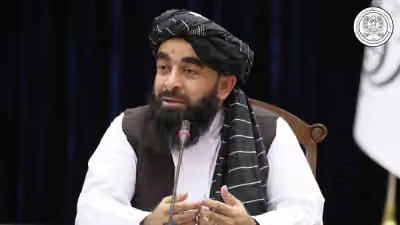
Zabihullah Mujahid, the Taliban’s spokesperson, stated in an interview with the Iranian media outlet "IRAF" that the number of ISIS fighters in Afghanistan could be between 100 and 200.
He mentioned that these fighters are hiding in mountainous and hard-to-reach areas but are being actively pursued by the Taliban forces.
Mujahid assured that they pose no significant threat and are unable to carry out any activities.
These comments come in the wake of the ISIS-Khorasan branch claiming responsibility for an explosion on Sunday, August 11, in the Dashte Barchi area of western Kabul, which targeted Shia Muslims and resulted in approximately 13 casualties, according to a statement released by ISIS on its Telegram channel.
ISIS has previously claimed responsibility for multiple attacks in Kabul and other regions.
Last week, Vladimir Voronkov, the UN Under-Secretary-General for Counter-Terrorism, reported to the Security Council that the financial and logistical capabilities of ISIS-Khorasan have improved over the past six months, and the group has intensified its recruitment efforts.
In response, Mujahid dismissed these claims as "propaganda”.