Uzbekistan's Prime Minister Visits Kabul
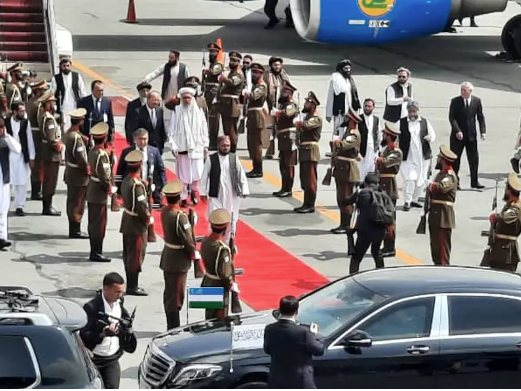
The Taliban's Ministry of Industry and Commerce has announced that Uzbekistan's Prime Minister, Abdulla Aripov, has visited Kabul.

The Taliban's Ministry of Industry and Commerce has announced that Uzbekistan's Prime Minister, Abdulla Aripov, has visited Kabul.
The purpose of his visit is to inaugurate an exhibition showcasing Uzbekistan's products and to participate in bilateral discussions with Taliban officials.
Prior to the Prime Minister's visit, Uzbekistan's Minister of Investment, Industry, and Trade, Laziz Kudratov, also travelled to Kabul and engaged in meetings with Taliban representatives.
According to the Taliban's Ministry of Industry and Commerce, these discussions centred on establishing joint chambers of commerce in Kabul and Tashkent, as well as expanding economic relations between the two nations.
Minister Kudratov also visited the exhibition of Uzbek products in Kabul the day before the Prime Minister's arrival.
While Uzbekistan, like most other countries, does not officially recognise the Taliban government, it maintains extensive political and economic ties with the group, particularly in northern Afghanistan.

The Taliban have announced that Mullah Hasan Akhund, the Prime Minister of the group, met with Mohammed bin Zayed Al Nahyan, the President of the United Arab Emirates (UAE), during his visit to Abu Dhabi.
This marks the first foreign trip by the Taliban Prime Minister since the group's return to power in Afghanistan.
According to a Taliban spokesperson, Mullah Hasan Akhund travelled to the UAE for medical examinations. Taliban spokesperson Zabihullah Mujahid stated that Mohammed bin Zayed Al Nahyan visited him during this trip.
In a post on X (formerly Twitter), Zabihullah Mujahid mentioned that the UAE President expressed his country's support for Afghanistan's reconstruction during the meeting. Mullah Hasan Akhund, in turn, emphasised strengthening the brotherly relations between Afghanistan and the UAE.
The Taliban Prime Minister is one of 61 senior Taliban members on the United Nations sanctions list. Sanctioned Taliban officials are allowed to travel with UN authorisation. It remains unclear whether the UN granted permission for this trip.
Mullah Hasan Akhund is known to be reclusive, and few images of him have surfaced in recent months. According to images released by the Taliban, Anas Haqqani, the brother of Taliban Interior Minister Sirajuddin Haqqani, accompanied him on the trip.
In late June, Sirajuddin Haqqani also made his first official foreign visit to the UAE, where he met with UAE President Mohammed bin Zayed Al Nahyan.

On the third anniversary of the Taliban's return to power in Kabul, France's Ministry of Foreign Affairs stated that Afghanistan's progress is impossible if women continue to be excluded from public life.
The French government stressed that the country's return to normalcy cannot occur while violence and threats against women persist.
In a statement released on Friday, August 16, the French Foreign Ministry condemned the severe violations of women’s and girls’ rights in Afghanistan, labelling the Taliban's ban on female education and employment as "unacceptable and unjustifiable”.
The French government reiterated its commitment to using all diplomatic and humanitarian measures to improve the situation for the Afghan people, even three years after the Taliban took control.
Additionally, the French Foreign Ministry accused the Taliban of failing to adhere to United Nations Security Council Resolution 2593, highlighting the group's repeated human rights violations and lack of compliance with international obligations.
This statement follows recent remarks by Germany’s Foreign Minister, Annalena Baerbock, who harshly criticised the Taliban regime for destroying the hopes of millions of Afghan women and girls, effectively confining them to "house arrest”.

Mumtaz Zahra Baloch, spokesperson for Pakistan's Ministry of Foreign Affairs, stated that Pakistan maintains good political relations with the Taliban.
However, she once again urged the Taliban to hand over members of Tehreek-e-Taliban Pakistan (TTP) to Pakistan.
Pakistan has repeatedly emphasised that TTP militants find safe haven in Taliban-controlled Afghanistan.
During a press briefing, Baloch reiterated that the Taliban should hand over the militants who have sought refuge in Afghanistan.
General Asim Munir, Pakistan's Chief of Army Staff, also recently urged the Taliban not to oppose Islamabad by supporting TTP.
Following a surge in deadly attacks in Pakistan, officials in the country have stated that TTP orchestrates these attacks from within Afghanistan. The Taliban, however, claim that no foreign forces are present in Afghanistan.

Taliban and Uzbek officials held a bilateral meeting in Kabul to discuss the establishment of a chambers of commerce in Afghanistan and Uzbekistan, as well as investment in the Termez International Trade Centre.
A high-level delegation from Uzbekistan arrived in Kabul on Thursday, August 15. Following their arrival, a trilateral meeting was also held between officials from the Taliban, Uzbekistan, and Azerbaijan.
During the meeting, discussions focused on regional cooperation and the potential re-entry of Afghanistan into the Economic Cooperation Organisation (ECO).
The Taliban also mentioned that during the economic and trade talks with Uzbekistan and Azerbaijan, agreements were made regarding the trilateral development of transportation, logistics, and mineral sectors.
However, the Taliban have not yet provided details on the agreements signed during these meetings.

Germany's Foreign Minister, Annalena Baerbock, has delivered a strong condemnation of Taliban, stating that their "inhumane regime" has destroyed aspirations of millions of Afghan women and girls, denying them the ability to lead normal lives.
Baerbock described the situation of Afghan women and girls as akin to living under house arrest.
In a statement released on Thursday, the German Foreign Minister emphasised the drastic changes that have occurred in Afghanistan, particularly for women, since the Taliban's return to power. She stated, "Since the seizure of power by the Taliban, with their radical Islamist worldview, the women of Afghanistan have been subjected to the most severe systematic human rights violations worldwide."
Germany, along with other European nations, has imposed sanctions on several key Taliban officials for their role in violating women's rights. On Thursday, Baerbock reiterated that as long as the Taliban continue to disregard Afghanistan’s international obligations, the country cannot be reintegrated into the global community.
On Wednesday, 14th August, the Taliban's Foreign Minister, Amir Khan Muttaqi, called on Western countries to strengthen their relations with the group. In an interview with the BBC, Muttaqi argued that concerns over women's rights should not hinder the recognition of the Taliban government.
Baerbock painted a bleak picture of the conditions faced by women under Taliban rule, asserting that they have been entirely excluded from public life.
She remarked, "Half of the population is no longer permitted to do things that are part of any normal life. They can’t work, they can’t enter a hospital or restaurant alone."
In response to international criticism regarding their treatment of women, the Taliban have claimed that they are ensuring all rights and freedoms for Afghan women within the boundaries of their interpretation of Sharia law.
Women's protests against the Taliban's discriminatory policies, particularly in the early months following the fall of the previous government, posed a significant challenge to the group. In retaliation, the Taliban arrested and tortured women and girls who participated in demonstrations.
Many Afghan civil activists argue that the persistent protests by women, both within and outside Afghanistan, are a major reason why the Taliban government has not gained international recognition.
