Over 32,000 Afghan Migrants Deported from Pakistan in Past Month
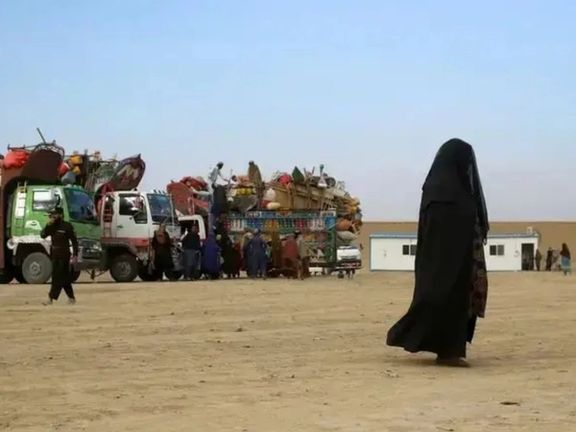
Samaa TV has reported that in the past month, 32,200 Afghan nationals have been deported from Pakistan back to Afghanistan.

Samaa TV has reported that in the past month, 32,200 Afghan nationals have been deported from Pakistan back to Afghanistan.
Since the implementation of Pakistan's deportation plan for Afghan migrants, more than 691,000 Afghans have been returned to their home country, according to Pakistani media.
Between Sunday, 21 July, and Saturday, 16 August, Pakistani media reported that 11,054 children, 9,320 women, and 11,826 men were expelled from the country.
These migrants were reportedly transported back to Afghanistan in 674 vehicles.
Pakistani authorities have confirmed that the deportation of Afghans without valid residency documents will continue.
The deportation programme for Afghan migrants from Pakistan commenced in October 2023, and despite widespread international criticism, Pakistan remains committed to continuing the expulsions of Afghan refugees.

Health officials in Balochistan have identified the five individuals whose bodies were recently discovered in the province.
The victims, all former members of Afghanistan’s security forces, have been named as Rozi Khan, Rahmatullah, Samiullah, Agha Wali, and Sardar Wali. Jaish ul-Adl, a militant Islamist group, had previously confirmed that it had captured these individuals.
The five men were originally from Lashkargah, the capital of Helmand province in Afghanistan.
On Saturday, 17 August, Mohammad Jawad, the official in charge at Fahd bin Sultan Hospital, where the bodies were transferred, informed Pakistani media that a group of Afghan nationals from the refugee camp in Chaghi district had identified the bodies. He also stated that the remains have since been moved to Quetta city.
Pakistani police have suggested that these victims might be the same five individuals whose confessions were circulated on social media by Jaish ul-Adl last month. Investigations into the case are ongoing.
In July of this year, Jaish ul-Adl released a video showing five Afghan citizens in their custody, accusing them of involvement in the assassination of one of the group’s leaders.
Now, the official from Fahd bin Sultan Hospital has confirmed the names of the five men that Jaish ul-Adl had claimed to have "captured" in July. At that time, the group accused them of collaborating with the Iranian government.
To date, no group, including Jaish ul-Adl, has claimed responsibility for the killings of these individuals. However, the Islamist group had previously announced that the five men had been sentenced to death for their alleged role in the murder of one of its leaders.
The bullet-riddled bodies of these five Afghans were discovered on Friday in the Chaghi district of Balochistan, Pakistan, near the Iranian border. Pakistani authorities reported that the victims were found hanging from electricity poles, with gunshot wounds to their chests and other parts of their bodies.

Abdul Haq Hamkar, the Taliban's Deputy Minister of Interior, has urged the international community to collaborate in the fight against drug trafficking during a meeting with a delegation from the Islamic Republic of Iran in Kabul.
Hamkar highlighted that drug trafficking is a regional issue and stressed the importance of joint efforts to address this challenge.
According to Bakhtar News Agency, which is under Taliban control, the Iranian delegation also called for global cooperation in combating drug trafficking in Afghanistan during the meeting on Sunday.
The six-member Iranian delegation, led by Mohammad Zarei, Deputy Head of Iran's Anti-Narcotics Headquarters, arrived in Kabul on Friday.
Iskandar Momeni, Head of Iran's Anti-Narcotics Headquarters, has previously stated that the border regions between Iran, Afghanistan, and Pakistan are recognised as key global drug trafficking routes. He further noted that Iran, with its extensive borders, particularly with Afghanistan and Pakistan, has become a major centre in the fight against drug trafficking.
In April 2022, the Taliban announced a ban on poppy cultivation, as well as the production, consumption, and sale of narcotics. However, reports suggest that drug cultivation and trafficking continue in Afghanistan despite the ban.

The Afghanistan Freedom Front (AFF) has claimed responsibility for an explosion in Kabul's Fourth Security District.
In a video clip released by the group, they stated that on Saturday evening, they targeted a convoy of the Taliban's Ministry of Interior in the Parwan-3 area.
The group claimed that four Taliban members were killed and one was injured in the attack.
Earlier, several Kabul residents had contacted Afghanistan International, reporting an explosion and gunfire in the Fourth Security District of the city.
Local residents said the explosion occurred around 7 p.m. on Saturday evening.
Taliban officials have not yet commented on the incident.

Five bullet-riddled bodies were discovered hanging from electricity poles in Pakistan's Chaghi district in Balochistan, near the Iranian border. Police have confirmed that the victims were from Lashkargah in Afghanistan's Helmand province.
The bodies were transferred to the morgue at the central hospital in Quetta. Local authorities in Chagai, Balochistan, believe that the five individuals were killed elsewhere and then moved to Dalbandin, a city in the Chaghi district.
Atiq Shahwani, a senior government official in the region, informed AFP that the bodies were taken to a local hospital where doctors confirmed that the cause of death was multiple bullet wounds, primarily to the chest.
Images of the bodies hanging from electric poles have circulated on social media, drawing widespread attention to the incident. Dalbandin, a city near the Iranian border, is known as a critical point in the border region, with separatist military groups active in the area.
Police have yet to release further details regarding the identities of the victims, and no group has claimed responsibility for the killings at this time.
Victims' Identities and Motive Behind Killings
Some local media outlets, citing unnamed sources, have reported that the victims were former Afghan government security personnel. However, official sources have not confirmed this information.
Earlier this year, the militant group Jaish ul-Adl released a video showing five Afghan nationals in their custody, claiming they were involved in the assassination of one of the group's leaders. At that time, Jaish ul-Adl stated that the five men were linked to the security forces of the former Afghan government and accused them of ties to an "assassination and espionage network" affiliated with Iran's Islamic Revolutionary Guard Corps (IRGC). The group had announced that it had sentenced the men to death but has not released any further information regarding their fate.

Suhail Shaheen, the head of the Taliban's political office in Qatar, has expressed the group's desire to strengthen relations with Russia.
In an interview with RIA Novosti, published on Saturday, Shaheen remarked that the former Afghan government's close ties with the West made it "impossible to imagine" the same level of cooperation with Russia. He justified his statement by labelling the previous Afghan administration as "pro-American."
While Russia, like most other countries, does not officially recognise the Taliban, it maintains a relationship with the group and has even handed over control of the Afghan embassy in Moscow to the Taliban.
Shaheen proposed that delegations from the Taliban travel to Moscow, and that Russian representatives visit Kabul, as a way to enhance bilateral relations between the two sides.
Previously, Russian Foreign Minister Sergey Lavrov warned of ongoing threats emanating from Afghanistan, emphasising the need for a more substantive dialogue with the Taliban on counter-terrorism efforts. In response to Lavrov's comments, the Taliban's Foreign Ministry announced its readiness for "result-oriented dialogue" with all parties on issues of mutual concern.
