Killed Four Taliban Members in Kabul, Claims AFF

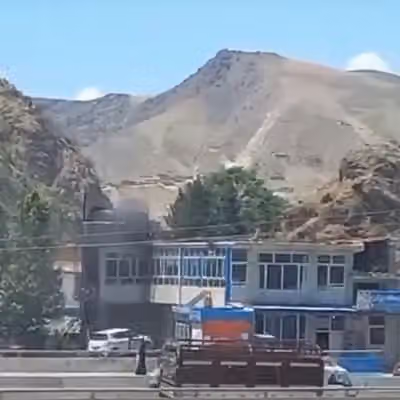
The Afghanistan Freedom Front (AFF) has claimed responsibility for an explosion in Kabul's Fourth Security District.

The Afghanistan Freedom Front (AFF) has claimed responsibility for an explosion in Kabul's Fourth Security District.
In a video clip released by the group, they stated that on Saturday evening, they targeted a convoy of the Taliban's Ministry of Interior in the Parwan-3 area.
The group claimed that four Taliban members were killed and one was injured in the attack.
Earlier, several Kabul residents had contacted Afghanistan International, reporting an explosion and gunfire in the Fourth Security District of the city.
Local residents said the explosion occurred around 7 p.m. on Saturday evening.
Taliban officials have not yet commented on the incident.

Five bullet-riddled bodies were discovered hanging from electricity poles in Pakistan's Chaghi district in Balochistan, near the Iranian border. Police have confirmed that the victims were from Lashkargah in Afghanistan's Helmand province.
The bodies were transferred to the morgue at the central hospital in Quetta. Local authorities in Chagai, Balochistan, believe that the five individuals were killed elsewhere and then moved to Dalbandin, a city in the Chaghi district.
Atiq Shahwani, a senior government official in the region, informed AFP that the bodies were taken to a local hospital where doctors confirmed that the cause of death was multiple bullet wounds, primarily to the chest.
Images of the bodies hanging from electric poles have circulated on social media, drawing widespread attention to the incident. Dalbandin, a city near the Iranian border, is known as a critical point in the border region, with separatist military groups active in the area.
Police have yet to release further details regarding the identities of the victims, and no group has claimed responsibility for the killings at this time.
Victims' Identities and Motive Behind Killings
Some local media outlets, citing unnamed sources, have reported that the victims were former Afghan government security personnel. However, official sources have not confirmed this information.
Earlier this year, the militant group Jaish ul-Adl released a video showing five Afghan nationals in their custody, claiming they were involved in the assassination of one of the group's leaders. At that time, Jaish ul-Adl stated that the five men were linked to the security forces of the former Afghan government and accused them of ties to an "assassination and espionage network" affiliated with Iran's Islamic Revolutionary Guard Corps (IRGC). The group had announced that it had sentenced the men to death but has not released any further information regarding their fate.

Suhail Shaheen, the head of the Taliban's political office in Qatar, has expressed the group's desire to strengthen relations with Russia.
In an interview with RIA Novosti, published on Saturday, Shaheen remarked that the former Afghan government's close ties with the West made it "impossible to imagine" the same level of cooperation with Russia. He justified his statement by labelling the previous Afghan administration as "pro-American."
While Russia, like most other countries, does not officially recognise the Taliban, it maintains a relationship with the group and has even handed over control of the Afghan embassy in Moscow to the Taliban.
Shaheen proposed that delegations from the Taliban travel to Moscow, and that Russian representatives visit Kabul, as a way to enhance bilateral relations between the two sides.
Previously, Russian Foreign Minister Sergey Lavrov warned of ongoing threats emanating from Afghanistan, emphasising the need for a more substantive dialogue with the Taliban on counter-terrorism efforts. In response to Lavrov's comments, the Taliban's Foreign Ministry announced its readiness for "result-oriented dialogue" with all parties on issues of mutual concern.

The Taliban's Ministry of Industry and Commerce has announced that Uzbekistan's Prime Minister, Abdulla Aripov, has visited Kabul.
The purpose of his visit is to inaugurate an exhibition showcasing Uzbekistan's products and to participate in bilateral discussions with Taliban officials.
Prior to the Prime Minister's visit, Uzbekistan's Minister of Investment, Industry, and Trade, Laziz Kudratov, also travelled to Kabul and engaged in meetings with Taliban representatives.
According to the Taliban's Ministry of Industry and Commerce, these discussions centred on establishing joint chambers of commerce in Kabul and Tashkent, as well as expanding economic relations between the two nations.
Minister Kudratov also visited the exhibition of Uzbek products in Kabul the day before the Prime Minister's arrival.
While Uzbekistan, like most other countries, does not officially recognise the Taliban government, it maintains extensive political and economic ties with the group, particularly in northern Afghanistan.

The Taliban have announced that Mullah Hasan Akhund, the Prime Minister of the group, met with Mohammed bin Zayed Al Nahyan, the President of the United Arab Emirates (UAE), during his visit to Abu Dhabi.
This marks the first foreign trip by the Taliban Prime Minister since the group's return to power in Afghanistan.
According to a Taliban spokesperson, Mullah Hasan Akhund travelled to the UAE for medical examinations. Taliban spokesperson Zabihullah Mujahid stated that Mohammed bin Zayed Al Nahyan visited him during this trip.
In a post on X (formerly Twitter), Zabihullah Mujahid mentioned that the UAE President expressed his country's support for Afghanistan's reconstruction during the meeting. Mullah Hasan Akhund, in turn, emphasised strengthening the brotherly relations between Afghanistan and the UAE.
The Taliban Prime Minister is one of 61 senior Taliban members on the United Nations sanctions list. Sanctioned Taliban officials are allowed to travel with UN authorisation. It remains unclear whether the UN granted permission for this trip.
Mullah Hasan Akhund is known to be reclusive, and few images of him have surfaced in recent months. According to images released by the Taliban, Anas Haqqani, the brother of Taliban Interior Minister Sirajuddin Haqqani, accompanied him on the trip.
In late June, Sirajuddin Haqqani also made his first official foreign visit to the UAE, where he met with UAE President Mohammed bin Zayed Al Nahyan.

On the third anniversary of the Taliban's return to power in Kabul, France's Ministry of Foreign Affairs stated that Afghanistan's progress is impossible if women continue to be excluded from public life.
The French government stressed that the country's return to normalcy cannot occur while violence and threats against women persist.
In a statement released on Friday, August 16, the French Foreign Ministry condemned the severe violations of women’s and girls’ rights in Afghanistan, labelling the Taliban's ban on female education and employment as "unacceptable and unjustifiable”.
The French government reiterated its commitment to using all diplomatic and humanitarian measures to improve the situation for the Afghan people, even three years after the Taliban took control.
Additionally, the French Foreign Ministry accused the Taliban of failing to adhere to United Nations Security Council Resolution 2593, highlighting the group's repeated human rights violations and lack of compliance with international obligations.
This statement follows recent remarks by Germany’s Foreign Minister, Annalena Baerbock, who harshly criticised the Taliban regime for destroying the hopes of millions of Afghan women and girls, effectively confining them to "house arrest”.