Afghanistan On The FrontLines In Fight Against ISIS, Says Uzbek Security Service Chief

Abdusalom Azizov, the head of Uzbekistan's State Security Service, stated that the Taliban is fighting international terrorism to the best of its ability.

Abdusalom Azizov, the head of Uzbekistan's State Security Service, stated that the Taliban is fighting international terrorism to the best of its ability.
At a counterterrorism meeting in Tashkent, Azizov emphasised that Afghanistan is on the frontlines in the fight against ISIS and should not be left isolated.
According to Uzbek media, Azizov, speaking at a Shanghai Cooperation Organisation (CSO) and Commonwealth of Independent States (CIS) meeting in Tashkent, said that mutual trust, regular information exchange, and coordinated actions in the fight against international terrorism are crucial for ensuring stability and security.
The SCO and CIS conference on combating terrorism and extremism was held over two days on September 4 and 5 in Tashkent.
Yevgeniy Sysoev, head of the CIS Anti-Terrorism Centre, warned at the meeting about the rising threat of ISIS-Khorasan, stating that its threat has peaked, with the group's goal being to incite hostility between ethnic groups and radicalise societies.
Since the Taliban's takeover of power, many regional countries have expressed concerns about the presence of terrorist groups in Afghanistan.
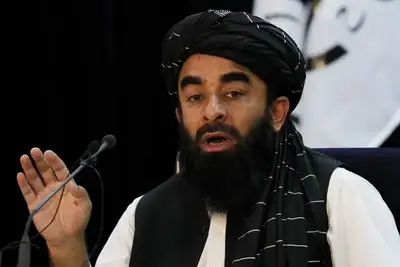

The National Resistance Front of Afghanistan (NRF) claimed responsibility for an attack on Taliban forces in Taloqan, the capital of Takhar province, stating they killed three Taliban members and injured another.
According to local sources, three civilians, including a child, were also injured and have been transported to the central hospital in Taloqan.
The NRF’s statement detailed that the attack occurred at 4pm on Wednesday, targeting Taliban fighters near Old Taloqan, in the Kabul Gate area.
Local sources informed Afghanistan International that the injuries resulted from a bicycle bomb explosion in the same area.
Witnesses confirmed that all those injured were civilians, with one being a child.
Taliban officials have not yet commented on the incident.
Following the explosion, local residents reported that Taliban forces cordoned off the area and blocked all access routes.

The UN Secretary-General, in his latest report to the Security Council, warned about the increasing cross-border threats posed by ISIS-Khorasan in Afghanistan.
According to reports, ISIS has ordered its fighters in Afghanistan to carry out attacks in other countries.
This warning was issued in the UN Secretary-General's report to the Security Council regarding ISIS’ threat to international security.
In Antonio Guterres’ report, Afghanistan is described as a dangerous base for ISIS-K to launch attacks on Europe and regional countries.
The report indicates that, following terrorist attacks in Kerman, Iran, on January 3, and in Moscow on March 22, the threat posed by various groups based in Afghanistan has raised concerns among member states.
It further noted that member states have reported ISIS directing its operatives in Afghanistan and neighbouring countries to conduct attacks abroad, while also exploiting Afghan and Central Asian migrant communities for logistical, financial, and operational support.
Despite the dismantling of several ISIS-K cells in Europe, logistical and financial support remains available to operatives travelling from Afghanistan and Central Asia to Europe, according to the report.
Intelligence from member states, whose names were not disclosed in the Secretary-General’s report, indicates that ISIS-K, through its networks between Afghanistan and Turkiye, is capable of transferring its operatives from Central Asia and Afghanistan to Europe for operations.
The report also mentioned that ISIS-K is attempting to recruit Afghan migrants in Europe.
Meanwhile, the UN Security Council's Sanctions Monitoring Team, in its 34th report on ISIS, al-Qaeda, and the Pakistani Taliban, issued a similar warning.
The Security Council's Monitoring Team report indicated that European countries now assess ISIS-K as the largest terrorist threat to Europe.
The committee’s report referred to several operations against ISIS in Belgium, France, Germany, the Netherlands, Spain, Sweden, and Turkiye, highlighting the renewed ambitions, efforts, and potential capacity of the group to carry out large-scale attacks on European soil.
The monitoring team predicted that in the coming year, Europe will face more complex plots from ISIS, which is why both European and non-European countries are deeply concerned about the terrorist threat emanating from Afghanistan.
The report also mentioned that ISIS is focusing on expanding its presence in Africa. The group has demonstrated its presence through bloody attacks on civilians in Africa.
This is not the first time the UN and its members have warned about the threat of ISIS and other terrorist groups in Afghanistan. However, the Taliban has described these warnings as an exaggeration of the ISIS threat.
Nevertheless, the Security Council’s Monitoring Team, in its new report, estimated that the number of ISIS fighters ranges from 4,000 to 6,000.
The report states that Sanaullah Ghafari remains the leader of the ISIS-K branch in Afghanistan, and Abu Ahmad al-Madani (an Iraqi national) commands the group's external operations unit in Kunar, Nuristan, and the Islamic Republic of Iran.
Previously, the Taliban claimed that the ISIS threat in Afghanistan had been significantly weakened. However, this week, ISIS attacked the Taliban’s Directorate of Monitoring and Enforcement of Taliban Decrees in Kabul.
Naseer Faiq, Afghanistan's representative to the UN, said this attack shows that the Taliban's claim of securing Afghanistan is questionable, as ordinary people continue to be killed by terrorist attacks.
The Security Council's committee said that ISIS-K is seeking to control Afghanistan as the country is a territory from which it can infiltrate neighbouring countries and expand terrorist threats to Central Asia, Russia, and Iran.
According to the committee, ISIS has softened its domestic operations in Afghanistan but strengthened its external operations.
The report states that the main routes for ISIS fighters entering Afghanistan are from Central Asia, Turkiye, and the Islamic Republic of Iran. Currently, ISIS has sent part of its forces to Kunar and Nangarhar, and others to Badakhshan, Herat, and Nimroz.

Sources informed Afghanistan International that tensions have significantly increased between Hibatullah Akhundzada, Taliban's leader; Sirajuddin Haqqani, the interior minister, and Yaqoob Mujahid, the defence minister of the group.
Sources say that Haqqani and Yaqoob are dissatisfied with Akhundzada's interference in their duties.
Reliable sources in Kabul told the Pashto service of Afghanistan International that these two ministers had discussed their differences with Mullah Hibatullah, describing some of his actions as interference in their affairs. However, it has been reported that Hibatullah dismissed their concerns as unimportant.
It has been said that the Taliban leader told Haqqani and Yaqoob that they had not significantly participated in the Taliban's "jihad" against the former Afghan government.
According to the sources, following these criticisms, supporters and affiliates of Haqqani and Yaqoob have widely circulated their "jihadi" images and videos on social media.
A source from the Taliban's Interior Ministry told the Pashto service of Afghanistan International that in response to the criticisms, they posted videos and images of Haqqani on social media, showing him before carrying out an attack or meeting with a suicide bomber.
Recently, an old video of Sirajuddin Haqqani and his brother bidding farewell to a teenage suicide bomber has been circulated widely on Afghanistan's social media.
Many users claim that the Haqqani network, by training suicide attackers, is responsible for the deaths of thousands of people in Afghanistan.
In the past, there have also been reports of internal disagreements between senior Taliban officials and Hibatullah. However, Haqqani, Yaqoob, and other senior officials of the group have emphasised on absolute obedience to the Taliban leader.

The National Resistance Front (NRF) announced on Wednesday that Ahmad Massoud would have a virtual meeting with the Chairman of the US House Foreign Affairs Committee, Michael McCaul.
The Front stated that a delegation representing Massoud would travel to Washington.
Following requests for the presence of the NRF leader in the Foreign Affairs Committee, McCaul, the committee's chairman, announced that he would meet with representatives of the NRF, including Ahmad Massoud, on September 10.
McCaul said that he was eagerly looking forward to hearing Massoud’s thoughts on freeing his people from the Taliban.
While the Front’s leader warmly welcomed McCaul's announcement, it remains unclear why he is not travelling to Washington to meet this Republican representative.
NRF wrote, "The leader of the National Resistance Front of Afghanistan is sending a delegation to Washington on behalf of the Front. Meanwhile, Ahmad Massoud will have a virtual conversation with McCaul, the chairman of the US House Foreign Affairs Committee."
The Front added, "It is expected that this conversation will initiate a new process of meaningful talks between the US Congress and the legitimate representatives of the Afghan people."
The Taliban have expressed their opposition to foreign countries meeting with anti-Taliban forces outside of Afghanistan. The group boycotted the second United Nations meeting in Doha on Afghanistan due to the presence of civil society representatives.
The chairman of the US House Foreign Affairs Committee said that he and his team have had continuous contact with Massoud and the NRF for a long time.
He emphasised that the Taliban's regime had undone any progress previously made on human rights in Afghanistan.
Recently, former US military officer Shawn Ryan launched a campaign to cut financial aid to the Taliban and invited Massoud to testify before the Congress. Tens of thousands of people have signed this petition.

The Iran Human Rights Organisation has reported that at least 100 people were executed in Iran during August this year.
The organisation, based in Norway, released a report on Tuesday, September 3, stating that among the executed were 11 Afghan citizens, eight Baluch citizens, and nine Kurdish citizens.
According to the statistics, the number of executions carried out by the Islamic Republic in the first eight months of this year has reached at least 402.
The report indicated that 50 of those executed were convicted of "premeditated murder," while 46 were executed on drug-related charges. Three individuals were accused of rape, and one political prisoner was sentenced to death for allegedly killing a security officer.
The Iran Human Rights Organisation emphasised that executions in the country have intensified following the recent presidential election in Iran.
The organisation reiterated its call for a global response to the wave of executions in Iran. Mahmood Amiry-Moghaddam, the organisation's director, stated, "The execution of at least 100 people in just one month should prompt a strong international reaction."
He further highlighted that the victims of the Islamic Republic's execution machine are often the most vulnerable members of society, stating, "These individuals are killed without fair trials, aimed at instilling fear in the community. People, human rights organisations, and the international community must use protests, condemnation, and political pressure to raise the cost for the regime."
According to the report, one of those executed was Reza Rasaei, a Kurdish protester who was arrested during the 2022 protests. He was sentenced to death without access to a fair trial, based on confessions extracted under torture and solely on the judge's discretion.
The report also confirmed that one of the individuals was hanged in public, which had not occurred in the past eight months.
The Iran Human Rights Organisation noted that only six of the 100 executions carried out in the past month (six percent) were reported by official Iranian media.
This report comes a day after UN experts expressed concern over the increasing number of executions in Iran. The UN experts, in their statement, called on the Islamic Republic to immediately halt the execution of individuals facing such punishment.
The statement revealed that at least 81 people were executed in Iran in August 2024, a significant rise from the 45 executions reported in July.
The UN experts stressed that "reports of serious violations of the right to a fair trial mean that the death penalty, as currently applied in the Islamic Republic of Iran, is unlawful."
They also noted that security-related charges with vague definitions, such as armed rebellion, spreading corruption on earth, and waging war against God or apostasy, do not meet the criteria for the "most serious crimes" under the International Covenant on Civil and Political Rights, and have, in several cases, led to the execution of regime opponents, which clearly violates international standards.