UN Secretary-General Condemns Shooting of Hazaras in Daikundi

UN Secretary-General António Guterres called the shooting of Hazaras in Daikundi "heinous" and condemned it.

UN Secretary-General António Guterres called the shooting of Hazaras in Daikundi "heinous" and condemned it.
Stephane Dujarric, the spokesperson for the UN Secretary-General, said at a press conference that António Guterres stressed on the protection of civilians in Afghanistan.
He said at the press conference on Friday that Guterres offered his condolences to the families of the victims of the attack.
The United Nations Assistance Mission in Afghanistan (UNAMA) also expressed sympathy with the families of the victims in a statement on Friday and called for the Taliban's investigation and accountability in this regard.
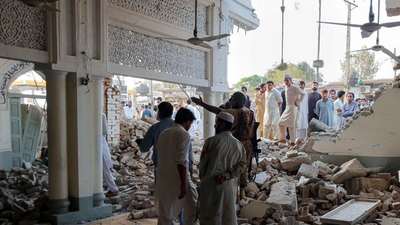
At least 14 people were killed and four others wounded in Thursday's armed attack on Hazara civilians in the village of Qarodal, an area between Ghor and Daikundi provinces.
Hours after the attack, ISIS claimed responsibility for the attack, saying that 15 people were killed in the attack.

The National Resistance Front (NRF) claims to have killed three Taliban members and injured two others during a targeted operation on Friday evening in the ninth district of Kabul.
In a statement, the NRF said that they attacked a Taliban patrol in the Hodkhel area of the city. Earlier, two local sources in Kabul had reported an explosion in the area.
The NRF added that a vehicle ferrying Taliban members was also destroyed in the attack, and no NRF personnel were harmed.
Taliban officials have not yet commented on the incident.
A video clip released by media outlets associated with the National Resistance Front captures the sound of an explosion.

A number of Afghan political leaders called the jamming of Afghanistan International TV broadcasts a sign of "fear and defeat" of the Taliban.
In order to counter the Taliban's interference, Afghanistan International has started its satellite broadcast on another frequency.
Rahmatullah Nabil, the former head of Afghanistan's National Directorate of Security (NDS), wrote on the social media network X that the Taliban's jamming of Afghanistan International TV broadcasts "shows their fear of a free media" and a direct attack on freedom of expression and people's right to access information. Nabil added that the Taliban has now resorted to censorship instead of listening to criticism.
Nabil called Afghanistan International a "key voice and a vital platform" for Afghans and a platform to strengthen voices inside Afghanistan. Despite the Taliban's efforts to silence independent media, Afghans will have access to accurate information as the free media fights, he said.
In response to the Taliban's action against Afghanistan International TV's broadcasts, Daoud Naji, head of the political committee of the Afghanistan Freedom Front (AFF), said that the use of jamming to suppress the media is "a sign of the Taliban's extreme fear" of voices and protests that have gone beyond the level of society and ordinary people and have now reached the Taliban's inner layers.
Naji added that media outlets operating in Afghanistan under the Taliban's control cannot comply with any of the media standards due to the fear of the group.
The head of the political committee of the Afghanistan Freedom Front emphasised that the use of technology for censorship is a failed experiment that has not yielded results in other countries.
On the other hand, Abdullah Khanjani, head of the political office of the National Resistance Front of Afghanistan, said that the exiled media, especially Afghanistan International TV, is one of the most important achievements after Afghanistan fell into the pit of ignorance and regression.
Abdullah Khanjani stressed that the Taliban has suffered from a content crisis and their systematic attacks on Afghanistan International TV are a sign of the Taliban's psychological failure in public opinion and the group's moral decline in the public psyche.

An official letter from the Pakistan's Foreign Ministry has been obtained by Afghanistan International, indicating that Asif Durrani, Pakistan's special representative for Afghanistan affairs, has been dismissed from his position.
According to this letter, Durrani's tenure ended on Tuesday, September 10.
Pakistani Prime Minister Shehbaz Sharif named Asif Durrani as his special envoy for Afghanistan in June last year, and Durrani held that position for about a year and three months.
This veteran Pakistani diplomat, who is fluent in Persian and Pashto, travelled to Kabul several times during his mission and met with Taliban officials. During his mission, he also participated in meetings of representatives of the countries of the region hosted by the United Nations in Doha.
Pakistan's relations with the Taliban were tense during Durrani's tenure due to the spread of insecurity in Pakistan and border disputes.

The Afghanistan Journalists Centre (AFJC) has strongly condemned the Taliban’s crackdown on Afghanistan International and called on the group to immediately and permanently stop jamming the satellite frequency of the media outlet.
AFJC expressed grave concern over the incident and urged the Taliban to allow the country's citizens to access the media freely and without restrictions.
A statement by Afghanistan International TV recently said that since September 5, 2024, the Taliban government has clearly violated the free flow of information and freedom of the press by jamming Afghanistan International's satellite frequencies.
Earlier too, the Taliban government tightened restrictions on Afghanistan International and the Taliban's Ministry of Information and Culture had accused the media outlet of "violating the privacy of citizens and legal persons, character assassination, distortion of information, and promoting ethnic, linguistic, and regional prejudices”. The group banned any kind of cooperation with this media outlet.
AFJC stressed that the continued restrictions on the Afghanistan International Network and the disruption of the audience's access to the programmes of this media outlet inside the country is a violation of the country's mass media law.

The Taliban's Ministry of Foreign Affairs has declared the termination of Hassan Soroosh, the Afghan ambassador appointed by the former government, from his position in Canada.
In an official document obtained by Afghanistan International, the ministry stated that Soroosh's tenure ended on September 5. The letter, issued by the Human Resources Directorate of the Taliban's Foreign Ministry on September 9, announced the decision.
It is unclear whether the Canadian government or the Afghan embassy in Ottawa will comply with the Taliban's request to end Soroosh's mission. The embassy, still under the administration of Soroosh, has not yet commented on the matter. Notably, the Afghan embassy in Canada had previously extended consular services to Afghan nationals in the US after the closure of the Afghan embassy and consulates there.
Earlier, the Taliban had declared that the consular services of 14 Afghan diplomatic missions abroad, including Canada, were no longer valid.
Canada has maintained a strict stance against the Taliban, compared to other Western countries. Observers note that Canada’s stringent anti-terrorism laws have even hindered the provision of humanitarian aid to the Afghan people.
In December 2022, Canadian Prime Minister Justin Trudeau labelled the Taliban as a terrorist group, stating that it should not receive humanitarian funding. He said, "We must work out how to help the communities and individuals suffering in Afghanistan without funding or supporting the terrorist organisation currently in control."
Trudeau acknowledged the complexity of the issue and noted that Canada, like some of its allies, was seeking a solution to these legal constraints.
In response, both the Canadian House of Commons and Senate passed an amendment in June last year that exempted aid organisations from Canada's anti-terrorism laws when delivering assistance to Afghans. The amendment ensured that aid groups were not considered "criminals" for paying taxes to the Taliban while providing humanitarian relief.
Canada has also strongly condemned the Taliban’s human rights violations, particularly those targeting women.
Earlier, in March of this year, Canadian newspapers reported that the government did not respond to a letter from the Taliban requesting the appointment of diplomats to the Afghan embassy and consulates in Canada.
Jason Kung, a spokesperson for Canada’s Foreign Ministry, reaffirmed that the country does not recognise the Taliban as a legitimate government.
In recent months, the Taliban have been attempting to exert pressure on Afghan diplomatic missions in Europe and Canada in an effort to take control of these embassies.