Taliban’s PM Tells Mullahs To Use Pulpits To Ensure Unity
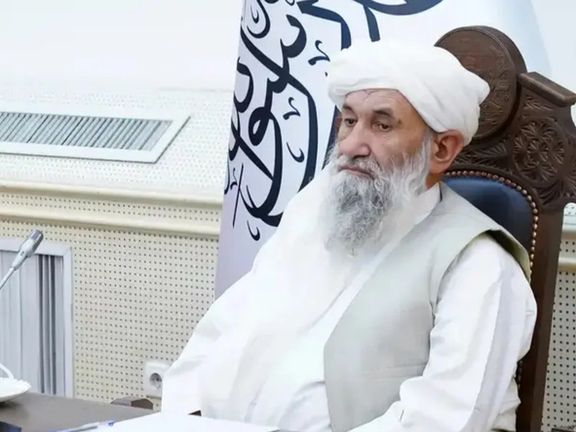
Mullah Hassan Akhund, the Taliban's prime minister called on mullahs and religious scholars to use pulpits to resolve differences and prevent divisions among the people.
Mullah Hassan Akhund, the Taliban's prime minister called on mullahs and religious scholars to use pulpits to resolve differences and prevent divisions among the people.
Many Afghan scholars are dissatisfied with the Taliban's religious policies and criticise them.
Mullah Hassan did not directly address the Taliban's internal divisions, but implicitly called for unity among all forces and religious leaders.
In a statement issued on Friday, he warned that anyone who disobeys this order will face a strong response from the Taliban.
In this declaration, the Taliban's prime minister has emphasised to prevent controversial discussions and debates in eight articles.
The statement called on the mullahs to refrain from mentioning "rare issues" so as not to cause sedition.
Mullah Hassan Akhund said that the mullahs should only express from the pulpit and the media those issues that "are in the interest and happiness of the people in this world”. Religious beliefs, religious rules, Islamic ethics and religious issues are among the issues that mullahs are asked to express.
According to the Taliban's prime minister, mullahs who continue to use inappropriate words in the media give people doubt and make way for sedition.

Following the Taliban's disrespect for the national anthem of the Islamic Republic, the Iranian Foreign Ministry summoned Fazl Mohammad Haqqani, the group's chargé d'affaires in Tehran.
Officials of the Islamic Republic of Iran have called the failure of the Taliban representative to stand up in honour of the national anthem as an "unconventional and unacceptable act”.
Fars News Agency, which is affiliated with the Islamic Revolutionary Guard Corps (IRGC), reported that the Iranian Foreign Ministry's Second South Asia Department summoned the Taliban's chargé d'affaires at the Afghan embassy in Tehran on Friday morning.
The agency called the Taliban's action "contrary to diplomatic norms”.
Azizur Rahman Mansour, the deputy of the Ministry of Guidance, Hajj and Religious Affairs, who headed a delegation to Tehran, did not stand up during the 38th International Islamic Unity Conference when the national anthem of the Islamic Republic of Iran was played. Iranian President Masoud Pezeshkian was also present at the ceremony.
Following widespread criticism of the move, Azizur Rahman Mansour on Friday in a video justifying not standing up in honour of the Iranian national anthem, claimed that it is not customary in Afghanistan to stand in honour of the national anthem.
These statements come at a time when in many cultures, including the culture of Afghanistan, standing during the playing of the national anthem is recognized as a sign of respect for the people and national symbols of that country.
Hassan Kazemi Qomi, the Iranian president's special representative for Afghanistan affairs, in a response, called the behaviour of the Taliban representative disrespectful to diplomatic principles. He stated, "Lack of respect for diplomatic principles under the pretext of banning music from the principles of Sharia has no meaning."
Abbas Mousavi, Iran's former ambassador to Azerbaijan, also reacted to the Taliban's disrespect for the national anthems of Iran and Pakistan, saying that they did not observe diplomatic decency. He suggested that "it would be best to suspend inviting them to any official events until their procedures were modified”.
Recently, the Taliban's consul general in the city of Peshawar behaved similarly when the Pakistani national anthem was played during an official ceremony and did not get up.
Pakistan's Foreign Ministry strongly condemned the Taliban's move, saying, "We will convey our strong protest to the Afghan authorities in Islamabad and Kabul."
The Taliban's consul general in Peshawar said that he did not get up because of the playing of music in Pakistan's national anthem, adding, "There was no intention to disrespect or humiliate the national anthem of Pakistan."
A spokesperson for Pakistan's Foreign Ministry rejected the acting Afghan Consul General’s explanation for not standing during the Pakistani national anthem at an event in Peshawar, terming the action a violation of diplomatic norms.
Mumtaz Zahra Baloch said that the behaviour of this Taliban diplomat is reprehensible and has hurt the sentiments of the people of Pakistan.
Pakistan's Foreign Ministry spokesperson Mumtaz Zahra Baloch announced during her weekly press conference in Islamabad on Thursday, that Pakistan has conveyed its strong protest to the Taliban's officials in Kabul.
She said decisions would be taken after due internal deliberations and conclusion of talks with the Taliban government. She said that Pakistan reserves the right to take action in accordance with diplomatic norms and practices.
Earlier, the Taliban's consul general in Peshawar had announced that he did not stand up when the national anthem was played because of the presence of music, stressing that there was "no intention to disrespect or humiliate the national anthem of Pakistan”.
Mohibullah Shakir, the Taliban's consul general in Peshawar, attended a conference on Tuesday at the invitation of Khyber Pakhtunkhwa Chief Minister Ali Amin Gandapur. While other officials and diplomats stood up as the Pakistani national anthem was played, he and his companion were the only ones who did not get up.
This action of the Taliban consul general has provoked the anger of Islamabad and the Pakistani media has extensively covered the issue over the past two days. Some Pakistani media outlets have described the behaviour of the Taliban diplomat as disrespectful to Pakistan.
The Taliban's foreign minister announced that 39 Afghan political missions in various countries are currently "obedient" to the group.
Amir Khan Muttaqi said that the Taliban's Foreign Ministry has been able to control and manage political representations in the region over the past year.
Amir Khan Muttaqi did not mention these countries.
On Thursday, during a programme explaining the one-year achievements of the Taliban's Foreign Ministry, he said that after trying to establish diplomatic relations with other countries, Kazakhstan and Kyrgyzstan removed the group's name from the list of banned groups.
According to Amir Khan Muttaqi, Russia is also ready to remove the Taliban from the list of banned groups in the near future.
The Taliban's foreign minister said that China, the United Arab Emirates and Uzbekistan have officially accepted the Taliban's ambassadors, and that dozens of the group's diplomats have been sent to Malaysia, Turkiye, Pakistan, Iran, Uzbekistan, Kazakhstan, Moscow, China, Doha and the United Arab Emirates.
The Taliban's foreign minister also criticised the UN Secretary-General's statements about the existence of terrorist groups in Afghanistan and the Taliban's support for these groups.
Amir Khan Muttaqi said that Antonio Guterres has made accusations against the Taliban without investigation.
According to Muttaqi, the UN Secretary-General's information about Afghanistan is very weak. He said that there are no irresponsible groups in Afghanistan and that no harm has been done to any other country from Afghan soil in the past three years.
At a press conference in New York on Wednesday, António Guterres expressed concern over the Taliban's support for terrorist groups in Afghanistan and warned that these groups may infiltrate other countries as well.
The Iranian president's special envoy for Afghanistan called the behaviour of the Taliban official of not standing up for the national anthem of the Islamic Republic of Iran in Tehran a disrespect of diplomatic principles.
Hassan Kazemi Qomi said, "Lack of respect for diplomatic principles under the pretext of banning music from the principles of Sharia has no meaning."
The ambassador and special representative of the Iranian president on social media network X wrote, "If the ban on music has a religious basis, it also includes listening.”
A Taliban official, Azizur Rahman Mansour, the deputy of the Ministry of Guidance, Hajj and Religious Affairs, headed a delegation to Tehran at the 38th International Islamic Unity Conference. He did not get up during the opening ceremony of the conference in honour of the national anthem of the Islamic Republic of Iran.
The Taliban's Ministry of Hajj said that the delegation travelled to Tehran yesterday at the official invitation of the Islamic Republic of Iran and on behalf of the Taliban at the International Islamic Unity Conference.
Recently, the Taliban's consul general in the city of Peshawar also showcased a similar behaviour when he did not get up when the Pakistan's national anthem was played during an official ceremony. Pakistan's Foreign Ministry spokesperson strongly condemned the move by the Taliban diplomat, saying, "We will convey our strong protest to the Afghan authorities in Islamabad and Kabul."
The Taliban's consul general in Peshawar has said that he did not get up because of the accompaniment of music during Pakistan's national anthem. "There was no intention to disrespect or humiliate the national anthem of Pakistan," he said.
The Taliban have not yet given an official explanation for the behaviour of the group's representative in Tehran.
The Taliban's Law on the Promotion of Virtue prohibits the playing of music. Article 222 of this law prohibits the playing of music in vehicles and the playing of music outside the home or in the parliament.
Meanwhile, in response to the "disrespect" of the national anthems of Iran and Pakistan by Taliban representatives, the former Iranian ambassador to Azerbaijan said that they did not observe diplomatic decency.
Abbas Mousavi has suggested that "it is best to suspend their invitation to any official ceremonies until their procedures are corrected".
Abbas Mousavi, who was once the deputy foreign minister of the Islamic Republic, wrote on social media platform X, "Recently, the Taliban's so-called diplomatic representatives in Pakistan and Iran did not observe the most obvious diplomatic norm and courtesy, which is to stand up in honour of the playing of the national anthem of the host country in an official ceremony under the pretext of Taliban law. It is best to suspend inviting them to any official event until the procedure is corrected."
On Thursday, the representative of the Taliban did not stand up to respect the national anthem of the Islamic Republic of Iran at the 38th International Islamic Unity Conference held in Tehran.
This action happened while Iran's president, Masoud Pezeshkian, was also present at the ceremony
The 38th International Conference of Islamic Unity was held on Thursday in the presence of representatives of Islamic countries. During the opening ceremony of this meeting, the national anthem of the Islamic Republic of Iran was played. In the video released since the beginning of the meeting, the representative of the Taliban government is the only one who did not stand up when the national anthem of the Islamic Republic was played.
The Taliban has not commented on this so far.
The authorities of the Islamic Republic of Iran have not said anything about this encounter between Taliban diplomats.
Earlier, the Taliban government's representative in Pakistan also showed similar behaviour in front of the Pakistani national anthem at an official ceremony. Mohibullah Shakir, the Taliban's consul general in Peshawar, was invited to a conference on Tuesday at the invitation of Khyber Pakhtunkhwa Chief Minister Ali Amin Gandapur. According to diplomatic custom, diplomats must stand when the host country's national anthem is played, but he and his companion were the only ones who did not.
Pakistani Foreign Ministry spokeswoman Mumtaz Zahra Baloch strongly condemned the Taliban diplomat's action, saying, "We will convey our strong protest to Afghan authorities in Islamabad and Kabul."