Taliban Announces Return Of Nearly 340 Families From Iran & Pakistan In Single Day

The Taliban-controlled Bakhtar News Agency reported on Friday that 338 families from Iran and Pakistan returned to Afghanistan in a single day.

The Taliban-controlled Bakhtar News Agency reported on Friday that 338 families from Iran and Pakistan returned to Afghanistan in a single day.
According to the report, 53 families returned from Pakistan via Torkham and Spin Boldak, and 285 families returned from Iran via the Silk Bridge and Islam Qala.
On Thursday, the Taliban had announced that 358 Afghan families entered Afghanistan from Iran and Pakistan in a single day.
Recently, the Islamic Republic of Iran and Pakistan have increased pressure and deportation of Afghan refugees.
According to Taliban statistics, hundreds of people return to Afghanistan daily from Iran and Pakistan.
In most cases, these migrants are forcibly deported.
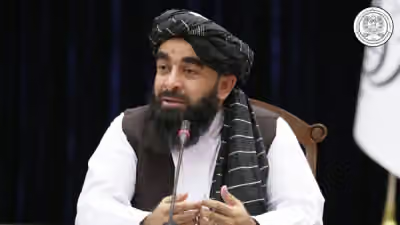
The Afghanistan Security Watch said in a report that Taliban forces have had at least 45 border clashes with neighbouring countries in the past three years.
According to the organisation's statistics, the Taliban forces have clashed with Pakistan 19 times, 16 times with Iran, and 10 times with Central Asian countries.
The organisation published a report on Tuesday announcing that the Taliban's border clashes with neighbouring countries left at least 100 dead and 67 wounded by the warring parties.
Most of the tensions occurred on the eastern and western borders of Afghanistan.
The report’s findings show that one of the causes of the Taliban's border tensions with Iran and Central Asian countries was due to the group's unfamiliarity with border issues.
However, the cause of the border tension with Pakistan has been due to the provocative actions of both sides.
The movements of terrorist groups from inside Afghanistan against Pakistan, Uzbekistan and Tajikistan are other factors that have increased border clashes in the last three years.
The study found that about 90 percent of border tensions led to exchanges of fire, which in some cases resulted in heavy casualties.
The organisation said that the bombing of Pakistani planes in Khost and Kunar provinces in 2022 left at least 50 dead and wounded.
The Afghanistan Security Watch is led by the national security officials of the previous government.

A former US National Security Advisor called for measures to weaken the Taliban and strengthen the Afghan people. HR McMaster said that destructive acts, such as aid to the Taliban, must be prevented, as it strengthens the group's foundations.
According to the Trump administration's national security advisor, more money in the hands of the Taliban will cause more people to suffer in Afghanistan.
The United States has provided more than $2.5 billion in aid to Afghanistan over the past three years. Although the aid is sent to Afghanistan under the guise of humanitarian aid, critics claim that the Taliban benefits from it in the form of taxes from aid organisations and the creation of aid institutions belonging to the group.
Speaking at a meeting of the Afghan Institute for Strategic Studies (AISS) held at George Washington University on Thursday evening, McMaster said that what has happened in Afghanistan over the past three years was completely predictable. Among other things, he pointed to the core nature of the Taliban, the group's repressive spirit and its links to terrorist organisations.
The former senior US military official also called the US policy towards the war in Afghanistan flawed and said that the US strategy was incomprehensible in light of the realities in Afghanistan.
"Specifically, I want to point out the distinction that the Obama administration said that the Taliban is not the main problem, but al-Qaeda is the main problem," McMaster said.
He also said that drawing a clear line between al-Qaeda and other terrorist organisations was an illusion, and that this illusion is still held by a number of US officials in the country's intelligence agencies.
The former US National Security Advisor also questioned the process of Doha peace talks between the United States and the Taliban, saying that these talks discredited Ashraf Ghani's government.
McMaster also accused the Trump administration of "colluding with the Taliban," which gave the group concessions, including halting airstrikes on the Taliban.
The Doha Agreement was signed during Trump's presidency and brokered by Zalmay Khalilzad, his special envoy for Afghanistan, in February 2020. According to US officials, this agreement paved the way for the fall of the previous Afghan government.
The former US national security adviser said, "In my opinion, the situation in Afghanistan and the collapse of the security forces were self-inflicted. It was based on an illusion, based on a self-inflicted story to justify the withdrawal from this country."
McMaster called the Taliban's resistance indigenous, rather than perceived as part of a jihadist-Salafi group, and the "useful and effective role of Pakistan" as part of these illusions.
He described the Doha peace agreement as a document of American surrender that was implemented by Biden head to heart. According to him, Biden did not have so much faith in any of the Trump administration's agreements except the Doha agreement.

Fahim Azimi, an education activist, has been released from Taliban custody after 11 months, Amnesty International said.
The organisation said that Fahim Azimi should not have been imprisoned for defending the right to education. The Taliban had arrested Azimi on charges of "helping the girls of the robotics team leave" and organising protests.
Amnesty International announced the release of the education activist on Thursday.
The Taliban has not yet commented on the release of Fahim Azimi.
Azimi, along with fellow education activist Sediqullah Afghan, was arbitrarily arrested by the Taliban on October 17, 2022, at their office in the Karte 4 district of Kabul. Sediqullah Afghan was released on April 9 of this year during a Taliban amnesty marking Eid al-Adha.
Over the past year, human rights organisations have called for the release of this girls' education activist from the Taliban's prison.

Former US envoy Zalmay Khalilzad called the claim of Michael McCaul, chairman of the US House Foreign Relations Committee, about his responsibility for the chaotic withdrawal from Afghanistan, unsubstantiated.
Khalilzad acknowledged that the final stage of the withdrawal was a disaster, but stressed that the main reason was a lack of intelligence.
According to Khalilzad, US officials did not anticipate that the Afghan government would simply collapse or that its military would be fundamentally disintegrated before US troops leave.
Michael McCaul has previously blamed 15 US officials, including Zalmay Khalilzad, for the chaotic withdrawal from Afghanistan. He mentioned President Joe Biden and Vice-President Kamala Harris, the secretaries of defence and foreign affairs, and Zalmay Khalilzad.
Zalmay Khalilzad, the former US envoy for the Afghan peace talks, wrote on Wednesday night, in response to Michael McCaul's remarks on social media platform X that he had not commented on the Taliban's adherence to their commitments and respect for basic human rights.
Zalmay Khalilzad said that the Doha agreement had nothing to do with human rights and instead focused on a safe military withdrawal, preventing the Taliban from attacking US forces and preventing terrorists from using Afghan soil against the United States.
He clarified that President Biden decided not to make the US withdrawal from Afghanistan conditional on an intra-Afghan political agreement, and he feared that with the prolongation of intra-Afghan negotiations, the Taliban's attacks against US forces would resume.
McCall claimed that Zalmay Khalilzad had assured that the Taliban would abide by their commitments and respect human rights.
However, Khalilzad emphasises in his statement that he did not make any comments about the Taliban's adherence to their human rights obligations during his tenure.
"When I was asked in various congressional committees whether I trusted the Taliban to fulfil their commitments on military issues and terrorism, I replied that we were talking about international relations, an arena where no one could be trusted, especially the Taliban," he wrote.
Zalmay Khalilzad also wrote that the peace talks were not a matter of trust, and that the agreement that was negotiated was based on conditions, not trust. He added that the agreement makes the fulfilment of US commitments conditional on the Taliban fulfilling their commitments, and this issue must be continuously evaluated and confirmed.
US House Foreign Relations Committee Chairman Michael McCaul said that the Doha agreement between Zalmay Khalilzad and the Taliban was a slap in the face to the Afghan government. He called the agreement a mistake by Zalmay Khalilzad, which had a negative impact on the morale of the previous Afghan government, adding that Khalilzad "negotiated with the Taliban and left out the Afghan government”.

More than 20 countries supported the decision of Germany, Australia, Canada, and the Netherlands to prosecute the Taliban at the International Court of Justice.
These countries announced that they condemn human rights violations in Afghanistan, especially gender discrimination against women and girls by the Taliban.
The countries said that they do not politically recognise the Taliban as Afghanistan's legitimate leaders, according to the Associated Press.
Recently, the foreign ministers of Germany, Australia, Canada, and the Netherlands have warned that if the situation of Afghan women and girls does not change, they will file a complaint against the Taliban with the International Court of Justice. The four countries stressed that the violation of the rights of women and girls in Afghanistan must stop.
In a statement on Wednesday, the foreign ministers of the four countries condemned the gross and systematic violations of human rights in Afghanistan, especially gender discrimination against women.
The Associated Press reported on Thursday that more than 20 countries have now backed the plan.
At the same time, Fereshta Abbasi, an Afghanistan researcher at Human Rights Watch, called on other countries around the world to declare their support for the legal measures taken by these four countries.
"The announcement by Germany, Canada, Australia and the Netherlands may be the beginning of a path to justice for the Taliban's gross human rights violations against Afghan women and girls," Abbasi said.
