Special Committee To Be Formed For Implementation Of Group's Orders, Says Taliban Official
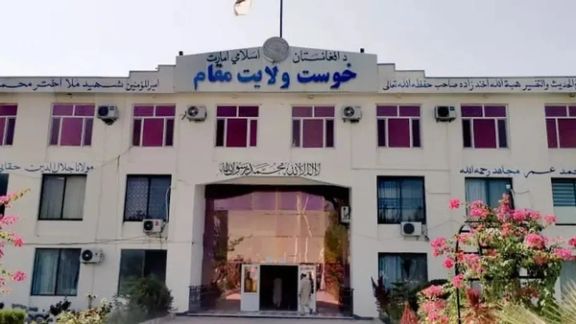
The Taliban’s governor in Khost said on Sunday that Islamic law is applied first in government institutions and then, in society.

The Taliban’s governor in Khost said on Sunday that Islamic law is applied first in government institutions and then, in society.
Abdul Qayyum Rouhani added that a special committee will be appointed to implement the Taliban's orders and laws throughout the country.
Some men's hair salons in Khost and Paktia provinces told Afghanistan International that the Taliban has imposed a fine of 10,000 afghanis for cutting hair in a modern style.
The group warned the owners of such salons that if they violated the law, their shops would be closed for a month.
The emphasis of Taliban officials on the implementation of Islamic laws in the light of the Sharia law desired by this group is not new.
Previously, the Taliban had forced employees of all government institutions to perform prayers, sport beards, and wear the clothing desired by the group.

During a speech, the Taliban's deputy foreign minister said that terrorist groups have been eliminated in Afghanistan and they will not allow such groups to wage a proxy war in the country.
Abbas Stanikzai claimed that terrorist groups are imported and use the territory of some neighbouring countries against the Taliban.
Stanikzai added that a number of terrorists have been arrested whose centres were located outside Afghanistan.
Earlier, the Taliban published the confessions of a number of detained ISIS members who claimed to have been trained in Pakistan's Balochistan province and sent to Afghanistan. In a statement, the Taliban spokesman claimed that the ISIS group's centres are located outside Afghanistan and in Pakistan's Balochistan province.
Previously, the former Afghan government accused Pakistan of using the Afghan Taliban against it. Now, the Taliban has pointed the finger at Pakistan and sees ISIS as a tool of Pakistan to put pressure on the group's government.
Speaking at the opening ceremony of the third international Imam Abu Hanifa exhibition in Kabul on Sunday (October 6), Stanikzai said, "We will not allow anyone to use Afghan soil against the security of other countries. We have mutual interaction and we do not allow anyone to interfere in our internal affairs. We stand firmly and courageously against those who pose a security threat."
"Just as we defeated the US and NATO, we will also fight against imported terrorists who seek proxy war in Afghanistan," he added.
In another part of his speech, Stanikzai called the treatment of Afghan refugees by Iran and Pakistan unacceptable and said that these two countries should treat the refugees "with good behaviour" until the ground for their voluntary return is provided.

The Taliban’s Ministry of Foreign Affairs has called on the Pakistani government to engage in dialogue with supporters of former Prime Minister Imran Khan, urging them to address the protesters’ “legitimate demands.”
Despite having suppressed numerous civil movements in Afghanistan over the past three years, the Taliban cautioned that refusing to negotiate could exacerbate the situation further.
In a statement released on Sunday, 6th October, the Taliban’s Ministry of Foreign Affairs expressed concern over the ongoing tensions between the Pakistani government and its political opponents. Abdul Qahar Balkhi, spokesperson for the Ministry, shared a message on the social media platform X, stating that the group is closely monitoring the current situation in Pakistan.
The Taliban called on the Pakistani government to approach the grievances of the protesters in a “reasonable” and “realistic” manner.
The demonstrations in Islamabad, supporting Imran Khan, were organised following a call from the leader of the Pakistan Tehreek-e-Insaf (PTI) party, who has been imprisoned in Rawalpindi for over a year.
Earlier, Pakistan’s Interior Minister, Mohsin Naqvi, alleged that Afghan citizens were involved in the protests, with 120 arrested so far. PTI officials have denied these claims.
While the Taliban now encourages dialogue in Pakistan, the group has violently suppressed numerous peaceful civil movements in Afghanistan in recent years. Hundreds of civil activists, journalists, human rights defenders, and political opponents have been imprisoned under their regime.
Human rights organisations have reported that many of the Taliban’s opponents have faced violence in detention, with some dying under torture in Taliban prisons during the past three years.

The federal government of Pakistan announced on Sunday that it has officially designated the Pashtun Tahafuz Movement (PTM) as a ‘proscribed organisation,’ effectively banning its activities across the country.
In a statement, the government explained that the movement’s activities are deemed a threat to national peace and security. The statement shared with the media read: “The Federal Government, having reasons to believe that the Pashtun Tahafuz Movement (PTM) is engaged in activities prejudicial to the peace and security of the country.”
Invoking Section 11B of the Anti-Terrorism Act, the government has moved to ban the PTM and prohibit its operations.
The PTM is a well-known movement advocating for the rights of Pashtuns in Pakistan. It has long protested against what it calls discrimination and unlawful actions by the Pakistani military, accusing the Army of committing human rights violations, including extrajudicial killings and enforced disappearances in Pashtun tribal areas.

Local sources have reported to Afghanistan International that a skirmish occurred between the Taliban and Pakistani border guards on Sunday, 6th October, in the Shorabak district of Kandahar.
According to these sources, Pakistani forces opened fire as the Taliban were constructing facilities along the Durand Line, the contentious border between Afghanistan and Pakistan.
The clash took place in the Noshak and Gaznal areas of Shorabak and lasted for approximately 15 minutes. No official statement has been released by the Taliban regarding the incident.
Meanwhile, the Taliban’s 205th Corps in Kandahar has reportedly established security checkpoints along the Durand Line, extending from Shorabak district to Zabul. While the Taliban assert that these checkpoints are intended to enhance security, there are reports that Pakistani border guards have been obstructing their construction.
This latest incident adds to a series of clashes between Taliban and Pakistani forces over the past three years. These confrontations, which have occurred at various border crossings and other points along the border, have frequently led to the closure of shared crossings, resulting in significant financial losses for traders on both sides.

Mohsin Naqvi, Pakistan’s Interior Minister, has claimed that Afghan citizens were involved in the recent protests organised by supporters of Imran Khan in Islamabad, with 120 of them arrested so far.
However, officials from the Pakistan Tehreek-e-Insaf (PTI) party have denied any Afghan involvement in the demonstrations.
During a press conference on Saturday, Naqvi revealed that over 100 Afghan nationals had been identified and detained over the past two days during the protests in the capital. He expressed surprise at their participation, stating, “If the protesters are our own people, why are Afghans among them?”
In response, Muhammad Ali Saif, Information Adviser for Khyber Pakhtunkhwa, dismissed these allegations, describing them as “propaganda.” He stressed that only PTI workers had participated in the protests and labelled Naqvi’s press conference as baseless.
The protests, led by Ali Amin Gandapur, the Chief Minister of Khyber Pakhtunkhwa and a senior PTI member, resulted in clashes between demonstrators and law enforcement. Reports indicate that at least 80 police officers were injured during the confrontations.
The Interior Minister further alleged that protesters, under Gandapur’s leadership, had opened fire on police personnel during the unrest.
