New Ambassador Of Uzbekistan Starts Role In Kabul

Uzbekistani media reported that Oybek Usmanov has started his work as the country's new ambassador to Afghanistan.

Uzbekistani media reported that Oybek Usmanov has started his work as the country's new ambassador to Afghanistan.
Oybek Usmanov, 62, previously served as Uzbekistan's ambassador to Egypt and Pakistan.
According to Uzbekistan news agencies, the Uzbek diplomat arrived in Kabul on Sunday, October 27.
Osmanov's biography states that he was the Deputy Minister of Foreign Affairs of Uzbekistan from 2011 to 2012.
The former ambassador of Uzbekistan to Afghanistan was Yadgar Khwaja Shadmanov, who announced the end of his mission in Afghanistan in September this year after 12 years.
Although Uzbekistan does not recognise the Taliban government like other countries, it has established close relations with the group.
Taliban and Uzbekistan officials have welcomed each other many times during the three years of the Taliban's rule.
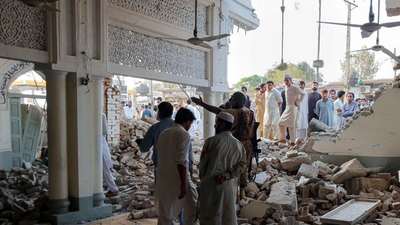
Rukhshana Media reported that the Taliban has established a jihadi school for followers of the Shia Ismaili sect in Shighnan District, Badakhshan.
According to the report, Taliban's Sunni mullahs teach Sunni religious books to children in the predominantly Shia Ismaili district of Shighnan.
Rukhshana Media reported on Monday (October 28), citing its sources, that the Taliban's action is "an attempt to forcibly convert the residents of this district", who are Shia Ismaili.
In October this year, the Taliban's education department in Badakhshan announced the establishment of a madrassa called "Imam Hussain" in the centre of Shighnan district.
Rukhshana media reported that more than 200 male children from the Ismaili sect of the district are studying in this school, and the teachers who were hired from schools outside the district were graduates of Taliban’s madrassas.
Rukhshana Media quoted their source as saying that none of the books taught in this school are common in the Ismaili sect.
Residents of the district said that in Shighnan, a religious school of the Ismaili sect already existed, which provided religious education based on the teachings of this Shia sect of Islam.
Residents of the district also said that the Taliban teach children about jihad, war and extremism in this madrassa.
The Taliban has paid special attention to the extensive establishment of jihadi schools after their return to power in Afghanistan. According to the Taliban government, the group has so far established more than 21,000 religious schools across Afghanistan. Taliban officials consider the establishment of jihadi madrassas important in maintaining the group's influence and power in Afghanistan.

Secretary General of the Shanghai Cooperation Organisation (SCO) announced that the organisation wants an inclusive government to be formed in Afghanistan with the participation of representatives of all political, ethnic and religious groups.
Zhang Ming told Russia's Izvestia newspaper that the formation of an inclusive government is in the interest of Afghanistan.
In the interview, which was published on Monday, October 28, Zhang Ming said, "The issue of Afghanistan is very important from the perspective of ensuring peace, stability and security in the region.
"We would like Afghanistan to become a country free of terrorism, war and drugs, and we hope that in the future, a government will be formed in Afghanistan with the broad participation of representatives of all political, ethnic and religious groups," he added.
According to him, these cases will be in the interest of Afghanistan, the member countries of the Shanghai Cooperation Organisation and the entire international community.
The Shanghai Cooperation Organisation (SCO), which was formed in 2001 by Russia and China, consists of nine members, including Belarus, Iran, Pakistan, India, Kazakhstan, Kyrgyzstan, Tajikistan, and Uzbekistan.
Afghanistan joined the SCO as an observer member on June 7, 2012, but the Taliban has not been invited to its meetings for the past three years.

Sources told Afghanistan International that representatives of private media met Taliban officials in Kandahar to discuss their concerns regarding the ban on publication of images of ‘living beings’ and the future of media.
According to sources, Taliban officials did not "respond positively" to the concerns of TV officials.
A source told Afghanistan International that the Taliban's Ministry of Information and Culture in Kabul, after the meeting with representatives of television stations and organisations supporting journalists, advised them to meet and discuss the ban on the publication of images of living creatures with senior Taliban officials in Kandahar.
"Last week, a number of officials of private television went to Kandahar in coordination with the Ministry of Information and Culture to discuss the future of television with Taliban leaders," the source said.
The source added that Taliban leaders have not responded positively to the concerns of the private media outlets.
The Taliban's Law for the Promotion of Virtue prohibits the photography and publication of images of living creatures, and a number of television stations have stopped broadcasting due to this restriction.
Another source said that media officials shared their concerns with Taliban leaders during the meeting, and apparently they assured them that televisions would not be blocked. However, media officials said that the ban on the publication of images of living creatures will pave the way for the gradual closure of televisions.
Sources claimed that media officials and organisations supporting journalists want to encourage Taliban leaders in Kandahar, especially Taliban leader Mawlawi Hibatullah Akhundzada, to show flexibility in this regard.
According to the source, one step in this regard is the establishment of a joint commission or committee that will hold talks with various Taliban leaders.
Officials of Afghanistan's private television stations have not yet confirmed the full details of the meeting, but journalists and media workers are deeply concerned about the implementation of the law.

The Taliban’s Deputy Foreign Minister, Abbas Stanekzai, has downplayed reports of internal discord within the group, attributing these rumours to “negative media propaganda.”
Stanekzai stated that the Taliban have no disagreements and that all members follow their leader. However, he acknowledged the existence of “differences of opinion” within various departments.
Speaking at a gathering in Kabul on Tuesday, Stanekzai dismissed claims of factional divisions, stating, “All members of the Emirate, from top to bottom, obey one Amir al-Mu’minin.” Yet, he also made contradictory remarks, admitting that “differences of opinion” exist within the group.
“Yes, differences of opinion are everywhere,” he said. “In every society, in every ministry, in every department, and even within families. You’ll find differences of opinion between fathers and children within a single household.”
Stanekzai went on to say that no previous leader in Afghanistan has exercised as much “control and authority” over the government as the Taliban leader does today. “This unity and cohesion show that our entire nation stands as one today,” he added.
In previous remarks, Stanekzai stressed that the continuation of the Taliban regime depends on establishing justice within society. He noted that in a society where justice is absent and corruption and disorder prevail, people lose trust in the system and eventually flee the country. According to the International Organization for Migration, at least eight million Afghans have left the country under Taliban rule since 2022.
Taliban officials often assert that there is no division among the group’s members, although certain statements from leaders suggest otherwise. According to various reports, the Taliban have internal disagreements over issues such as girls’ education and the stringent laws imposed by the Ministry for the Promotion of Virtue. Some officials have also reportedly expressed dissatisfaction with the “concentration of power” among Kandahari members of the Taliban.
In one instance, Taliban Interior Minister Sirajuddin Haqqani criticised this concentration of power in February 2023, stating that the current situation is “unacceptable.”

The Taliban Supreme Court announced that a man was publicly flogged in Faryab Province on charges of extramarital sexual relations.
According to the court’s statement, the accused was sentenced on Sunday, October 27, to 35 lashes and four months of imprisonment.
The statement from the Taliban Supreme Court detailed that the punishment was carried out based on the decision of the court and executed by the primary court of Dawlatabad District in Faryab Province. No further information regarding the individual’s identity was provided, but it was noted that the punishment was administered in a public gathering with the presence of Taliban officials and local residents.
Despite opposition from international human rights organisations, the Taliban continue to carry out public corporal punishment and torture of accused individuals. On Thursday, the Taliban’s Supreme Court also publicly flogged 17 people in Khost Province on charges that included extramarital relations and same-sex relations.
