Taliban Announces Deportation of 200 Afghan Refugee Families From Iran & Pakistan
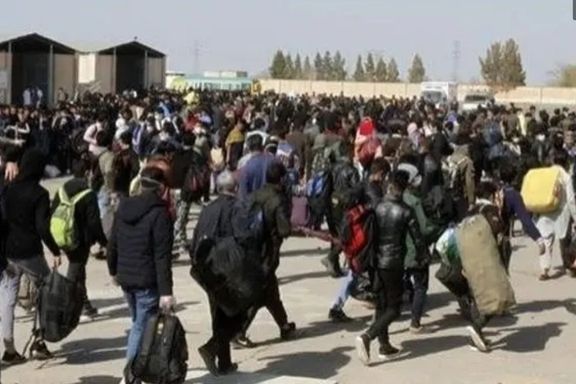
Bakhtar News Agency, a Taliban-controlled media outlet, reported that 204 Afghan refugee families were deported from Iran and Pakistan in a single day.
Bakhtar News Agency, a Taliban-controlled media outlet, reported that 204 Afghan refugee families were deported from Iran and Pakistan in a single day.
The media outlet reported that 58 families from Pakistan and 146 families from Iran have returned to Afghanistan.
The Taliban-controlled state media outlet Bakhtar News Agency reported on Friday, November 1, that the Afghan refugees were deported to Afghanistan from the Torkham, Spin Boldak, Islam Qala and Pul-e-Abrisham crossings.
On Tuesday, October 29, the media outlet also reported the deportation of 268 Afghan refugee families from Iran and Pakistan.

Russia's foreign minister said that the United States and its allies fled Afghanistan after 20 years of "occupation”, but today they still want to "interfere" in the country's situation.
Sergey Lavrov said that the United States and its allies are seeking to resume a military presence in Central Asia.
"The United States and its allies, who fled Afghanistan after 20 years of occupation, today want to interfere in the fragile process of stabilising the situation in the country and are inventing excuses to resume their military presence in Central Asian countries," he said on Thursday, October 31, at the International Eurasian Security Conference in Minsk, Belarus.
Sergey Lavrov did not provide further details. However, following its withdrawal from Afghanistan, the US government had said that it would monitor the activities of terrorist groups in Afghanistan "with aerial surveillance and reconnaissance”.
Under the plan, the US military in the region has strengthened its ability to monitor, control, and, if necessary, strike terrorists.
Earlier, the Taliban's defence minister had said in a televised interview that the group was trying to prevent foreign planes from patrolling Afghanistan's airspace. Mullah Yaqoob had said that Afghanistan's airspace was still under "occupation".
The Taliban has accused Pakistan of allowing US planes to enter Afghan territory. There have been reports of US drones patrolling the skies over Kandahar, Kapisa, Kabul, Badakhshan, Panjshir, Nimroz, Herat and some other provinces of Afghanistan.
Referring to the role of the United States in the political developments of various countries, Sergey Lavrov said, "As a result of the aggressive actions of the United States, NATO and the European Union, the risks of the fragmentation of our continent have increased."
Richard Bennett, the United Nations Special Rapporteur on Human Rights, said that countries that pledged to support Afghanistan and then left the country "in a hurry" should not forget Afghanistan.
Bennett added that the international community must have a coherent strategy and action plan on Afghanistan.
In a recent interview with United Nations Radio in New York, which aired on Thursday, October 31, He said that the human rights situation in Afghanistan is deteriorating, especially for women, girls, ethnic and religious minorities, the media, and civil society. He stressed that space in Afghanistan is shrinking.
Bennett also said that nowhere in the world are women and girls treated in such a "horrific" way as in Afghanistan. He said that during his report to the UN General Assembly in New York, he would ask the UN member states not to forget Afghanistan.
Bennett told the international community, "Don't forget Afghanistan. The countries that had committed themselves to Afghanistan abandoned it in a hurry. These countries have a responsibility not to forget Afghanistan."
The UN human rights official said that the international community should have a coherent international strategy on Afghanistan in which the interests of the Afghan people are prioritised over the interests of regional or specific countries.
Referring to the recommendations and suggestions of the United Nations Special Coordinator, Feridun Sinirlioğlu, Richard Bennett stressed on the need to develop a roadmap and action plan for the future of Afghanistan that includes women, civil society, and even the Taliban.
The United Nations on Monday released a detailed report by Richard Bennett, the special rapporteur on the human rights situation in Afghanistan. Bennett will present the report to the UN General Assembly on Friday, November 1.
The report mentions the repression of women in protest against the Taliban's compulsory hijab. According to Bennett's report, some female protesters were taken to a Taliban police station where they were subjected to verbal and physical violence.
In his new report, he said that some "credible sources" testified about the sexual harassment and rape of women in Taliban prisons.
In response to the Taliban's deputy interior minister's offer to hold talks with the Pakistani Taliban, Mumtaz Zahra Baloch, Pakistan's foreign ministry spokesperson said that Islamabad was not willing to engage with "terrorist" groups.
Baloch said that negotiating with the Pakistani Taliban is an insult to the group's victims.
Earlier, Mohammad Nabi Omari, the Taliban's deputy interior minister, suggested that the Pakistani government and the TTP should enter into dialogue instead of war.
The Taliban official also warned against the expansion of Pakistan's violence in Afghanistan.
However, during a press conference in Islamabad on Thursday, Pakistan's Foreign Ministry spokesperson stressed that Pakistan has no interest in interacting with terrorist groups responsible for the killing of civilians and security forces in the country.
"Such advice is an insult to people who have lost loved ones to the activities of the TTP," Baloch said.
Baloch stressed that the Afghan Taliban bears the main responsibility for taking action against terrorist groups, especially the Tehreek-e-Taliban Pakistan (TTP), which operate from Afghanistan.
Baloch noted that Pakistan has provided evidence to Taliban officials in this regard.
Pakistan has always accused the Afghan Taliban of supporting and sheltering the Pakistani Taliban. However, the Afghan Taliban has repeatedly denied this claim, claiming that it does not allow militant groups to use Afghan soil against neighbouring countries and the region.
Sources from Türkiye have informed Afghanistan International that on Thursday, a closed-door meeting was held in Istanbul, gathering a group of Afghan political activists and officials from Afghanistan’s former government.
The meeting was reportedly hosted by Hikmat Khalil Karzai and Idris Zaman.
A copy of the agenda obtained by Afghanistan International indicates that attendees of this “First Session of the National Dialogue Process” discussed the current situation in Afghanistan and explored “pathways to overcoming the existing challenges in achieving political stability.”
Among those in attendance were prominent women’s rights activists, including Shukria Barakzai, Fawzia Koofi, and Shahgul Rezai. Additionally, former Afghan government officials, such as Mustafa Mastoor, the former Minister of Economy, and Ali Ahmad Osmani, the former Minister of Energy and Water, were present.
Sources also reported the participation of political activists Jafar Mahdawi and Abdul Qayum Sajjadi, who travelled from Kabul for the meeting. The guest list further included religious figures, such as Abdul Salam Abed.
According to sources, the meeting commenced on Thursday in Istanbul and is expected to continue into Friday. As of now, none of the participants have provided comments on the meeting’s objectives or specifics.
This meeting comes as preparations are underway for the fourth round of Doha Talks on Afghanistan, hosted by the United Nations. On October 29, Qatar’s Ministry of Foreign Affairs announced that Alya Ahmed bin Saif Al-Thani, Qatar’s representative to the UN, had held discussions with Rosemary DiCarlo, UN Under-Secretary-General, regarding the forthcoming Doha Talks. The exact date for this session is yet to be determined.
The Taliban’s embassy in Beijing has announced the inauguration and operational launch of a new freight railway line connecting China and Afghanistan.
According to a statement from the embassy, this new route originates in the city of Nantong, China, and is intended to facilitate the transportation of goods between China and the Hairatan port in northern Afghanistan.
On Thursday, the Taliban embassy in Beijing released a statement declaring that the Nantong-Hairatan railway line was inaugurated in the presence of Bilal Karimi, the Taliban’s representative in China; Yue Xiaoyong, China’s representative for Afghanistan; and several Nantong officials, including the city’s mayor and the heads of transportation and foreign relations.
According to the statement, the first journey of the freight train to the Hairatan port has commenced, with an initial shipment of 50 containers expected to reach its destination within the next 20 days.
During his address at the ceremony, Karimi emphasised the Taliban’s prioritisation of economic ties with neighbouring countries, noting that this project could help strengthen economic and trade relations between Kabul and Beijing. He remarked, “As we view China through the Nantong railway line as a gateway to the broader world, we believe that the Wakhan Corridor can also serve as an efficient and cost-effective link between Afghanistan and China.”
The Wakhan Corridor, located in the Pamir mountains of Badakhshan, connects Afghanistan from the northeast to China, Tajikistan, and Pakistan, and provides the only direct route between Afghanistan and China’s Xinjiang or Kashgar region.
The statement also quoted Nantong city officials, who indicated that the process of goods transportation between the two countries will continue.
The Taliban highlighted that this freight railway line was executed under China’s “Belt and Road Initiative.”