Islamic Republic Executes Three Afghan Prisoners in Karaj's Ghezel Hesar Prison
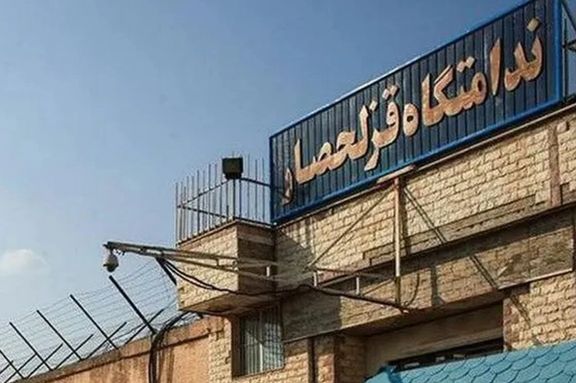
Iran Human Rights announced that the Islamic Republic has executed 10 prisoners, including three Afghan citizens, in Ghezel Hesar Prison in Karaj.

Iran Human Rights announced that the Islamic Republic has executed 10 prisoners, including three Afghan citizens, in Ghezel Hesar Prison in Karaj.
The organisation said that the prisoners had been sentenced to death on charges of murder, drug offences, and sexual assault.
Iran Human Rights wrote in a report that these prisoners were executed by the authorities of Ghezel Hesar Prison on the morning of Wednesday, November 6.
The organisation identified one of the Afghans executed in the prison as Mohammad Tajik, saying that he had been sentenced to death by the Islamic Republic's judiciary on charges of "rape”.
Iran Human Rights (IHR) stated that an Afghan prisoner named Ajmal Azizi was executed on charges of "premeditated murder" in Karaj's Ghezel Hesar Prison. The organisation did not elaborate on the identity of the third Afghan prisoner who was executed in this prison.
In recent days, Iran Human Rights has consistently reported on the execution of Afghan citizens imprisoned in Iran.
The organisation announced on November 4 that the execution of Afghans in Iran has increased since the Taliban came to power in Afghanistan no, and that 90 Afghans have been executed in the country since 2022. In the past month alone, 13 Afghans have been executed in Iran on various charges, the organisation said.


The Commonwealth of Independent States (CIS) Secretary-General Sergey Lebedev announced that the bloc supports the Collective Security Treaty Organisation's plan to create a security belt around Afghanistan.
Lebedev expressed hope that the plan will lead to a reduction in the activity of terrorist groups in the region.
Azerbaijan, Armenia, Uzbekistan, Belarus, Tajikistan, Russia, Kyrgyzstan, Kazakhstan and Moldova are members of the Commonwealth of Independent States.
At a meeting of the secretaries of the Commonwealth of Independent States (CIS) Security Council in Moscow, Sergey Lebedev called for expanding cooperation for regional security, TASS news agency reported on Thursday, November 7.
"We hope that the establishment of a security belt around Afghanistan will help thwart the activities of international terrorist groups and combat drug trafficking, weapons and illegal immigration," he said.
The plan to create a security belt around Afghanistan was first proposed by Tajik President Emomali Rahmon in October 2022 at an extraordinary meeting of the Collective Security Treaty Organisation (CSTO).
At the time, he stressed that in order to prevent dangers, it was necessary to create a security belt around Afghanistan.
Although some countries in the region have economic and diplomatic relations with the Taliban, none of them recognise the Taliban and are still concerned about the spread of extremism.
In this regard, CSTO announced about two weeks ago that it would approve a plan to strengthen Tajikistan's border with Afghanistan.

Governor Khyber Pakhtunkhwa Faisal Karim Kundi called for the opening of seven joint border crossings between Afghanistan and Pakistan.
Kundi said that the reopening of these crossings will enhance trade and regional connectivity.
The governor of Khyber Pakhtunkhwa province said on Wednesday, November 7, at a meeting in the city of Peshawar that the opening of these crossings will boost trade between Pakistan, Afghanistan and Central Asian countries.
Dawn newspaper quoted Kundi as saying, "The opening of all border crossings with Afghanistan will not only expand trade, but also create economic activities in the region."
He also emphasised that the process of issuing visas for Afghans should be facilitated and common border markets between Afghanistan, Iran and Pakistan should be established.
Afghanistan and Pakistan share more than 2,000 kilometres of border, along which there are at least eight border crossings. Among these crossings, the movement of passengers and commercial goods is mostly through the two crossings of Torkham and Spin Boldak.
The governor of Khyber Pakhtunkhwa province did not specify which border crossings should be opened.
Other border crossings such as Angur Ada border crossing between Barmal district of Paktika and South Waziristan of Pakistan's Khyber Pakhtunkhwa; Kharlachi border crossing between Kurram tribal district of Khyber Pakhtunkhwa and Patan district of Paktia province; Ghulam Khan border crossing between Miranshah region of Khyber Pakhtunkhwa and Khost; Arandu border crossing between Swat region of Khyber Pakhtunkhwa and Barkunar district of Kunar province; Bodi border crossing between Qala Saifullah area of Balochistan and Zabul province, and Tari Mangal border crossing between Parachinar and Aryob in Zazi district.

The Taliban announced that the representative of the European Union during a meeting with the group's minister of economy promised to provide another $100 million in aid to Afghanistan.
The aid will be allocated to support development projects, especially in the agriculture sector, the statement said.
The Taliban's Ministry of Economy wrote in a statement that Veronika Boskovic Pohar, the representative of the European Union, said that the organisation will soon hold a conference on small businesses in Afghanistan.
In a statement issued by the ministry on Thursday, November 7, the ministry said that during the meeting, the Taliban's Minister of Economy, Din Mohammad Hanif, appreciated the EU's humanitarian aid to Afghanistan and called for the continuation of the EU's development cooperation in various sectors.
The European Union has not yet commented on the meeting and the promise of $100 million in aid to Taliban-controlled Afghanistan.
Humanitarian aid from the international community is usually distributed through United Nations-owned agencies in Afghanistan. The process of distributing these aids has been the subject of much criticism over the past three years. A number of critics claim that there is no transparent monitoring body to prove that this aid actually reaches the needy and that the Taliban does not benefit from it.
According to the United Nations, more than 20 million people in Taliban-controlled Afghanistan are in need of humanitarian assistance.

The Reporters Without Borders (RSF) organisation has called for the immediate reopening of a local radio "Zhman" in Khost province of Afghanistan.
In a note on social media platform X, this organisation once again condemned the Taliban's attacks on press freedom.
The Afghan Journalists Centre had reported on Wednesday that the Taliban in Khost province closed the office of the local radio "Zhman" for playing music in the background of a programme.
This centre said that the Taliban has stopped the broadcast of two local radio stations in this province since the past two weeks.
In the past three years, the Taliban has closed a large number of media outlets under various pretexts.
The group has also imposed strict restrictions on journalists and the media. The actions of the Taliban against the media and the narrowing of the space have caused a large number of these institutions and journalists to stop working.

During a meeting with JP Singh, an official of the Indian Foreign Ministry, Taliban’s Foreign Minister Amir Khan Muttaqi said that the group expects its relations with Delhi to develop.
In this meeting, Muttaqi also called for facilitating the issuance of Indian visas to Afghans, especially businessmen.
Zia Ahmad, the Taliban's deputy foreign ministry spokesman, said in a statement on the social media platform X on Thursday, November 7, that Muttaqi and Singh discussed political and economic relations between Afghanistan and India.
The statement quoted Amir Khan Muttaqi as saying that the Taliban expect the group's relations with India to expand in various sectors.
JP Singh is in charge of the Afghanistan, Pakistan and Iran section of the Indian Ministry of External Affairs.
In its statement, the Taliban's Foreign Ministry quoted the Indian official as saying that in addition to humanitarian aid, Delhi has also started its development assistance to Afghanistan and is in technical talks in this regard with relevant institutions in Afghanistan.
The Taliban statement also quoted JP Singh as saying that in the near future, talks on Chabahar port will be held between technical delegations of the countries of the region, Afghanistan and India.
The Indian diplomat also met with Yaqoob Mujahid, the Taliban's defence minister. In this meeting, Taliban and Indian officials emphasised on the expansion of bilateral relations.
The Taliban said that the Indian official promised to facilitate the issuance of visas to Afghans.
After the Taliban takeover, India closed its embassy in Kabul. New Delhi also cancelled all visas issued to Afghans and stopped issuing new visas. More than three years after the Taliban rule, India is still not responding to Afghans' visa applications. Thousands of Afghan students in India, who went to Afghanistan on vacation after the Taliban came to power, are stranded there.
India sent a delegation to Kabul for the first time since the fall of the Islamic Republic of Afghanistan in 2022. Although the visit was aimed at providing humanitarian aid, Taliban officials, including Mullah Yaqoob, Amir Khan Muttaqi, and Abbas Stanikzai, spoke to Indian media afterwards and expressed their desire to expand ties with Delhi.
The Taliban and India are discussing expanding relations at a time when relations between the Taliban and Pakistan are tense. Pakistan accuses the Taliban and India of supporting the country's armed opposition. An accusation that the Taliban and India have denied.