Terrorist Threats From Afghanistan Persist, Warns CSTO
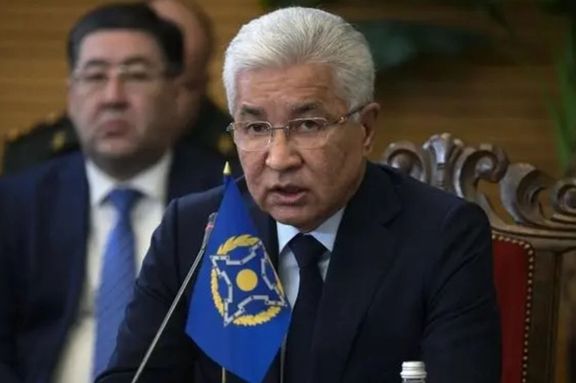
Imangali Tasmagambetov, the secretary-general of the Collective Security Treaty Organisation (CSTO) warned that the risk of the spread of terrorism in Central Asia remains.

Imangali Tasmagambetov, the secretary-general of the Collective Security Treaty Organisation (CSTO) warned that the risk of the spread of terrorism in Central Asia remains.
Tasmagambetov stressed that the CSTO continues to monitor challenges and threats from Afghanistan.
Russia's state-run TASS news agency reported on Thursday, November 7, that he said, referring to Afghanistan, that there is still a risk of the spread of terrorist activities, illegal migration and illegal trafficking of weapons and drugs in Central Asia.
At the same time, Tasmagambetov announced that the Counter-Terrorism Centre of the Collective Security Treaty Organisation (CSTO) and the Commonwealth of Independent States (CIS) will expand their cooperation to prevent potential dangers by using common capabilities.
At the same time, the Secretary-General of the Commonwealth of Independent States (CIS) Sergei Lebedev had announced on Thursday that the bloc supports the Collective Security Treaty Organisation’s (CSTO) plan to create a security belt around Afghanistan.
Sergei Lebedev expressed hope that the plan will lead to a reduction in the activity of terrorist groups in the region.
The Collective Security Treaty Organisation (CSTO) had announced about two weeks ago that it would soon approve a plan to strengthen Tajikistan's border with Afghanistan.

According to a new decree attributed to the Taliban leader, the Ministries of Defence, Interior and the General Directorate of Intelligence have been stripped of the authority to distribute weapons, ammunition and military equipment.
According to the decree, only the Taliban leader, Hibatullah Akhundzada, can decide on the distribution of military equipment.
A copy of the decree has been obtained by Afghanistan International, the first article of which states that no one except Hibatullah Akhundzada can distribute military equipment registered in the depots of the Ministries of Interior and Defence and the General Directorate of Intelligence.
According to the second article of the decree, whenever a Taliban organisation needs military equipment, it must send its request to Hibatullah Akhundzada's office in Kandahar.
In Article 3, Hibatullah Akhundzada has entrusted the Ministries of Defence and Interior and the General Directorate of Intelligence to report the list of military equipment in their possession to the Office of Verification, Registration, and Oversight.
The Office of Verification, Registration, and Oversight, which operates under the supervision of Hibatullah Akhundzada's office in Kandahar, is responsible for sealing military equipment and distributing it, only if ordered by the Taliban leader. The office is also responsible for the management of military equipment depots.
The decree asks the Ministries of Defence, Interior and General Directorate of Intelligence to repair weapons, ammunition, cameras, communications and other military equipment if needed.
According to this document, when the seals and locks of military equipment depots are opened or closed, representatives of Hibatullah Akhundzada's Registration and Oversight Directorate must be present. Also, during the distribution of weapons, a representative of this office must be present.
Taliban spokesman Zabihullah Mujahid confirmed in an interview on Friday (November 8) that the order was issued with the aim of "proper management and security of weapons" and to prevent the "misuse" of military equipment.
Mujahid also described the move as a step to "improve coordination and reduce differences" among the military forces.
Some see the decision as a sign of mistrust among the Taliban leadership and divisions within the group.
A source told Afghanistan International that the decision was made after the Taliban's interior minister, Sirajuddin Haqqani, distributed quantities of military equipment among his supporters in the eastern provinces.
According to the source, the distribution of weapons among militias that have no role in the administration of the Taliban has angered Hibatullah Akhundzada.

The Iranian Ministry of Interior has announced plans to intensify the deportation of undocumented Afghan migrants by the end of the year, with an official calling it one of the ministry’s key objectives.
Nader Yar-Ahmadi, head of the Bureau for Aliens and Foreign Immigrants’ Affairs at the Interior Ministry, emphasised the urgency of the policy, stating, “One of the most important policies of the Iranian Interior Ministry is the deportation of undocumented Afghans by the end of this year.”
The statement, reported by IRIB on November 8, highlights the ministry’s focus on managing undocumented migration from Afghanistan.
Yar-Ahmadi stressed that the presence of unauthorized Afghans in Iran is considered illegal under Iranian law, necessitating their return to Afghanistan.
He specified that most deportations are carried out through the Dogharoun International Crossing, a crucial border point in eastern Iran.
According to the official, approximately 3,000 Afghan migrants are apprehended daily and returned to Afghanistan via this crossing.
Iran has intensified its efforts to deport Afghan migrants throughout the country, with reports indicating that Afghan students faced enrollment rejections at the beginning of the academic year.
Observers note that these measures reflect a broader trend of discriminatory policies targeting Afghan refugees and migrants, often influenced by socio-political factors beyond their residency status. In addition, Iran has formally prohibited Afghan nationals from entering 16 provinces, with reports suggesting that even Afghans holding valid visas face potential arrest and deportation.

Afrasiab Khattak, a former member of Pakistan's Senate, told Afghanistan International that the recent visit of the Indian delegation to Kabul is to assess the situation in Afghanistan and Delhi's new approach with the Taliban government.
This week, an Indian foreign ministry official travelled to Kabul and met with the Taliban's foreign and defence ministers.
In the interview, Afrasiab Khattak said that the rivalry between India and Pakistan has been transferred to Afghanistan and Taliban officials have also shown their desire for relations with both countries.
JP Singh, who is in charge of the Afghanistan, Pakistan and Iran section of the Indian Ministry of External Affairs, visited Afghanistan on November 6.
The Taliban quoted Singh as saying that talks on Chabahar port would be held in the near future between the technical delegations of Iran, Afghanistan and India.
The Indian official also met with Taliban’s Defence Minister Mullah Yaqoob and discussed the expansion of bilateral relations.
Although India had a close relationship with the previous Afghan government, it improved its relations with the Taliban after the group came to power. New Delhi has said that regardless of the type of regime, it is willing to have good relations with Afghanistan and its people.
Despite Pakistan's sensitivity to India's activities, the Taliban has called for improved relations with New Delhi, and the Indian government has also approached the Taliban step by step. India is one of the few countries in the region that has a diplomatic presence in Afghanistan.
The Taliban's Ministry of Defence wrote in a statement on Wednesday, November 6, that the two sides emphasised on their common desire to expand bilateral relations, especially in the field of humanitarian cooperation and other issues of interest.
The ministry said that the two sides expressed their interest in strengthening further interactions between the Taliban and India.
Earlier, in an interview with India's News 18 TV channel, Mullah Yaqoob had expressed his desire to send Taliban’s armed forces to India for training. He told the Indian media outlet that he sees no problem in training Taliban forces in India.

Iran Human Rights announced that the Islamic Republic has executed 10 prisoners, including three Afghan citizens, in Ghezel Hesar Prison in Karaj.
The organisation said that the prisoners had been sentenced to death on charges of murder, drug offences, and sexual assault.
Iran Human Rights wrote in a report that these prisoners were executed by the authorities of Ghezel Hesar Prison on the morning of Wednesday, November 6.
The organisation identified one of the Afghans executed in the prison as Mohammad Tajik, saying that he had been sentenced to death by the Islamic Republic's judiciary on charges of "rape”.
Iran Human Rights (IHR) stated that an Afghan prisoner named Ajmal Azizi was executed on charges of "premeditated murder" in Karaj's Ghezel Hesar Prison. The organisation did not elaborate on the identity of the third Afghan prisoner who was executed in this prison.
In recent days, Iran Human Rights has consistently reported on the execution of Afghan citizens imprisoned in Iran.
The organisation announced on November 4 that the execution of Afghans in Iran has increased since the Taliban came to power in Afghanistan no, and that 90 Afghans have been executed in the country since 2022. In the past month alone, 13 Afghans have been executed in Iran on various charges, the organisation said.

The Commonwealth of Independent States (CIS) Secretary-General Sergey Lebedev announced that the bloc supports the Collective Security Treaty Organisation's plan to create a security belt around Afghanistan.
Lebedev expressed hope that the plan will lead to a reduction in the activity of terrorist groups in the region.
Azerbaijan, Armenia, Uzbekistan, Belarus, Tajikistan, Russia, Kyrgyzstan, Kazakhstan and Moldova are members of the Commonwealth of Independent States.
At a meeting of the secretaries of the Commonwealth of Independent States (CIS) Security Council in Moscow, Sergey Lebedev called for expanding cooperation for regional security, TASS news agency reported on Thursday, November 7.
"We hope that the establishment of a security belt around Afghanistan will help thwart the activities of international terrorist groups and combat drug trafficking, weapons and illegal immigration," he said.
The plan to create a security belt around Afghanistan was first proposed by Tajik President Emomali Rahmon in October 2022 at an extraordinary meeting of the Collective Security Treaty Organisation (CSTO).
At the time, he stressed that in order to prevent dangers, it was necessary to create a security belt around Afghanistan.
Although some countries in the region have economic and diplomatic relations with the Taliban, none of them recognise the Taliban and are still concerned about the spread of extremism.
In this regard, CSTO announced about two weeks ago that it would approve a plan to strengthen Tajikistan's border with Afghanistan.
