• العربية
  • پښتو
  • فارسی
Brand
  • Afghanistan
  • Sport
  • Markets
  • Afghanistan
  • Sport
  • Markets
  • Theme
  • Language
    • العربية
    • پښتو
    • فارسی
  • Afghanistan
  • Sport
  • Markets
All rights reserved for Volant Media UK Limited
volant media logo

IRGC Agent Responsible For Trump's Assassination Attempt Is An Afghan, Says US
Nov 9, 2024, 09:23 GMT+0

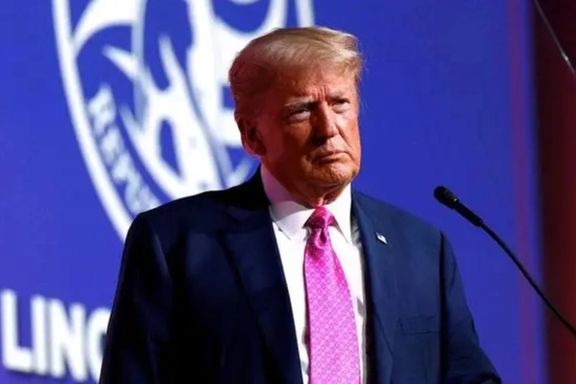
The US Department of Justice announced that Farhad Shakeri, who was assigned by Iran to assassinate Donald Trump, is an Afghan.

According to a criminal complaint in Manhattan federal court, an Islamic Revolutionary Guard Corp (IRGC) official ordered Shakeri last September to prepare a plan to kill Trump, the department said in a statement.

The US Department of Justice on Friday announced criminal charges related to the foiling of the Iranian government's plot to assassinate Donald Trump before the recent election.

In a criminal complaint filed in Manhattan federal court, the department said in a statement on Friday, November 8, that an unnamed IRGC official had instructed a liaison, Farhad Shakeri, last September to prepare a plan to monitor and ultimately kill Trump.

According to the US Department of Justice, the IRGC official told Farhad Shakeri that if he could not assassinate Trump before the election, it would be postponed until after the presidential election, because he claimed that Trump would lose the election and it would be easier to assassinate him.

US prosecutors said that Shakeri was initially tasked by Iran's Islamic Revolutionary Guard Corps (IRGC) with carrying out other assassinations against US and Israeli citizens inside the United States, but IRGC officials told Shakeri to focus only on Trump.

According to the US Department of Justice, Farhad Shakeri is an IRGC operative based in Tehran. He immigrated to the United States as a child and was deported from the United States around 2008 after spending 14 years in New York prisons for robbery.

The Justice Department statement said that Shakeri told the FBI in a recorded interview that he did not intend to present a plan to kill Trump within the seven-day deadline given to him by the Revolutionary Guard official.

Shakeri informed law enforcement agents that he had been tasked with hatching a plot to assassinate Donald J. Trump, the president-elect. He also announced that he was obliged to spy on two Jewish American citizens living in New York, and that a Revolutionary Guard official had offered $500,000 for the murder of each of them. He was also tasked with targeting Israeli tourists in Sri Lanka.

The US Department of Justice on Friday charged three people with assassinating US citizens, including conspiracy to assassinate Trump.

Farhad Shakeri, 51, of Iran; Carlisle Rivera, known as "Pop," of Brooklyn, NY, and Jonathan Loadholt, 36, of Staten Island, NY, were charged with involvement in the plot to assassinate a US citizen, according to a statement from the US Department of Justice.

"Loadholt and Rivera, for months, monitored an Iranian-American citizen living in the United States on Shakeri's orders," the statement said, referring only to the "victim-1" and saying that the person was an outspoken critic of the Iranian government and that the Islamic Republic had previously attempted to kidnap or kill them. It seems that this critic is Masih Alinejad.

Masih Alinejad, a human rights activist and journalist critical of the Islamic Republic, wrote on social media platform X that she has learned that the FBI has arrested two people who were planning to assassinate her in the United States.

During their efforts to find and kill the "victim-1", the statement said that Shakeri, Loadholt and Rivera exchanged messages and photos about the progress of their work.

Earlier, the US government confirmed that the Islamic Republic is seeking to kill Donald Trump and a number of his first administration officials, including Mike Pompeo, Brian Hook, and John Bolton, in retaliation for the killing of Qassem Soleimani, the former commander of the Islamic Revolutionary Guard Corps' Quds Force.

US Attorney General Merrick Garland said, "Few countries in the world pose a more serious threat to US national security than Iran. The Department of Justice has charged an Iranian regime operative with directing a network of criminal accomplices to advance Iran's assassination plots against its targets, including President-elect Donald Trump."

Most Viewed

Taliban Order Cut To Residential Fibre-Optic Internet In Kabul, Say Sources
1

Taliban Order Cut To Residential Fibre-Optic Internet In Kabul, Say Sources

2

Taliban Leader Adviser Arrested In Kandahar Over Alleged Bribery

3

Taliban Besieged TOLOnews Offices After Journalist Detentions, Say Sources

4

Exiled Media Watchdog Urges UN, EU To Seek Release Of Journalists Held By Taliban

5

Taliban Urges Turkmenistan To Implement 24-Hour Operations At Torghundi Port

•
•
•

More Stories

India's Envoy Went To Kabul For Humanitarian & Economic Purposes, Says New Delhi

Nov 8, 2024, 16:21 GMT+0

Indian External Affairs Ministry spokesperson Randhir Jaiswal said that India's envoy had travelled to Kabul to discuss the use of Chabahar port to strengthen economic ties and humanitarian aid.

Jaiswal said that the Indian delegation met with Taliban officials and former president Hamid Karzai in Kabul.

Jaiswal also gave details of the Indian delegation's visit to Afghanistan during a press conference in New Delhi on Thursday.

JP Singh, the head of the Pakistan, Afghanistan and Iran section of the Indian Ministry of External Affairs, travelled to Kabul with a delegation over the past few days and met with Taliban officials.

The Taliban's Ministry of Defence wrote in a statement on Wednesday that Yaqoob Mujahid, the Taliban's defence minister, spoke with JP Singh and discussed the shared desire to expand bilateral relations.

Amir Khan Muttaqi, the Taliban's foreign minister, also said in a meeting with JP Singh that the group expects its relations with New Delhi to develop.

Former Afghan President Hamid Karzai, in a meeting with the Indian delegation, also called for the country's attention to education for Afghans and the development of trade exchanges between India and Afghanistan.

The spokesperson of the Indian Ministry of External Affairs confirmed that during the meetings of the Indian delegation in Kabul, the humanitarian aid to Afghanistan and how the Chabahar port can be used by the business community in Afghanistan for exchanges, exports and imports, and any other work they wish to do, were discussed.

Declaring that the provision of humanitarian aid to Afghanistan is an important part of India's aid programmes, Jaiswal said, "We have sent several shipments of wheat to Afghanistan so far.

Switzerland Resumes Deportation Of Afghan, Ukrainian 'Criminal Migrants'

Nov 8, 2024, 15:24 GMT+0

Swiss radio and television reported that the country has resumed the process of deporting some Afghan and Ukrainian foreign criminals after a hiatus of several years.

The Swiss State Secretariat for Migration (SEM) announced that the decision includes people who pose a threat to the country's public safety.

In the first phase of this action, Switzerland deported three Ukrainian citizens last week and two Afghan citizens last month. The report also notes that the two Afghan nationals are the first cases of deportations of Afghan refugees since the Taliban came to power in August 2021.

One of them is an asylum seeker who was sentenced to a 16-month suspended prison sentence and a seven-year ban on entering Switzerland in 2018 for kicking another Afghan citizen in the head during a soccer match.

Vincenzo Mascioli, director of the Swiss State Secretariat for Migration (SEM), defended the decision, saying it was the first deportation to Ukraine since the start of the war in the country.

Some human rights organisations and migration experts have criticised Switzerland's decision. Amnesty International Switzerland has considered this action a violation of the humanitarian principle of non-return of refugees, stressing that Afghanistan and Ukraine are not suitable places for these people to return due to the dangerous security situation.

However, the Swiss State Secretariat for Migration (SEM) has stated that the dangerous security situation in these countries is generally not an obstacle to deporting people to these countries. According to this decision, the insecurity of the destination country alone is not enough to waive the deportation, and the decision on each case is made separately and after further investigation.

Terrorist Threats From Afghanistan Persist, Warns CSTO

Nov 8, 2024, 13:47 GMT+0

Imangali Tasmagambetov, the secretary-general of the Collective Security Treaty Organisation (CSTO) warned that the risk of the spread of terrorism in Central Asia remains.

Tasmagambetov stressed that the CSTO continues to monitor challenges and threats from Afghanistan.

Russia's state-run TASS news agency reported on Thursday, November 7, that he said, referring to Afghanistan, that there is still a risk of the spread of terrorist activities, illegal migration and illegal trafficking of weapons and drugs in Central Asia.

At the same time, Tasmagambetov announced that the Counter-Terrorism Centre of the Collective Security Treaty Organisation (CSTO) and the Commonwealth of Independent States (CIS) will expand their cooperation to prevent potential dangers by using common capabilities.

At the same time, the Secretary-General of the Commonwealth of Independent States (CIS) Sergei Lebedev had announced on Thursday that the bloc supports the Collective Security Treaty Organisation’s (CSTO) plan to create a security belt around Afghanistan.

Sergei Lebedev expressed hope that the plan will lead to a reduction in the activity of terrorist groups in the region.

The Collective Security Treaty Organisation (CSTO) had announced about two weeks ago that it would soon approve a plan to strengthen Tajikistan's border with Afghanistan.

Taliban Leader Strips Haqqani, Yaqoob, & Wasiq Of Arms Distribution Authority

Nov 8, 2024, 11:41 GMT+0

According to a new decree attributed to the Taliban leader, the Ministries of Defence, Interior and the General Directorate of Intelligence have been stripped of the authority to distribute weapons, ammunition and military equipment.

According to the decree, only the Taliban leader, Hibatullah Akhundzada, can decide on the distribution of military equipment.

A copy of the decree has been obtained by Afghanistan International, the first article of which states that no one except Hibatullah Akhundzada can distribute military equipment registered in the depots of the Ministries of Interior and Defence and the General Directorate of Intelligence.

According to the second article of the decree, whenever a Taliban organisation needs military equipment, it must send its request to Hibatullah Akhundzada's office in Kandahar.

In Article 3, Hibatullah Akhundzada has entrusted the Ministries of Defence and Interior and the General Directorate of Intelligence to report the list of military equipment in their possession to the Office of Verification, Registration, and Oversight.

The Office of Verification, Registration, and Oversight, which operates under the supervision of Hibatullah Akhundzada's office in Kandahar, is responsible for sealing military equipment and distributing it, only if ordered by the Taliban leader. The office is also responsible for the management of military equipment depots.

The decree asks the Ministries of Defence, Interior and General Directorate of Intelligence to repair weapons, ammunition, cameras, communications and other military equipment if needed.

According to this document, when the seals and locks of military equipment depots are opened or closed, representatives of Hibatullah Akhundzada's Registration and Oversight Directorate must be present. Also, during the distribution of weapons, a representative of this office must be present.

Taliban spokesman Zabihullah Mujahid confirmed in an interview on Friday (November 8) that the order was issued with the aim of "proper management and security of weapons" and to prevent the "misuse" of military equipment.

Mujahid also described the move as a step to "improve coordination and reduce differences" among the military forces.
Some see the decision as a sign of mistrust among the Taliban leadership and divisions within the group.

A source told Afghanistan International that the decision was made after the Taliban's interior minister, Sirajuddin Haqqani, distributed quantities of military equipment among his supporters in the eastern provinces.

According to the source, the distribution of weapons among militias that have no role in the administration of the Taliban has angered Hibatullah Akhundzada.

Iran Stresses Mass Deportation of Undocumented Afghan Migrants by Year’s End

Nov 8, 2024, 10:16 GMT+0

The Iranian Ministry of Interior has announced plans to intensify the deportation of undocumented Afghan migrants by the end of the year, with an official calling it one of the ministry’s key objectives.

Nader Yar-Ahmadi, head of the Bureau for Aliens and Foreign Immigrants’ Affairs at the Interior Ministry, emphasised the urgency of the policy, stating, “One of the most important policies of the Iranian Interior Ministry is the deportation of undocumented Afghans by the end of this year.”

The statement, reported by IRIB on November 8, highlights the ministry’s focus on managing undocumented migration from Afghanistan.

Yar-Ahmadi stressed that the presence of unauthorized Afghans in Iran is considered illegal under Iranian law, necessitating their return to Afghanistan.

He specified that most deportations are carried out through the Dogharoun International Crossing, a crucial border point in eastern Iran.

According to the official, approximately 3,000 Afghan migrants are apprehended daily and returned to Afghanistan via this crossing.

Iran has intensified its efforts to deport Afghan migrants throughout the country, with reports indicating that Afghan students faced enrollment rejections at the beginning of the academic year.

Observers note that these measures reflect a broader trend of discriminatory policies targeting Afghan refugees and migrants, often influenced by socio-political factors beyond their residency status. In addition, Iran has formally prohibited Afghan nationals from entering 16 provinces, with reports suggesting that even Afghans holding valid visas face potential arrest and deportation.