• العربية
  • پښتو
  • فارسی
Brand
  • Afghanistan
  • Sport
  • Markets
  • Afghanistan
  • Sport
  • Markets
  • Theme
  • Language
    • العربية
    • پښتو
    • فارسی
  • Afghanistan
  • Sport
  • Markets
All rights reserved for Volant Media UK Limited
volant media logo

Islamic Republic & Taliban Officials Discuss Expanding Rail Cooperation

Nov 18, 2024, 12:07 GMT+0

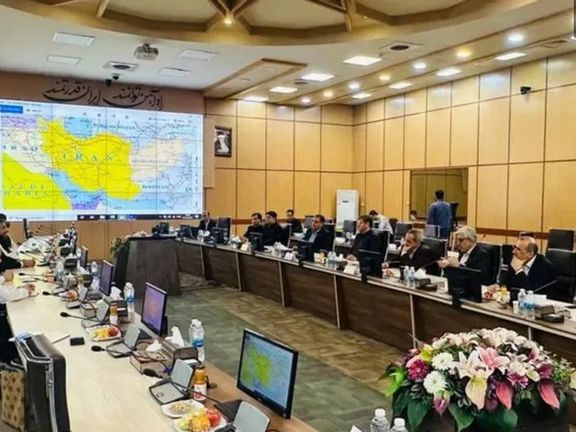
Officials of the Islamic Republic of Iran and the Taliban discussed opportunities for joint investment in the development of rail infrastructure and increased transportation through the Khaf-Herat railway.

Mohammad Ishaq Sahebzada, the deputy minister of railways at the Taliban's Ministry of Public Works, visited Iran two days ago.

Mohammad Ashraf Haqshenas, a spokesman for the Taliban's Ministry of Public Works, wrote on social media platform X on Sunday, November 17, that officials of the group and the Islamic Republic emphasised on the "continuity and expansion" of cooperation.

Haqshenas wrote that during the Taliban delegation's meeting with Islamic Republic officials, "increasing transfers through the third section of the Khaf-Herat railway, upgrading the technical and specialised capacities of Afghan railway employees, and joint investment opportunities in the development of railway infrastructure" were discussed.

The Taliban's Ministry of Industry and Commerce has previously announced an increase in trade with the Islamic Republic. According to figures recently provided by the ministry, the value of the Taliban's trade with the Islamic Republic in the past seven months reached $1.827 billion.

Most Viewed

Taliban Reject Pakistan Army Chief Remarks, Urge Islamabad To Tackle Militants
1

Taliban Reject Pakistan Army Chief Remarks, Urge Islamabad To Tackle Militants

2

Arrests & Killings Of Former Afghan Forces Continue, Says UN

3

Taliban To Put TOLOnews Journalists On Trial

4

Taliban Beat Shia Cleric In Kabul After Marriage Dispute, Say Sources

5

Attack On Pakistani Police Centre Was Not Planned In Afghanistan, Says Taliban

•
•
•

More Stories

Aid To Taliban-Controlled Afghanistan: US Over $3 Billion & China $64 Million

Nov 18, 2024, 11:14 GMT+0

Yue Xiaoyong, China's special envoy for Afghanistan, announced that Beijing has provided about $64 million in aid to Taliban-controlled Afghanistan in three years.

According to SIGAR, the United States has also sent more than $3 billion to Afghanistan during this period.

In an interview with the Beijing Club, China's special envoy for Afghanistan, said that his country has provided 470 million yuan ($64 million) in aid to Afghanistan in the past three years.

Although China does not recognise the Taliban government, it has appointed an ambassador in Kabul and accepted the Taliban's ambassador to Beijing.

After the withdrawal of US forces and the return of the Taliban to power, China has also tried to get involved in economic projects and contracts for mining, oil and gas in Afghanistan.

The amount of aid from China and the United States to Afghanistan reflects the two countries' approach to a country controlled by the Taliban.

US aid to Taliban-controlled Afghanistan in the past three years has been about 47 times higher than China's. The United States does not recognise the Taliban, but it has continued to send aid to Kabul after its withdrawal from Afghanistan.

The United States has collectively allocated $21.6 billion over the past three years to help Afghanistan and Afghan refugees, according to a SIGAR report released in October.

According to SIGAR, $3.33 billion of this money has been sent to Afghanistan under the guise of humanitarian and development aid.

US aid to Taliban-controlled Afghanistan has always faced criticism. Some critics of the Taliban, as well as the US special inspector, say that the Taliban may have had access to and benefited from the money flowing into Afghanistan.

However, the United Nations, which coordinates the aid, claims that the money is not being provided to the Taliban.

Prior to May last year, the Taliban-controlled Central Bank announced the arrival of $40 million packages in Kabul twice a week.

Following mounting criticism, the Taliban stopped making the aid public but at the same time, sources told Afghanistan International that $40 million packages were still arriving in Kabul.

Other Countries Have Invested More In Afghanistan Than Iran, Says Iranian official

Nov 18, 2024, 10:24 GMT+0

Mahmoud Siadat, the head of Iran-Afghanistan Joint Chamber of Commerce, Industries and Agriculture said that despite announcing their readiness to implement joint trade projects with Iran, Taliban is not very willing to pursue these projects.

Referring to Uzbekistan, Siadat said that others have surpassed Iran in the field of investment in Afghanistan.

According to Iranian media, Siadat, said on Sunday that "other countries are now implementing very extensive projects" in Afghanistan.

He added that Afghanistan's neighbouring countries are establishing industrial factories, cultivating a variety of greenhouse crops, and even building universities in Afghanistan.

Referring to Uzbekistan's investments in Afghanistan, he said that Uzbekistan has signed joint agreements with Afghanistan and is now "one of Afghanistan's main trading partners”.

The Iranian official proposed the formation of a joint consortium with the Afghan private sector to pave the way for participation in the implementation of projects and coordination between the private sector of the two countries.

This comes even as the Taliban's Ministry of Industry and Commerce announced an increase in trade with the Islamic Republic.

The ministry said that Afghanistan had more than $1.827 billion in trade with Iran in the past seven months, including $30 million in exports and $1.8 billion in imports.

Afghanistan, as the sixth country for Iran's export destinations, had the highest amount of exports from Iran last year.

China Not Seeking Sphere Of Influence In Afghanistan, Says Country’s Special Envoy

Nov 18, 2024, 09:03 GMT+0

Yue Xiaoyong, China's special envoy for Afghanistan, said in an interview that Beijing is not seeking to create a sphere of influence in Afghanistan.

"Afghanistan should become a platform for all parties to cooperate, rather than becoming a geopolitical arena [competition]," he added.
Over the past three years, US officials have repeatedly expressed concern about China's growing influence in Afghanistan.

US President-elect Donald Trump said, during the election campaign, that China had taken over the Bagram base after the withdrawal of US troops from there.

After the withdrawal of US forces and the return of the Taliban to power, China has tried to get involved in economic projects and contracts for mines, oil and gas in Afghanistan.

The country has also established close political and diplomatic relations with the Taliban and is one of the few countries to accept the group's ambassador.

In an interview with the Beijing Club on Sunday, China's special envoy stressed that China respects Afghanistan's independence, sovereignty and territorial integrity and will never interfere in the country's internal affairs. He added that China does not seek selfish interests in Afghanistan.

Yue Xiaoyong said that Afghanistan's priorities are the formation of an inclusive government and the adoption of a national and moderate policy. He also expressed concern about the presence of terrorist groups in Afghanistan, saying, "Before the presence of the United States, one or two terrorist groups were active in Afghanistan, but now there are more than 20 terrorist groups in this country."

In response to a question about the situation of women in Afghanistan, the Chinese special envoy said, "The issue of women is only a small part of Afghanistan's problems and is not the main cause of the country's problems."

He also criticised Western countries for what he called "double standard," adding, "In order to secure human rights, the issue of poverty, hunger and famine in Afghanistan must be addressed."

According to international organisations, at least 20 million people in Afghanistan face extreme poverty.

Yue Xiaoyong also announced that he is consulting with the ruling group in Afghanistan to provide 1 billion yuan in humanitarian aid from China. Some of the aid will go to Afghanistan, as well as Pakistan and Iran, he said, to arrange for the return of refugees to their country.

He added that the country has provided 470 million yuan in aid to Afghanistan in the past three years.

Yue Xiaoyong stressed that by helping Afghanistan during this period, they have prevented the country's collapse.

The Chinese special envoy also defended the Taliban's performance over the past three years, saying that during this period, Afghanistan has prevented the collapse and mass exodus of refugees through joint efforts, and the situation is improving.

China's top diplomat also noted that the Taliban has performed well in controlling the situation, fighting drugs, corruption, and focusing on economic activities.

He called on the United States to accept primary responsibility for the suffering and destruction of Afghanistan and emphasised on their responsibility to rebuild Afghanistan.
Tehran Police Warn Against Assisting Afghan Migrants with SIM Cards & Bank Accounts

Nov 17, 2024, 17:10 GMT+0

Tehran’s Cyber Police Chief, Davood Moazami Goodarzi, has issued a stern warning to Iranian citizens against providing SIM cards and bank accounts to Afghan migrants, stating that such actions constitute a criminal offence and can lead to severe legal consequences.

Speaking at a press conference on Sunday, 17 November, Goodarzi highlighted that many Iranians are unaware of the serious repercussions involved in facilitating access to these services for undocumented migrants.

Goodarzi explained that some individuals, either knowingly or unknowingly, are registering SIM cards and bank accounts in their own names, which are then handed over to Afghan migrants who lack legal residency status in Iran. He stressed that any crimes committed through these accounts or SIM cards would legally implicate the Iranians who have facilitated their use.

Describing the practice as a "serious offence," Goodarzi also revealed that the rental of SIM cards, bank accounts, and cryptocurrency exchange accounts to Afghan migrants has been a contributing factor to a number of cybercrimes in the past. He pointed to the rise of a black market in Iran, where SIM cards and bank accounts are provided to migrants, often through fraudulent registration under false identities.

Afghan migrants, particularly those without long-term residency permits, face significant challenges in obtaining mobile SIM cards and opening bank accounts in Iran. According to Goodarzi, only a small number of Afghan migrants with permanent residency are eligible for such services.

The police chief called for stricter enforcement measures to combat the growing black market and to safeguard both the Iranian financial system and the integrity of personal data.

Taliban Imposes Ban on Broadcasting Images of Living Beings in Herat

Nov 17, 2024, 13:42 GMT+0

The Taliban’s Ministry for the Propagation of Virtue and Prevention of Vice in Herat has instructed journalists in the province to refrain from photographing the group’s officials during both official and unofficial meetings.

This latest directive follows similar restrictions previously enforced in other provinces across Afghanistan.

On Sunday, the Afghanistan Journalists Support Organisation (AJSO) issued a statement, citing local sources in Herat, to announce the new media restriction. The organisation expressed deep concern over the Taliban's increasing crackdown on press freedom, noting that such measures not only stifle media independence but also violate the fundamental rights of Afghan citizens.

In its statement, the AJSO called on international institutions and freedom of expression advocacy groups to take decisive action to address the deteriorating media situation in Afghanistan. The organisation also urged the Taliban to respect media freedom and create a safer environment for journalists to carry out their work without fear of reprisal.

This restriction on media freedom comes amid a broader pattern of increasing censorship by the Taliban. In recent months, similar bans have been imposed in multiple provinces, including Nangarhar, where officials have prohibited the publication of images of living beings, including photographs and videos. These actions are part of a wider trend of mounting media restrictions that have severely limited press freedom throughout the country.