Over 500,000 Visas Issued To Afghans Annually, Says Adviser To Iran's Interior Minister

Nader Yarahmadi, an adviser to Iran's interior minister, said that the Islamic Republic issues more than 500,000 visas annually to Afghan citizens.
Nader Yarahmadi, an adviser to Iran's interior minister, said that the Islamic Republic issues more than 500,000 visas annually to Afghan citizens.
Emphasising on the deportation of migrants from Iran, he said that some Afghans "have quasi-legal documents that are considered inadmissible".
Yarahmadi is an adviser to the Minister of Interior and the head of the Centre for Aliens and Foreign Immigrants Affairs of the Ministry.
In a meeting with the governor of Bushehr on Tuesday, he said that Afghan immigrants who have quasi-legal documents will be identified and deported from Iran.
The official did not elaborate on the "quasi-legal evidence”.
The Islamic Republic deports undocumented immigrants. The country has also deported Afghans with Iranian passports and visas, and this process is still ongoing.
He claimed that Afghan immigrants who enter Iran with visas have the necessary services.
The head of the Centre for Aliens and Foreign Immigrants Affairs of the Iranian Ministry of Interior said that the number of Afghan nationals and immigrants in Iran exceeds the population of a number of countries combined.
Nader Yarahmadi added that the United Nations High Commissioner for Refugees (UNHCR) pays $5 for each citizen, which he said is insignificant compared to the services the refugees get from the Islamic Republic.
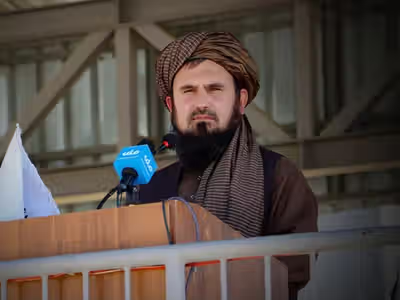
The Taliban's Supreme Court announced that the group had flogged a woman in Baghlan on charges of "procuring" in front of the public.
The Taliban did not elaborate on the accusation, but the term "pimp" (to procure) refers to a person who mediates between two people to have sex outside of marriage.
The Taliban's Supreme Court said in a statement on Tuesday, November 19, that the woman was sentenced to six months in prison and 30 lashes.
The Taliban said that the court sentence was carried out on Monday, November 18, in the presence of local officials of the group and local people.
Despite international condemnation, the Taliban's Supreme Court announces corporal punishment almost daily.
Human rights organisations say that the Taliban's judicial system is not standardised and that defendants do not have access to due process such as a lawyer.
Nobel Peace Prize laureate Malala Yousafzai criticised the Taliban's harsh laws against Afghan women, stating that she never imagined that women's rights would be trampled on so easily.
In the shadow of these Taliban directives, "women lost everything", Malala said.
According to international organisations, the Taliban has enacted at least 70 decrees and laws that directly target women's rights.
The Taliban's Law on the Promotion of Virtue and the Prevention of Vice completely excludes women from the public sphere. According to this law, women's voices in the public sphere are "awrah”.
A number of international organisations, especially Amnesty International, the Office of the United Nations Special Rapporteur on Human Rights, and some countries, have called the situation in Afghanistan a "clear example of gender apartheid”.
Malala told the BBC's English service about the Taliban's rules, "These laws are so extreme that no one can consider them rational. Many girls find themselves in a very desperate and depressed situation, where there is no way out for them. The future looks very bleak for them."
Malala Yousafzai co-produced the film "Bread and Roses", which narrates the lives of three Afghan women under the Taliban's rule.
The documentary, directed by Afghan director Sahra Mani and in collaboration with American actress Jennifer Lawrence, deals with the stories of Afghan women's resistance.
"This film is not just about the lives of three women, but about 20 million Afghan girls and women whose stories are rarely shown," Malala said about the film.
The documentary tells the story of the lives of Zohra, a dentist who was forced to leave her profession; Taranoom, a human rights activist who fled to the border, and Sharifa, a civil servant who lost her job and financial independence.
The three women in the film no longer live in Afghanistan, but Malala and Sahra Mani hope the documentary will raise global awareness of what the remaining women in the country endure.
Sahra Mani said, "Bread is a symbol of freedom, that is, providing for one's livelihood and supporting one's family. We say in our language, "He who gives you bread also commands you." Therefore, when you find your bread, it means that you have your own choice."
Malala and the film's production team hope that this work will convey the message of Afghan women's resistance to the world and create an incentive to further support their rights.
Pakistani media reported that Islamabad had shared "convincing evidence" about the sanctuaries of the Tehreek-e-Taliban Pakistan (TTP) and other terror groups on Afghan soil with China's special envoy for Afghanistan Yue Xiaoyong.
Xiaoyong held talks with Pakistani Foreign Ministry officials in Islamabad on Monday.
Pakistani authorities have provided Xiaoyong with information about the use of Afghan soil by the Tehreek-e-Taliban Pakistan (TTP) and its affiliates, the Express Tribune reported.
The information also includes new evidence of how Taliban-controlled Afghanistan threatens regional peace and stability.
China's special envoy for Afghanistan travelled to Pakistan just days after Russia's special envoy for Afghanistan Zamir Kabulov visited Islamabad to discuss the latest developments in Afghanistan.
In a statement issued by Pakistan's Foreign Ministry, it was stated that the Chinese special envoy met with Deputy Foreign Minister Amna Baloch. According to the statement, he also held detailed consultations with Pakistan's Deputy Foreign Minister of Afghanistan and West Asian Affairs Ahmed Naseem Warraich.
The Foreign Ministry statement said, "The two sides exchanged views on relations with Afghanistan. They stressed on the vital role of neighbouring countries for a peaceful and stable Afghanistan."
According to the Express Tribune, sources said that Pakistan briefed the Chinese envoy on the current situation in Afghanistan and how the country's territory is being used by terrorist groups such as the Tehreek-e-Taliban Pakistan (TTP) and other groups.
Sources said officials in Islamabad shared convincing evidence with the Chinese diplomat about terrorist sanctuaries inside Afghan territory that pose a threat to Pakistan's security.
Pakistani officials have repeatedly accused the ruling Taliban of harbouring the TTP and other insurgent groups opposed to Islamabad, and in some cases elements within the Taliban have facilitated TTP attacks from Afghanistan into Pakistan.
The Afghan Taliban have repeatedly denied the accusations and have said that they will not allow any group to use Afghan soil.
Al-Mirsad, a media outlet affiliated with the Taliban, compared the current situation of the Pakistani government to the final months of Ashraf Ghani's government in Afghanistan and promised victory to the Pakistani Taliban.
In an article, the publication stressed that Pakistan is following the same failed policies that Ashraf Ghani employed.
Al-Mirsad publishes the Taliban's unofficial positions. Zabihullah Mujahid and other Taliban spokesmen have repeatedly shared reports and news from this media outlet on social media. It is said that this media outlet is close to the Taliban's intelligence agency.
Al-Mersad wrote in an article on Monday that Ashraf Ghani's government used blind airstrikes and violent operations against civilians to confront the Taliban, and now Pakistan is making the same mistakes by carrying out similar attacks in the tribal areas.
Al-Mirsad also compared the media policies of Ashraf Ghani's government and the current Pakistani government, saying that the previous Afghan government was trying to portray the Taliban as a group affiliated with the ISI. Now, Pakistan is trying to portray the TTP as affiliated with the Afghan Taliban.
The media outlet close to the Taliban claimed that this propaganda did not harm the Taliban and contradictorily boosted the morale of the group.
The Pakistani military has consistently accused the Afghan Taliban of hosting and supporting the Tehreek-e-Taliban Pakistan (TTP). Pakistan's military says Afghan soil is being used against Pakistan.
Pakistani media are propagating that the TTP is in Afghanistan, al-Mirsad said. According to this media outlet, the Tehreek-e-Taliban Pakistan (TTP) is present in the tribal areas of Pakistan.
Al-Mirsad claimed that popular support for the TTP is increasing day by day.
The outlet wrote that the TTP's morale is getting stronger day by day, and the Pakistani government is facing panic and fear. Public support for the TTP is growing, and hatred towards the country's military is becoming more deep-rooted, it reported.
Al-Mirsad wrote, "Now the territory of Pakistan, especially the province of Khyber Pakhtunkhwa, has become a battlefield, and the current situation is far more worrying than it was in 2013."
Stating that the Pakistani army has targeted civilians in the tribal areas, the Taliban-affiliated media outlet wrote, "If the people of Pakistan, especially the residents of Khyber Pakhtunkhwa, resist these atrocities, as Afghans stood up to Ashraf Ghani, security, stability and Islamic order will soon prevail in Pakistan."
"Public trust in this group is increasing day by day and is moving towards stability and strength," the outlet added.
In the end, the Taliban media outlet claimed that the TTP has become an invincible force.
The Taliban's relations with Pakistan are tense. Both sides accuse each other of supporting their opponents. Pakistan accuses the Afghan Taliban of supporting the Tehreek-e-Taliban Pakistan (TTP) and providing shelter to the group. But the Taliban accuse the Pakistani army of supporting, financing and equipping ISIS in Balochistan.
A Chinese citizen was killed in an attack by armed assailants on workers on the Tajik-Afghan border, local sources told the media.
Four Chinese citizens and a Tajik citizen were wounded in the attack in the Zarbuz Gorge of the Shamsiddin Shohin district in the Khatlon region.
According to informed sources, the attack took place on November 18. The Chinese nationals who were targeted in the attack were working in a gold mine in the area.
A local source told the news website Yeni Safak, "All the victims have been taken to a hospital in the district. Security forces are present at the scene of the incident and an investigation is underway."
The attackers are said to have come to Tajikistan from Afghanistan and targeted Chinese engineers and workers.
However, it is not yet officially clear whether the attack was carried out by drug traffickers or Islamist militant groups.
The Tajik government has not yet officially commented on the incident.
The incident could raise concerns about the infiltration of armed and militant groups into Central Asian countries. Previously, Baloch militants in Pakistan have carried out bloody attacks on Chinese engineers and workers.
Tajikistan has always expressed concern about the security situation on the Afghan border and has asked the Shanghai Cooperation Organisation and the Collective Security Treaty Organisation to strengthen security measures on the border.
In the past three years, there have been numerous reports of drug traffickers and extremist groups attempting to cross the Tajik border. After the Taliban's return to power in Afghanistan, Tajikistan has stepped up border security measures and deployed more troops in these areas.
One of the most serious threats to Tajikistan is the Ansarullah group, which is based in northern and northeastern Afghanistan, especially in Badakhshan. The group, which is allied with the Taliban, is an Islamist opponent of Tajik President Emomali Rahmon.
On August 6 last year, Tajikistan's State National Security Committee announced that it had eliminated three members of the Ansarullah group. In the past, they had transported large shipments of weapons, ammunition, explosives, communications equipment and financial resources to Tajikistan, it said.