• العربية
  • پښتو
  • فارسی
Brand
  • Afghanistan
  • Sport
  • Markets
  • Afghanistan
  • Sport
  • Markets
  • Theme
  • Language
    • العربية
    • پښتو
    • فارسی
  • Afghanistan
  • Sport
  • Markets
All rights reserved for Volant Media UK Limited
volant media logo

ECO Foreign Ministers' Expert Meeting Held in Mashhad Without Taliban Members

Dec 2, 2024, 12:59 GMT+0

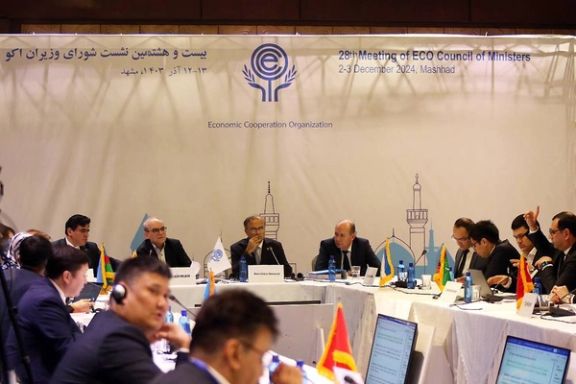
The expert meeting of the foreign ministers of the member countries of the Economic Cooperation Organisation (ECO) began on Monday without the presence of Taliban members in Mashhad.

The main meeting of ECO foreign ministers will be held tomorrow (Tuesday). It is not yet clear whether the Taliban has been invited to the meeting or not.

Earlier, an Iranian Foreign Ministry official had said that Amir Khan Muttaqi, the Taliban's foreign minister, will not attend the 28th meeting of foreign ministers of the member states of the Economic Cooperation Organisation (ECO). Ahmad Masoumifar clarified that not inviting the Taliban is the decision of the ECO secretariat. The Taliban has not commented on the group's presence at the summit.

Last year, no representative from Afghanistan was invited to participate in the ECO meeting.

According to Iranian media reports, in addition to expert delegations and ambassadors of ECO member countries in Tehran, the foreign ministers of Tajikistan and Kazakhstan and the ECO secretary general have arrived in Mashhad.

According to IRNA, the head of the Islamic Republic of Iran's Foreign Ministry's mission in Khorasan Razavi province said, "A wide range of different issues in the region will be put on the agenda of the summit by senior experts and officials at today's ECO expert meeting."

On the sidelines of the first day of the ECO summit in Mashhad, Ahmad Masoumifar said that these issues revolve around transit, environment, inter-agency trade, customs, and banking transactions.

"In addition to officials from member countries, the summit will be attended by the head of the ECO Trade and Development Bank, the heads of ECO affiliated institutions and other unions in the region, including the eight Islamic developing countries, and the Asian Dialogue Forum," he told reporters.

The ECO was created on the initiative of Iran, Turkey and Pakistan, and then Afghanistan, Tajikistan, Kazakhstan, Uzbekistan, Kyrgyzstan, Turkmenistan and Azerbaijan joined it.

ECO is a regional organisation established by Iran, Pakistan and Türkiye in 1964 with the aim of promoting economic and cultural cooperation among member states. Then, since 1992, with the admission of seven new countries, including Afghanistan, Azerbaijan, Kazakhstan, Kyrgyzstan, Tajikistan, Turkmenistan, and Uzbekistan, the number of its members has increased to 10 countries.

Since joining the Economic Cooperation Organisation (ECO), Afghanistan has always been an active member of this regional organisation. However, the Taliban's return to power in 2021 and the group's lack of recognition have caused Afghanistan's representative to be absent from many important international meetings. Afghanistan was also the biggest absentee from last year's ECO meeting in Tashkent, Uzbekistan.
Most Viewed

Female Ismaili Entrepreneur Shot Dead In Badakhshan
1

Female Ismaili Entrepreneur Shot Dead In Badakhshan

2

Afghanistan May Not Remain Intact In Future, Says Pakistani Analyst

3

French Parliament Hosts Two-Day Meeting On Afghanistan

4

Taliban, Iran Working On Surveillance App For Afghan Users, Say Sources

5

Pakistan Welcomes Local Ceasefire Agreement In Kunar & Nuristan Border Areas

•
•
•

More Stories

Work Of TAPI Project Ongoing In Afghanistan, Claims Taliban

Dec 2, 2024, 11:57 GMT+0

Taliban spokesman Zabihullah Mujahid posted a video on social media network X on Monday and wrote, "The work of the TAPI project is actually going on in Afghanistan."

The officials of the Taliban and Turkmenistan restarted work on the TAPI project on September without the presence of the officials of India and Pakistan.

This project was opened for the second time on Wednesday last week, in the presence of Mullah Hasan Akhund, the Prime Minister of the Taliban, and Gurbanguly Berdimuhamedow, the national leader of Turkmenistan.

The TAPI pipeline is a major regional project that will transport Turkmenistan's gas through Afghanistan to Pakistan and India.

The Taliban said at that time that they support this project and cooperate with the contracted companies of this project in the areas under the control of this group.

The practical work of this project was not implemented due to insecurity in Afghanistan.

This project is one of the largest regional projects, it is 1,821 km long.

Fatemiyoun & Other Militias Affiliated With Islamic Republic Enter Syria

Dec 2, 2024, 10:03 GMT+0

According to Reuters, militants affiliated to the Islamic Republic entered Syria from Iraq on Sunday evening to join the fight against anti-government rebels.

According to this report, Popular mobilisation forces and forces of Kata’ib Hezbollah of Iraq as well as Fatemiyoun are present in this mission.

A senior Syrian army source has confirmed that these militants crossed the Abu Kamal border and entered Syria on the evening of Sunday, December 2.

Ayatollah Rahimi Sighani Bamiani criticised the Shiite migrants of Afghanistan living in Iran who were willing to participate in the Syrian war. In response to the request of immigrants to participate in this war, he said that the participation of Afghans in the Syrian war "is not jihad, it is aggression”.

In a video message published on Sunday, Ayatollah Bamiani criticised Iran's view of Afghans and said, "Iran uses Afghan refugees as fuel and in the end throws them out as spies, looters, identity-less and terrorists."

Lashkar Fatemiyoun is a paramilitary force under the supervision of the Quds Force, the overseas branch of the IRGC, most of whose members are Afghan immigrants living in Iran, and a large number of them have been killed in Syria.

With the start of the attacks of the opposition forces of the Syrian government, the civil war in this country has entered a new phase. These attacks started on Wednesday and reports indicate that the anti-government forces have captured parts of the city of Aleppo and Idlib.

According to reports, more than 250 people have been killed in the first three days of these clashes, and this figure includes at least 140 rebels and 87 Syrian government forces.

Abbas Araghchi, the Foreign Minister of the Islamic Republic, said on Sunday before his trip to Damascus that the Islamic Republic "resolutely supports the Syrian government and army”.

The Islamic Republic considers the survival of the Syrian government very important to secure its regional interests, and for this reason, the forces of the Islamic Republic entered the battlefield in Syria in 2017. It is said that around 2000 forces of the Islamic Republic were killed in Syria at that time.

Taliban Announces Detection Of 200 AIDS Cases In Afghanistan

Dec 2, 2024, 09:07 GMT+0

The spokesperson of the Taliban’s Ministry of Health announced on the occasion of World AIDS Day that 200 cases of AIDS have been registered in Afghanistan this year.

Sharafat Zaman Amarkhel said that the number of patients with AIDS has reached 3,700.

In a video message on the occasion of World AIDS Day, the spokesperson of the Taliban’s Ministry of Health claimed that with the efforts of this group, the number of AIDS patients has "reduced" as compared to previous years.

He said that eight treatment centres and 61 AIDS diagnosis centres are operating throughout Afghanistan.

According to Amarkhel, the Ministry of Health of this group is trying to increase the care related to 1400 patients under treatment and to inform them about this disease by launching awareness programmes in remote areas.

Today, the World Health Organisation announced that by the end of 2023, about 40 million people in the world will be struggling with the HIV virus.

The United Nations reported this year that in 2023, one person died every minute due to AIDS.

Taliban Conducts Public Flogging of Five Individuals in Khost Province

Dec 1, 2024, 16:25 GMT+0

The Taliban’s Supreme Court has announced the public flogging of five individuals, including one woman, in Khost province. These individuals were convicted on charges of “adultery” and “homosexuality.”

According to the court’s statement released on Sunday, each person received sentences ranging from one to four years’ imprisonment and 39 lashes. The punishments were administered in the presence of local officials and members of the public.

Earlier, on 28 November, the Supreme Court reported the public flogging of ten individuals, including two women, across three provinces for offences such as “immorality,” “adultery,” and “homosexuality.” In the past week alone, the Taliban has flogged over 20 people throughout Afghanistan on various charges.

The Taliban asserts that public flogging is in accordance with “Islamic Sharia” law. Despite international appeals to cease such corporal punishments, the group continues to implement them. The Supreme Court has not provided details regarding the judicial processes or the defendants’ access to legal representation.

International human rights organisations have previously expressed concerns about the administration of justice under Taliban rule, highlighting issues related to fair trials and the treatment of the accused.

Japan’s Support Improves Lives of Two Million Afghans Over Three Years, Reports UN

Dec 1, 2024, 15:26 GMT+0

The United Nations Development Programme (UNDP) has reported that Japan’s assistance has significantly improved the lives of over two million people in Afghanistan since 2021.

This support has enabled 856,000 individuals, including 225,000 women, to secure employment, while more than 1.7 million people have gained access to enhanced services.

In a post on the social media platform X on Sunday, UNDP expressed its gratitude to Japan for its sustained three-year commitment to Afghanistan.

The organisation highlighted that during this period, 14,600 micro, small, and medium enterprises, including 8,600 women-led businesses, benefited from Japan’s financial contributions. Additionally, Japan’s support enabled the installation of renewable energy facilities powering over 5,000 sites across Afghanistan.

The UNDP also acknowledged Japan’s previous aid of $10 million for treating addiction and providing alternative livelihoods in Afghanistan. Earlier this year, Japan allocated more than $7 million to improve basic services and support vulnerable urban populations in the country.

Afghanistan is currently grappling with one of the world’s most severe and complex humanitarian crises. According to reports, more than 23 million Afghans are in need of urgent humanitarian assistance.