Chinese Envoy Reports Constructive Talks With Tajik Diplomat On Afghanistan

Yue Xiaoyong, China's envoy to Afghanistan, announced his meeting with Sharaf Rahimi, head of the strategic studies department of the Tajik Foreign Ministry.

Yue Xiaoyong, China's envoy to Afghanistan, announced his meeting with Sharaf Rahimi, head of the strategic studies department of the Tajik Foreign Ministry.
After the meeting, he wrote on social media platform X that he had a very good conversation with the Tajik diplomat about helping Afghanistan.
China and Tajikistan, like other countries, have not yet recognised the Taliban. However, China has extensive diplomatic and economic ties with the Taliban. Tajikistan, which hosts members of the National Resistance Front, has refused to establish diplomatic relations with the Taliban.
The Chinese representative wrote on Facebook on Friday, December 13, "We had a very good conversation today about working together to help rebuild Afghanistan."
The Chinese diplomat did not elaborate on the details of the conversation.
Tajik officials have repeatedly criticised the Taliban over the past three years. The Tajik president has said that the Taliban, despite their promises, are opposed to forming an inclusive government in Afghanistan. Previously, Emomali Rahmon said that the Taliban pursues a discriminatory aggressive policy against different ethnic groups in Afghanistan.
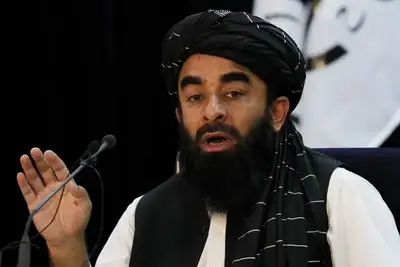

In its annual report on terrorism, the US State Department announced that the Taliban continues to host and shelter al-Qaeda in Afghanistan.
The report also states that the United States has not yet made a decision to recognise the Taliban government.
The US report on terrorism from 2023, published on Thursday, states that the Taliban claims that al-Qaeda members are unable to carry out terrorist acts from Afghan soil.
The report, citing the UN's independent assessment of Afghanistan, said that the Afghan Taliban also allowed the Pakistani Taliban to operate on Afghan soil.
According to the report, members of the TTP travel between Afghanistan and Pakistan and launch attacks.
The report emphasised that there are differences within the Taliban group over how to deal with the TTP.
The US State Department said that the Taliban carried out attacks against ISIS-K in 2023 and sees the group as the main threat against them.
The United States has said that the Taliban has emphasised on their commitment to their counterterrorism obligations under the Doha Agreement in public and private talks. However, al-Qaeda, the Pakistani Taliban and ISIS are present in Afghanistan.
In April 2023, Tajik security forces identified and destroyed terrorist elements of Afghan origin who were planning to carry out attacks on Tajik territory, the report said.
The US State Department said that in 2023, ISIS-K also continued its attacks in Afghanistan, especially against religious minorities.

Andrés Efren Montalvo Sosa, head of the UN Sanctions Committee said on Thursday (December 12) that a number of key Taliban officials are complicit in drug cartels and production and trafficking networks.
However, according to Sosa, the Taliban leadership encourages ordinary Afghan farmers to cultivate alternatives.
Sosa, who is also Ecuador's ambassador to the United Nations, said at Thursday's Security Council meeting on Afghanistan, citing the 15th report of the UN Sanctions Monitoring Team, that the drug trade and production in Afghanistan remains the main source of the country's GDP.
Addressing the members of the UN Security Council, he said, "A number of key Taliban officials are deeply involved in drug cartels as well as drug trafficking networks. Meanwhile, ordinary Afghan farmers have been pushed to alternative cultivation."
In his statement, Sosa also referred to a report by the United Nations Office on Drugs and Crime (UNODC), according to which drug cultivation and production in Afghanistan has increased by 30%. The report also states that the geography of drug cultivation has changed from the southwest to the northeast of Afghanistan in 2024.
However, Sosa said the rate of drug production is lower than the level that existed in 2022, before the Taliban leadership issued a decree banning it.
The United Nations Office on Drugs and Crime (UNODC) had earlier announced that opium production in Afghanistan has increased by 30% in 2024 compared to the previous year. According to the statistics of this office, contrary to the orders of the Taliban leader, 433 tons of opium were produced in Afghanistan this year.
The office said that despite a 30% increase in opium production in 2024, opium production shows a 93% decrease compared to 2022, before the Taliban leader's decree banning the cultivation and production of narcotics.
However, the Taliban's Interior Ministry rejected the UN report on the increase in opium production, calling it far from reality.

Iran’s ambassador to the United Nations Security Council, has warned that ISIS is actively seeking to destabilise Afghanistan and the wider region.
Referring to the assassination of the Taliban’s Minister of Refugees in an explosion on Wednesday (December 11), the ambassador emphasised that no one, including Taliban leaders, is immune to the threat of terrorism.
Amir Saeid Iravani, Iran’s representative at the United Nations, addressed the Security Council on Thursday, expressing deep concerns over Afghanistan’s deteriorating security situation.
Highlighting the recent attack, which claimed the life of the Taliban’s Minister of Refugees, Iravani urged the Taliban leadership to honour their commitments and to engage in a “comprehensive fight against terrorist networks”.
He also drew attention to the systematic violence targeting Afghanistan’s Hazara community, describing these attacks as acts of extremist brutality.
Addressing the severe humanitarian crisis in Afghanistan, Iravani called upon the international community to respond with impartiality, without imposing conditions, and free from political motivations.
On the issue of Afghan refugees, Iravani stated that Iran hosts approximately six million Afghan refugees, incurring an annual expenditure of $10 billion to provide for their needs.
The ambassador criticised what he termed the “inadequate” support from the international community in addressing refugee needs. He underscored the necessity for sustained international assistance to countries like Iran and Pakistan, which bear a significant burden in hosting Afghan refugees.

A Taliban spokesman Zabihullah Mujahid said that a United Nations Security Council meeting on Afghanistan without the presence of a representative of the group is "useless”.
Mujahid said that the decisions of this meeting without the presence of the Taliban are also "complicated". The United Nations Security Council will hold a meeting on Afghanistan on Thursday, December 12.
In an interview with National Radio and Television on Thursday, Mujahid called for handing over Afghanistan's seat in the United Nations to the Taliban.
He claims that by handing over the UN seat to the Taliban, meetings on Afghanistan will be useful. According to the Taliban spokesman, without the presence of the group's representative, the Security Council meeting is "full of ambiguity”.
The UN Secretary-General's Special Representative Roza Otunbayeva is scheduled to speak at the meeting on the situation in Afghanistan.
The United Nations Assistance Mission in Afghanistan (UNAMA) said in a statement on Wednesday, December 11, that the meeting will be held on Thursday, December 12 at 7:30pm Afghan time.
The meeting is expected to review the human rights situation and the situation of women in Afghanistan.
The UN Security Council also held a meeting on Afghanistan in September to discuss the situation in the country.
Currently, the seat of Afghanistan is held by Nasir Ahmad Faiq, a diplomat of the former Afghan government.
The Taliban's Ministry of Foreign Affairs has nominated Suhail Shaheen as its representative to the United Nations, which has not been accepted.

The Taliban's Supreme Court announced the flogging of two people for alleged extramarital affairs in Kabul.
The court said in a statement on Thursday that the defendants were sentenced to 19 lashes and one year in prison each.
The Taliban's Supreme Court wrote that the defendants were punished on Thursday, December 12, by the group's Fourth Zone Primary Court in Kabul. Hours earlier, the court also reported that two people had been flogged in Paktia province on charges of buying and selling alcoholic beverages.
In the past week, the Taliban has punished more than 10 people across Afghanistan on various charges.