Senior National Resistance Front Commander Enters Afghanistan

Saleh Mohammad Registani, a senior commander of the National Resistance Front, says he has returned to Afghanistan to continue the fight against the Taliban.
Saleh Mohammad Registani, a senior commander of the National Resistance Front, says he has returned to Afghanistan to continue the fight against the Taliban.
The National Resistance Front of Afghanistan on Monday released a video showing Registani in a mountainous area. In the video, he says: “After a difficult period of absence, we are once again in our homeland, serving our people and in the Hindu Kush.”
Registani said that the resistance continues and that several other fronts across Afghanistan have also raised the flag of resistance and are fighting the Taliban.
The National Resistance Front confirmed to Afghanistan International that Registani had returned to Afghanistan and that the video was recent.
Pakistan’s Defence Minister Khawaja Muhammad Asif has claimed that 70 to 80% of those carrying out terrorist attacks and targeting Pakistani troops are Afghans. He also urged Pakistani students not to support Afghan students in the country.
Writing on X on Sunday, 20 September, Asif said Pakistan had provided refuge to Afghans for the past five decades and allowed them to share the country’s limited resources.
He added that after NATO forces withdrew from Afghanistan, Pakistan had hoped its borders would remain secure and countries in the region would live in peace.
The senior Pakistani official claimed that those carrying out terrorist attacks in mosques, schools and markets and attacking military personnel were mostly Afghans.
He also alleged that some of these individuals expressed solidarity with India, which he described as Pakistan’s longstanding and bitter enemy. Taliban officials have consistently rejected such allegations.
Asif said Pakistan’s military and civilian leadership had been in direct and indirect contact with these individuals but claimed that those efforts had failed to reduce what he called Afghan hatred and hostility.
Responding to support expressed by some Pakistani students for Afghan students, Asif said it was not motivated by affection but reflected their political leanings.
Reposting a video of a female student supporting the presence of Afghan students in Pakistan, he said Pakistani students taking such a position were insulting the blood of soldiers and civilians killed in attacks by people coming from Afghanistan.
His comments come after Pakistan this month ordered Afghan medical and dental students to return home.
On 1 September, the Pakistan Medical and Dental Council instructed medical universities and colleges to prepare enrolled Afghan students to return to Afghanistan and to prevent the admission of Afghan students during the current academic year.
However, the order to remove Afghan medical students has for now been suspended.
The Lahore High Court temporarily halted its implementation on 11 September and extended the suspension on 18 September. The case, brought by Afghan students, remains pending.
Pakistan accuses the Taliban of allowing anti-Pakistan armed groups to operate from Afghan territory. The Taliban rejects the allegations.
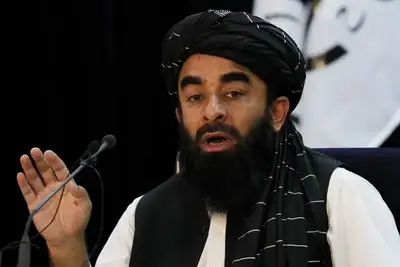
Taliban spokesperson Zabihullah Mujahid has condemned Pakistan’s attacks on Kunar and Paktika provinces as crimes and aggression. Writing on X on Monday, 21 September, he said the attacks would receive an appropriate response.
The Taliban spokesperson said Pakistan’s military establishment had carried out the attacks to divert public attention from security failures within the country.
Providing details of the casualties, Mujahid said one woman and two men had been killed in Kunar province, while two women and two men were wounded.
He added that a house and a local shop had been bombed in Paktika province, but the attack had caused no casualties.
The Taliban said the attacks took place early on Monday, 21 September, in Patan village in Kunar’s Nurgal district and in the Rakha and Tor Kandi areas of Paktika’s Barmal district.
Hamdullah Fitrat, the Taliban’s deputy spokesperson, shared images of destroyed houses and said those killed and wounded in the Kunar attack were members of the same family.
Pakistani officials have not yet commented on the attacks.
The strikes come amid an escalation in insecurity and deadly clashes inside Pakistan.
Pakistan’s military announced on Sunday that six soldiers, including two officers, had been killed in heavy fighting between security forces and armed militants in Hangu district, Khyber Pakhtunkhwa province.
The Pakistani military described the attackers as members of “Fitna al-Khawarij”, a term Pakistani officials use for Tehreek-e-Taliban Pakistan and affiliated groups. Islamabad also claims that some of these groups receive foreign support.
Meanwhile, sources say the suicide bomber who attacked a police compound in Kohat, Pakistan, on Friday was a resident of Sangin district in Afghanistan’s Helmand province.
Pakistan’s Ministry of Information and Broadcasting had previously said in a statement that the perpetrators of the attack on worshippers and police officers in Kohat, Khyber Pakhtunkhwa, had links to Afghanistan.
Pakistan has repeatedly bombed areas in Afghanistan’s border provinces in the past.
Islamabad says its strikes on Afghan territory target militant bases, particularly those of the Pakistani Taliban, whose members it alleges are being sheltered by the Afghan Taliban.
Iran’s Energy Minister Abbas Aliabadi has told the head of the Taliban’s state-owned companies that Tehran is ready to facilitate the supply of up to 2,000 megawatts of electricity to Afghanistan.
According to a statement from the Taliban’s state-owned companies, Mohammad Ahmad Jan Bilal, the head of the organisation, met Aliabadi during a visit to Iran. The two discussed cooperation in electricity and energy, drinking water supplies and the construction of wastewater treatment facilities.
According to the Taliban’s statement, Iran’s energy minister said his country was ready to cooperate with Afghanistan in the electricity sector and could provide training for Afghan technical personnel and help improve their professional skills in technical and specialised services.
Aliabadi added that Iran was prepared to facilitate the supply of up to 2,000 megawatts of electricity to Afghanistan to meet the country’s energy needs.
The head of the Taliban’s state-owned companies also emphasised expanding cooperation between the two countries in the energy sector, strengthening technical capacity and implementing joint projects.
At the end of his visit, Bilal also toured major water and wastewater treatment facilities in Tehran.
Iran Faces Electricity Shortages
Iran’s offer to supply electricity to Afghanistan comes as the country itself faces electricity shortages and an imbalance between power supply and demand.
Reports this year have highlighted widespread power cuts and restrictions on electricity consumption in various sectors, including industry, across Iran. One research report suggests that Iran’s electricity shortfall during peak demand could exceed 13,000 megawatts.
Iranian President Masoud Pezeshkian has repeatedly emphasised the need to manage consumption, improve efficiency and address the country’s energy imbalance in recent months.
In August, he said damage to power plants and disruptions to gas production had increased pressure on Iran’s electricity sector.
Pezeshkian also stressed the need to manage water, electricity and gas consumption in June and called on the public to help reduce energy use.
Despite these challenges, Iran’s energy minister now says Tehran is ready to provide up to 2,000 megawatts of electricity to meet Afghanistan’s needs.
Details of the proposal, including the timetable, the amount of electricity that could be supplied and how it would be transmitted to Afghanistan, have not yet been announced.
Abdul Mateen Qani, spokesperson for the Taliban Interior Ministry, said developments in Iran and tensions between Kabul and Islamabad were among the key issues discussed during meetings between Turkish and Qatari delegations and Taliban officials in Kabul.
İbrahim Kalın, head of Türkiye’s National Intelligence Organisation, and Hamad bin Khamis Al-Kubaisi, Qatar’s deputy national security adviser, visited Afghanistan separately on Tuesday and Wednesday last week and held talks with senior Taliban officials on regional and security developments.
Qani told Al Arabiya that the situation in Iran was one of the main topics discussed during the meetings. He added that a further deterioration in Iran could affect countries across the region, particularly Afghanistan, Qatar and Türkiye.
The Taliban Interior Ministry spokesman also said the parties had emphasised the need for joint cooperation to ensure regional security and stability, particularly in combating terrorism and drug trafficking.
Talks on Tensions With Pakistan
Qani said clashes and tensions between Afghanistan and Pakistan were also among the main issues discussed during the meetings. He added that the parties had committed to continuing joint efforts to resolve the dispute and improve relations between Kabul and Islamabad.
In Kabul, Kalın met Abdul Haq Wasiq, the Taliban’s intelligence chief, Mohammad Yaqoob Mujahid, the defence minister, and Sirajuddin Haqqani, the interior minister. The Qatari delegation also held separate meetings with Taliban officials.
The meetings took place amid serious tensions between the Taliban and Pakistan in recent months. Islamabad accuses the Taliban of allowing Tehreek-e-Taliban Pakistan and some armed Baloch groups to operate from Afghan territory. The Taliban has rejected these allegations.
Turkish Intelligence Chief’s Visit to Pakistan
After visiting Afghanistan, Kalın travelled to Pakistan. Pakistani officials did not formally announce the Turkish delegation’s visit, but Turkish media reported on it.
The visit came amid rising security tensions between the Taliban and Pakistan, with attacks by armed groups continuing in Pakistan’s border regions.
In the latest incident, a suicide attack on a mosque inside a police compound in Kohat, Khyber Pakhtunkhwa, killed at least 31 people. A vehicle packed with explosives entered the police compound, followed by an armed clash between the attackers and security forces.
The Ittehad-ul-Mujahideen group, affiliated with Hafiz Gul Bahadur, claimed responsibility for the attack.
In recent months, Islamabad has repeatedly alleged that armed groups opposed to Pakistan are using Afghan territory to organise and carry out attacks.
The Taliban has rejected the allegation, saying insecurity in Pakistan is an internal matter for that country.
Pakistani media, citing intelligence sources, have reported allegations of organised cooperation between the Taliban and Indian intelligence agencies aimed at fuelling instability and insecurity in Pakistan.
Pakistani intelligence sources claim that India’s external intelligence agency, the Research and Analysis Wing (RAW), is working with senior Taliban officials to use Afghan territory to train, finance and shelter militants who carry out attacks in Balochistan and Khyber Pakhtunkhwa.
Pakistan’s Geo News reported that it had reviewed a confidential intelligence document alleging that RAW had allocated more than $7.8 million to coordinate joint attacks by the Balochistan Liberation Army (BLA) and Tehreek-e-Taliban Pakistan (TTP).
These allegations have not been independently verified. India and the Taliban administration have previously rejected similar accusations.
Allegations of a Joint Network
According to Geo News, a network involving RAW, the Taliban’s General Directorate of Intelligence and senior Taliban leaders was established around 2025.
The report claims that the Taliban’s intelligence agency, acting on the instructions of Taliban leader Hibatullah Akhundzada, sought to establish links between the Balochistan Liberation Army, Tehreek-e-Taliban Pakistan and other armed groups.
RAW is also alleged to have played a role in coordinating meetings and securing foreign funding for Baloch militants.
The document further claims that al-Qaeda in the Indian Subcontinent (AQIS) is part of the same network and has been preparing to carry out attacks inside Pakistan.
Meetings and Alleged Funding
Pakistani intelligence sources say Mullah Shirin, the Taliban governor of Kandahar, met representatives of AQIS and TTP on 26 May 2026 to secure support for operations by Baloch militants.
According to the document, three further meetings were held in July.
At the first meeting, the Taliban’s General Directorate of Intelligence reportedly pledged full support for BLA activities inside Pakistan.
At the second meeting, held at a TTP facility in Kandahar, the BLA allegedly handed over 3.5 million afghanis to Jamaat-ul-Ahrar.
At the third meeting, between the Taliban’s intelligence chief and RAW representatives outside Afghanistan, a decision was reportedly made to finance coordinated attacks by Baloch militants and TTP in Balochistan.
The document alleges that RAW contributed more than $7.8 million to the operation.
Emergency Meeting in Kandahar
The document also refers to an emergency meeting held in Kandahar on 26 August 2026.
According to Pakistani sources, the meeting was attended by BLA figures including Bashir Zeb, Khalil Baloch, Sifatullah Mengal, Anwar Nizami and Majeed Baloch.
Representatives of TTP and networks affiliated with Hafiz Gul Bahadur, including Mullah Mirajuddin, Mullah Asad Waziristani and Mujib ur Rahman Gujjar, were also reportedly present.
The sources claim that BLA representatives expressed concern about a shortage of manpower and were subsequently promised fighters, weapons and logistical support from TTP and AQIS.
The document also refers to an order from the Taliban’s Directorate of Stability, Registration and Monitoring of the Treasury to deliver weapons, including assault rifles, rocket launchers and ammunition, to an organisation known as the Baloch Refugee Coordination Office.
The report alleges that this organisation serves as a front for Baloch militants.
Alleged Division of Responsibilities Among Armed Groups
Another section of the document alleges that TTP and AQIS fighters carry out most of the attacks, while Baloch militants claim responsibility for them.
According to Pakistani sources, the purpose of this arrangement is to conceal the involvement of AQIS, which is subject to US sanctions.
The attack in Ziarat on 4 September 2026 is cited as an example. The BLA officially claimed responsibility for the attack, but the document alleges that TTP carried it out.
Pakistani intelligence sources identified Mullah Mirajuddin Farahi, a former TTP figure, as the coordinator responsible for transferring fighters, weapons and financial resources to the BLA.
They also alleged that newly recruited Baloch youths were receiving training at an AQIS-affiliated facility under the supervision of Mullah Obaidullah Asim.
Pakistan’s Allegations and the Taliban’s Response
Two senior Pakistani security officials told Geo News that the document’s findings confirmed Islamabad’s longstanding concerns about cross-border support for militant activities. However, they provided no further details.
Pakistan has repeatedly accused India and the Taliban administration of supporting armed groups and using Afghan territory to carry out attacks against Pakistan.
India and the Taliban administration have rejected these allegations.
The Taliban has previously denied any involvement in insecurity and conflict in Pakistan.