• العربية
  • پښتو
  • فارسی
Brand
  • Afghanistan
  • Sport
  • Analysis
  • Markets
  • Afghanistan
  • Sport
  • Analysis
  • Markets
  • Theme
  • Language
    • العربية
    • پښتو
    • فارسی
  • Afghanistan
  • Sport
  • Analysis
  • Markets
All rights reserved for Volant Media UK Limited
volant media logo

Talks With Turkish Delegation Covered Pakistan Tensions & Iran, Says Taliban

Sep 19, 2026, 13:32 GMT+1

Abdul Mateen Qani, spokesperson for the Taliban Interior Ministry, said developments in Iran and tensions between Kabul and Islamabad were among the key issues discussed during meetings between Turkish and Qatari delegations and Taliban officials in Kabul.

İbrahim Kalın, head of Türkiye’s National Intelligence Organisation, and Hamad bin Khamis Al-Kubaisi, Qatar’s deputy national security adviser, visited Afghanistan separately on Tuesday and Wednesday last week and held talks with senior Taliban officials on regional and security developments.

Qani told Al Arabiya that the situation in Iran was one of the main topics discussed during the meetings. He added that a further deterioration in Iran could affect countries across the region, particularly Afghanistan, Qatar and Türkiye.

The Taliban Interior Ministry spokesman also said the parties had emphasised the need for joint cooperation to ensure regional security and stability, particularly in combating terrorism and drug trafficking.

Talks on Tensions With Pakistan

Qani said clashes and tensions between Afghanistan and Pakistan were also among the main issues discussed during the meetings. He added that the parties had committed to continuing joint efforts to resolve the dispute and improve relations between Kabul and Islamabad.

In Kabul, Kalın met Abdul Haq Wasiq, the Taliban’s intelligence chief, Mohammad Yaqoob Mujahid, the defence minister, and Sirajuddin Haqqani, the interior minister. The Qatari delegation also held separate meetings with Taliban officials.

The meetings took place amid serious tensions between the Taliban and Pakistan in recent months. Islamabad accuses the Taliban of allowing Tehreek-e-Taliban Pakistan and some armed Baloch groups to operate from Afghan territory. The Taliban has rejected these allegations.

Turkish Intelligence Chief’s Visit to Pakistan

After visiting Afghanistan, Kalın travelled to Pakistan. Pakistani officials did not formally announce the Turkish delegation’s visit, but Turkish media reported on it.

The visit came amid rising security tensions between the Taliban and Pakistan, with attacks by armed groups continuing in Pakistan’s border regions.

In the latest incident, a suicide attack on a mosque inside a police compound in Kohat, Khyber Pakhtunkhwa, killed at least 31 people. A vehicle packed with explosives entered the police compound, followed by an armed clash between the attackers and security forces.

The Ittehad-ul-Mujahideen group, affiliated with Hafiz Gul Bahadur, claimed responsibility for the attack.

In recent months, Islamabad has repeatedly alleged that armed groups opposed to Pakistan are using Afghan territory to organise and carry out attacks.

The Taliban has rejected the allegation, saying insecurity in Pakistan is an internal matter for that country.

Most Viewed

Taliban Seeks To Draw Pakistan Into Yemen Conflict, Say Sources
1

Taliban Seeks To Draw Pakistan Into Yemen Conflict, Say Sources

2

Pak Ready To Reopen Afghan Border If Taliban Cooperates, Says Foreign Ministry

3

Germany Presses Ahead With Legal Action Against Taliban Over Women’s Rights

4

Ex-NSA Mohib Accuses Khalilzad Of Betraying Afghan Republic In New Book

5

Pakistan Must Not Use Self-Defence To Justify Strikes In Afghanistan, Says Taliban

•
•
•

More Stories

Pakistan Claims Taliban, India Cooperate To Launch Attacks On Its Soil

Sep 19, 2026, 11:49 GMT+1
100%

Pakistani media, citing intelligence sources, have reported allegations of organised cooperation between the Taliban and Indian intelligence agencies aimed at fuelling instability and insecurity in Pakistan.

Pakistani intelligence sources claim that India’s external intelligence agency, the Research and Analysis Wing (RAW), is working with senior Taliban officials to use Afghan territory to train, finance and shelter militants who carry out attacks in Balochistan and Khyber Pakhtunkhwa.

Pakistan’s Geo News reported that it had reviewed a confidential intelligence document alleging that RAW had allocated more than $7.8 million to coordinate joint attacks by the Balochistan Liberation Army (BLA) and Tehreek-e-Taliban Pakistan (TTP).

These allegations have not been independently verified. India and the Taliban administration have previously rejected similar accusations.

Allegations of a Joint Network

According to Geo News, a network involving RAW, the Taliban’s General Directorate of Intelligence and senior Taliban leaders was established around 2025.

The report claims that the Taliban’s intelligence agency, acting on the instructions of Taliban leader Hibatullah Akhundzada, sought to establish links between the Balochistan Liberation Army, Tehreek-e-Taliban Pakistan and other armed groups.

RAW is also alleged to have played a role in coordinating meetings and securing foreign funding for Baloch militants.

The document further claims that al-Qaeda in the Indian Subcontinent (AQIS) is part of the same network and has been preparing to carry out attacks inside Pakistan.

Meetings and Alleged Funding

Pakistani intelligence sources say Mullah Shirin, the Taliban governor of Kandahar, met representatives of AQIS and TTP on 26 May 2026 to secure support for operations by Baloch militants.

According to the document, three further meetings were held in July.

At the first meeting, the Taliban’s General Directorate of Intelligence reportedly pledged full support for BLA activities inside Pakistan.

At the second meeting, held at a TTP facility in Kandahar, the BLA allegedly handed over 3.5 million afghanis to Jamaat-ul-Ahrar.

At the third meeting, between the Taliban’s intelligence chief and RAW representatives outside Afghanistan, a decision was reportedly made to finance coordinated attacks by Baloch militants and TTP in Balochistan.

The document alleges that RAW contributed more than $7.8 million to the operation.

Emergency Meeting in Kandahar

The document also refers to an emergency meeting held in Kandahar on 26 August 2026.

According to Pakistani sources, the meeting was attended by BLA figures including Bashir Zeb, Khalil Baloch, Sifatullah Mengal, Anwar Nizami and Majeed Baloch.

Representatives of TTP and networks affiliated with Hafiz Gul Bahadur, including Mullah Mirajuddin, Mullah Asad Waziristani and Mujib ur Rahman Gujjar, were also reportedly present.

The sources claim that BLA representatives expressed concern about a shortage of manpower and were subsequently promised fighters, weapons and logistical support from TTP and AQIS.

The document also refers to an order from the Taliban’s Directorate of Stability, Registration and Monitoring of the Treasury to deliver weapons, including assault rifles, rocket launchers and ammunition, to an organisation known as the Baloch Refugee Coordination Office.

The report alleges that this organisation serves as a front for Baloch militants.

Alleged Division of Responsibilities Among Armed Groups

Another section of the document alleges that TTP and AQIS fighters carry out most of the attacks, while Baloch militants claim responsibility for them.

According to Pakistani sources, the purpose of this arrangement is to conceal the involvement of AQIS, which is subject to US sanctions.

The attack in Ziarat on 4 September 2026 is cited as an example. The BLA officially claimed responsibility for the attack, but the document alleges that TTP carried it out.

Pakistani intelligence sources identified Mullah Mirajuddin Farahi, a former TTP figure, as the coordinator responsible for transferring fighters, weapons and financial resources to the BLA.

They also alleged that newly recruited Baloch youths were receiving training at an AQIS-affiliated facility under the supervision of Mullah Obaidullah Asim.

Pakistan’s Allegations and the Taliban’s Response

Two senior Pakistani security officials told Geo News that the document’s findings confirmed Islamabad’s longstanding concerns about cross-border support for militant activities. However, they provided no further details.

Pakistan has repeatedly accused India and the Taliban administration of supporting armed groups and using Afghan territory to carry out attacks against Pakistan.

India and the Taliban administration have rejected these allegations.

The Taliban has previously denied any involvement in insecurity and conflict in Pakistan.

What Is Happening In the Region, and Where Is Afghanistan Being Taken?

Sep 19, 2026, 10:55 GMT+1
•
Gulbuddin Hekmatyar
100%

The role of colonial powers, the Soviet Union, the United States and their intelligence networks in Afghanistan’s wars has been widely exposed and examined. Yet oil companies, proxy wars, hired fighters and their brokers have received far less scrutiny.

Their role, however, has been broader and more influential than that of many other actors. After every victory, agents and brokers linked to these companies were placed in senior positions. One became an ambassador, another was appointed as a viceroy of the conquered country, while others became prime ministers and presidents. Power was also handed to the same groups and hired fighters whom they had selected and recruited.

Recently, Saudi-Arabia linked private company, Delta, signed a $200 million contract with the Taliban emirate for the extraction of oil and gas from the Kushk and Tirpul area.

What is particularly striking is the presence at meetings related to this contract of the former US ambassador in Kabul and former employee of the American oil company Unocal, acting as a broker and intermediary. More striking still, Washington announced that he was neither a US official nor a representative of Washington.

Saudi Arabia’s reaction was silence and an apparent reluctance to address the agreement. Neither the Saudi ambassador in Kabul nor another Saudi representative attended the meetings, and no statement was issued either confirming or rejecting the contract.

Yet the comments and praise from the Taliban emirate about the scale and benefits of this agreement were remarkable, even though they had already seen and experienced the consequences of such arrangements 30 years ago during their first period in power.

This is not the first test of a new experiment. It is the repetition of an experience with a history of more than half a century, one that has played an extensive role in Afghanistan’s instability and proxy wars.

Examples From Historical Experience

Fifty-five years ago, towards the end of Zahir Shah’s absolute monarchy, the United States, which held concessions for projects in southern and western Afghanistan, began oil and gas exploration in the same region because of the importance of its reserves.

It constructed the necessary buildings and took the initial steps. But serious objections from the then Iranian king, Mohammad Reza Shah Pahlavi, caused the work to be halted midway, because Iran at the time was America’s regional gendarme and, for Washington, more important even than Israel.

Extracting oil and gas from Badghis and Herat would have had a serious impact on Iran’s reserves because these areas are connected and geographically adjacent.

Five years later, during Sardar Daoud’s rule, when the Russians had replaced the Americans, they too began preliminary exploration and extraction work in the same region.

But fortune did not favour them, and their work remained unfinished.

The coup against Daoud, the failed communist governments, the subsequent occupation of Afghanistan and nearly 14 years of war left no opportunity for their affiliated company, Gazprom, to take control of the area.

When proxy groups entered the scene and their proxy wars began, major international oil companies such as Unocal and Bridas transferred their rivalry to Afghanistan.

Bridas succeeded in recruiting the Jabal al-Saraj alliance.

The company tried to persuade the rulers in Kabul to accept a plan under which Turkmenistan’s oil and gas would be transported, under Bridas management, through Badghis and Herat to Pakistan and India.

They reached an agreement without publicly announcing it. Gifts, presents and initial financial assistance did their work.

But the agreement did not remain hidden for long.

It was soon reported in the American media that in early 1996, Bridas had paid $1 million to Burhanuddin Rabbani’s government.

According to Bridas, the money was assistance for winter fuel supplies. But in the Bridas v Unocal case before a US appeals court, the payment was described as being made in return for an agreement granting Bridas the right to build oil and gas pipelines through Afghan territory.

Other sources exposed more of this secret deal and said Bridas had offered $1 million to a well-known member of the Jabal al-Saraj alliance to create problems for the Unocal project and, if Unocal secured the contract, to prevent the pipeline from passing through Afghanistan.

On the other side, the American company Unocal and Saudi Arabian Delta established a multinational consortium in 1997 called CentGas, or Central Asia Gas Pipeline Ltd, to transport Turkmenistan’s oil and gas.

The largest share, 46.5%, belonged to Unocal, while Delta held 15%.

Each of the other partners, including Turkmenistan, Indonesia, Japan, South Korea and Pakistan, held 7% or less.

Russia was also allocated a 10% share, but this was something close to a joke, because the company had essentially been created in opposition to Russia’s Gazprom and with the aim of ending Moscow’s complete dominance over Central Asia’s energy reserves.

Russia therefore soon announced that it would not join the consortium. Moscow’s 10% share was then added to America’s 46%, bringing it to 56%.

Unocal sided with the Taliban, invited their delegation to the United States and received them with gifts and hospitality.

In fact, Saudi Arabia, the United Arab Emirates, Britain, the United States and Pakistan jointly played a role in the formation of the Taliban.

The group was formed in Quetta, Pakistan, among Kandahar’s Durranis because Britain and Saudi Arabia wanted to restore Afghanistan’s former monarchy and return the deposed king.

The Taliban had agreed to this plan. That was why Saudi Arabia, the United Arab Emirates and Pakistan recognised their government.

Delta was confident that all of Turkmenistan’s oil and gas reserves would come under their control.

This was intolerable for Moscow and Tehran.

They therefore multiplied their support for Ahmad Shah Massoud and Burhanuddin Rabbani against the Taliban.

Every day, several Russian aircraft loaded with Russian weapons and ammunition, as well as Afghan banknotes printed in Russia, travelled through Mashhad city in Iran to Kulob city in Tajikistan and were then transferred to Khwaja Bahauddin in Takhar city of Afghanistan.

Now, nearly three decades later, Delta has returned to Afghanistan.

The former broker has returned with it, and the plan to connect Turkmenistan, Herat, Kandahar, Pakistan, India and Gwadar is once again under consideration.

The geopolitical continuity between today’s project and the plan of the 1990s is therefore clearly visible.

On 7 September 2026, the Taliban Ministry of Mines and Petroleum and Saudi company Delta International signed a contract for oil and gas exploration and extraction in the Kushk-Tirpul area of Herat.

An initial investment of $200 million was announced, and the former US ambassador in Kabul also attended the signing ceremony.

His presence was not sudden.

On 24 October 2025, the same ambassador was sitting beside Delta chief executive Shahr al-Taqi in a meeting with Abdul Ghani Baradar, where “gas exploration, extraction and pipeline construction” were explicitly discussed.

Delta’s current plan is not limited to extracting Afghanistan’s gas.

According to Taliban officials, Delta wants to buy Turkmen gas through TAPI, increase the production capacity of Turkmenistan’s gas fields, build a pipeline from Herat to Spin Boldak, extend it through Pakistan to the Indian border and establish a major gas centre in Gwadar.

The project is so enormous that it would require $50 billion in investment.

How can we believe that this company would dare undertake such a huge investment without the permission and approval of the US and Saudi governments?

This is especially difficult to believe when the United States does not recognise the government in Kabul and goes even further by saying that the Kabul government supports terrorism and terrorists, and that investment in the country benefits terrorists.

These companies choose countries that have neither a principled legal system, nor a government supported by the nation, nor a constitution, nor a representative council, nor a strong and united central administration.

By buying a few powerful figures, they can place the entire government and administration in their hands and do whatever they want.

Just as they have now succeeded, by winning over and recruiting a handful of powerful individuals, in securing a contract that they could not obtain through extensive military, political and financial efforts.

We can say with certainty that this agreement, like those of the past, will bring long and widespread proxy wars to Afghans.

The rivals of this company will not remain with their hands tied, watching indifferently.

Such agreements can only be implemented without serious problems when they are concluded with a lawful government that derives its authority from the will of the nation.

Governments created and imposed with foreign money and weapons can never trade away values and resources that belong to the entire nation and then prevent the damaging consequences of such arbitrary deals.

Even when someone sells their own private home, they are normally expected to consider the consent and interests of their neighbour.

But Afghanistan’s situation today is such that a handful of powerful figures from one group can sell the country, its values and its resources sometimes to America, sometimes to Russia and China, sometimes to India and Pakistan, sometimes to Iran and sometimes to Saudi Arabia, without asking the nation and without debating such major national matters in a council representing the people.

We must bear in mind that Russia wants to preserve its dominance and monopoly over Central Asian energy export routes and will try at any cost to prevent these countries’ oil and gas from being transported south through Afghanistan.

Iran is an even stronger opponent of this project than Russia and, over the past several decades, has invested more than Moscow in preventing it.

Tehran will not allow itself to permanently lose the two major markets of Pakistan and India.

Delta, Unocal and any other company can succeed only if such a major national agreement is concluded with a lawful government rather than with one side in a war, and if the contract is awarded through open competition among rival companies, not, as in the past, through bribery and the purchase of a handful of powerful figures.

If they believe Russia, China and Iran have become so weak that they now have no ability to act against them, that would certainly be a major mistake and an unfounded confidence in their own power.

They signed this agreement in Herat, but immediately afterwards the Houthis took control of Bab al-Mandab and carried out attacks against Saudi Arabia.

There was even a drone attack towards Mecca.

Saudi Arabia signed a defence agreement with Türkiye and Pakistan, and Mohammed bin Salman is now travelling to Egypt, where he will ask that country to take part in the ongoing war.

At the same time, security officials from Qatar and Türkiye are coming to Kabul.

Without doubt, one purpose of their sudden visit will be to persuade the Taliban to align themselves with Türkiye and Saudi Arabia rather than India and Iran.

It remains unclear whether the Taliban will preserve their previous cooperation with Tehran or change direction and conclude that joining an anti-Iran alliance would be more beneficial.

It is also unclear what role they would play if they chose that direction.

The current government in Kabul is the government of a group, not a national government.

It has neither a representative council nor a constitution. Its leaders were selected abroad, and Kabul was handed over to them by the United States.

Even now, it faces serious domestic opposition and armed resistance.

If anyone believes that this government can do a great deal for them, that would be another major mistake.

Were the failures of the past and the previous bloody experiences not enough to prevent the repetition of similar actions?

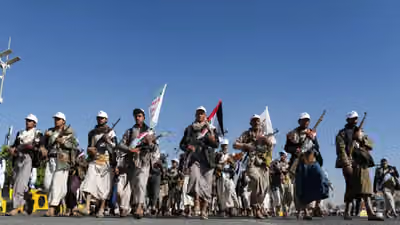
Taliban Seeks To Draw Pakistan Into Yemen Conflict, Say Sources

Sep 18, 2026, 15:49 GMT+1
100%

Informed security sources say the Taliban administration is seeking to encourage the Houthis to intensify attacks on Saudi Arabia, with the aim of drawing Pakistan into the Yemen conflict.

According to the sources, the Taliban is seeking, through direct and indirect engagement with the Houthis, to increase the group’s attacks against Saudi Arabia.

The sources told Afghanistan International that the Taliban’s objective is to open a new front for Pakistan and divert Islamabad’s military and security focus away from the Afghanistan-Pakistan border.

They said the Taliban wants to draw Pakistan into the Yemen crisis in order to reduce Pakistani military pressure on armed groups inside Pakistan and along the Afghan border, giving groups allied with the Taliban greater room to operate.

The Taliban is pursuing these efforts at a time when relations between Kabul and Islamabad have become severely strained in recent months.

Pakistan accuses the Taliban of allowing Tehreek-e-Taliban Pakistan to operate from Afghan territory. The Taliban denies the allegation.

Turkish and Qatari Delegations Visit Kabul

The reported Taliban efforts coincide with visits to Kabul by senior security officials from Türkiye and Qatar.

İbrahim Kalın, head of Türkiye’s National Intelligence Organisation, and Hamad bin Khamis Al-Kubaisi, Qatar’s deputy national security adviser, travelled to Kabul on Tuesday and met several senior Taliban officials.

After meetings in Kabul and Kandahar, Kalın travelled to Islamabad, where he met Pakistani Prime Minister Shehbaz Sharif, army chief Asim Munir and intelligence chief Asim Malik.

In Kabul, Kalın and Qatar’s deputy national security adviser met senior Taliban officials, including Abdul Ghani Baradar, Sirajuddin Haqqani, Abdul Haq Wasiq and Mohammad Yaqoob Mujahid.

Sources told Afghanistan International that restarting talks between Kabul and Islamabad and reviewing the regional situation were among the main topics of the meetings.

The sources added that the high-level Turkish and Qatari delegations travelled to Kabul at the Taliban’s request as part of efforts to resume negotiations with Pakistan.

Türkiye and Qatar have previously mediated to reduce tensions between the Taliban and Pakistan and have hosted talks between the two sides.

At the same time as the senior Turkish and Qatari officials visited Kabul, the Taliban Foreign Ministry described a Houthi drone attack near Mecca as a matter of deep concern and condemned any action targeting Islam’s two holy mosques. The Houthis are backed by Iran.

In Islamabad, Kalın also stressed Turkey’s efforts to resolve tensions between the Taliban and Pakistan through dialogue.

Turkish and Pakistani officials also discussed regional developments and tensions in the Middle East, including developments involving Yemen and Saudi Arabia.

Pakistan’s Position on Houthi Attacks Against Saudi Arabia

The Mecca Mutual Defence Pact was signed on 7 August in Mecca in the presence of Saudi Crown Prince Mohammed bin Salman, Turkish President Recep Tayyip Erdoğan and Pakistani Prime Minister Shehbaz Sharif.

Under the publicly disclosed terms of the pact, an armed attack on any one of the three member states is regarded as an attack on all three. Its stated aim is to strengthen collective deterrence against external aggression.

Pakistani officials have said Islamabad would stand with Saudi Arabia if the conflict in Yemen escalates.

Pakistan’s Defence Minister Khawaja Asif said on Wednesday that if the situation escalated, Pakistan would stand with Saudi Arabia practically and diplomatically. He also referred to the defence agreement between Pakistan, Türkiye and Saudi Arabia.

Pakistan’s Foreign Ministry on Thursday described the situation around the Bab al-Mandab Strait as very serious and said the joint defence agreement with Saudi Arabia was operational, with several Pakistani forces stationed in the kingdom.

Islamabad has nevertheless stressed that the crisis should be resolved through dialogue and diplomacy.

Houthi attacks against Saudi Arabia have intensified in recent days.

The Saudi-led coalition on Wednesday accused the Houthis of attempting a drone attack on Mecca. The Houthis denied the allegation.

Taliban’s Objective

Informed security sources say the Taliban’s aim in drawing Pakistan into the Yemen crisis is to alter Islamabad’s security calculations.

According to the sources, the involvement of Pakistani forces in a military crisis in the Middle East could divert some of Pakistan’s capabilities and attention away from the Afghan border and operations against armed groups opposed to Islamabad.

The reported efforts come as Islamabad is increasing pressure on the Taliban to prevent Tehreek-e-Taliban Pakistan from operating in Afghanistan, while Pakistan is also facing security threats at home.

Security sources say the Taliban is seeking to create pressure on an external front to gain greater room to manage tensions and the activities of allied groups along the Afghanistan-Pakistan border.

The Financial Times, citing informed sources, reported that Pakistan’s army chief Asim Munir has repeatedly urged Iranian officials to help stop Houthi attacks on Saudi Arabia and its energy infrastructure.

Germany Presses Ahead With Legal Action Against Taliban Over Women’s Rights

Sep 18, 2026, 13:23 GMT+1
100%

A source at Germany’s Foreign Ministry told Afghanistan International that Berlin, together with international partners, is pursuing efforts to hold the Taliban accountable for violations of women’s rights.

The German Foreign Ministry official said initial legal steps had been taken under Article 29 of the Convention on the Elimination of All Forms of Discrimination against Women.

According to the source, Germany supports international mechanisms, including the UN-led Doha process, aimed at improving the human rights situation in Afghanistan.

The German official stressed that the country would continue its efforts to ensure Afghanistan fulfils its obligations under the Convention on the Elimination of All Forms of Discrimination against Women.

Germany’s Foreign Ministry added that, together with Australia, Canada and the Netherlands, it had taken the first necessary steps under Article 29 of the convention and had contacted the Taliban administration.

Legal Process at the International Court of Justice

Australia had previously also announced that it was pursuing the legal process.

A spokesman for Australia’s Foreign Ministry told Afghanistan International that Canberra, in cooperation with Germany, Canada and the Netherlands, was pursuing legal action to hold the Taliban accountable for widespread violations of the rights of women and girls.

Under Article 29 of the Convention on the Elimination of All Forms of Discrimination against Women, disputes between member states over the interpretation or application of the convention can, after specified procedures, be referred to arbitration and ultimately to the International Court of Justice.

In September 2024, Germany, Australia, Canada and the Netherlands jointly announced that they had initiated legal proceedings under Article 29 of the convention and called on the Taliban administration to enter into dialogue over the matter.

The Rawadari human rights organisation and several other civil society groups have also recently launched campaigns urging the countries that initiated the process to continue with their commitments and legal action.

More than 20 countries have backed the move by Germany, Australia, Canada and the Netherlands to use the mechanism provided under Article 29 of the convention. They include Spain, Sweden, Belgium and South Korea.

Since the Taliban returned to power in August 2021, sweeping restrictions have been imposed on the rights and freedoms of women and girls in Afghanistan.

Girls are barred from education beyond sixth grade, while women and girls are also prohibited from attending universities.

Women have also been excluded from many areas of public and social life, with broad restrictions imposed on their employment and freedom of movement.

In several cases, women and girls have been detained or questioned for failing to comply with Taliban dress requirements.

Human rights organisations have described the Taliban’s policies as a clear example of gender apartheid.

The Taliban has previously rejected allegations of human rights violations and discrimination against women, saying citizens’ rights in Afghanistan are protected within the framework of Sharia law and that no one is discriminated against.

Ex-NSA Mohib Accuses Khalilzad Of Betraying Afghan Republic In New Book

Sep 18, 2026, 12:24 GMT+1
100%

Former Afghan national security adviser Hamdullah Mohib has published a book titled Shadows Over Kabul: An Insider Account of the Fall of the Afghan Republic, accusing former US envoy Zalmay Khalilzad of betrayal.

Mohib writes that Khalilzad bears significant responsibility for the collapse of the Afghan republic.

In the book, co-written with Tom Hussain, Mohib sharply criticises Khalilzad’s role in the US negotiations with the Taliban and describes his conduct as a major betrayal.

The book was published in English on Thursday, 17 September.

According to Mohib’s account, former Afghan president Ashraf Ghani was sceptical of Khalilzad’s mission from the outset of his appointment as Washington’s chief negotiator on Afghanistan and believed his involvement could have disastrous consequences for the country.

Mohib writes that Khalilzad’s professional background and his links to the oil company Unocal created what Ghani saw as an ethical ambiguity surrounding his mission.

According to Mohib, Khalilzad had a strong ability to connect government activities with personal interests and was also secretive in his working style.

The former Afghan national security adviser goes on to accuse Khalilzad of establishing contacts with the Taliban without informing the Afghan government at the time.

Mohib writes that Khalilzad had known several Taliban officials since the 1990s.

According to Mohib, the Taliban’s confidence increased significantly after Khalilzad was appointed US envoy and entered the Afghan peace process because the group realised it could negotiate directly with Washington while excluding the Afghan government.

Mohib says that after arriving in Kabul, Khalilzad did not even meet him or Salam Rahimi, who was responsible for the peace process in the former government, preventing Afghan officials from presenting their position on the negotiations.

In this section of the book, Mohib writes that Khalilzad’s work was a major betrayal.

He also recounts that after a trip to Pakistan; Khalilzad returned to Kabul without briefing Ashraf Ghani on the details of his discussions.

Mohib says Afghan government officials later learned that Khalilzad had met the Taliban in Pakistan.

Mohib writes that Khalilzad, without informing officials of the former government, spoke directly to the Taliban on our behalf and marginalised us.

He adds that, at the time, Afghan officials were unclear whether Khalilzad was acting under official US policy or following his own views and personal initiative.

According to Mohib, former government officials tried to determine the answer but did not reach a clear conclusion.

In another section of the book, Mohib refers to a trip he made to Washington, where he says he publicly stated that Khalilzad’s efforts were weakening the Afghan government and strengthening the Taliban.

He writes that he questioned whether Khalilzad was pursuing such a policy with the support of, and on behalf of, the US government.

According to Mohib, the responses he received were contradictory, and his scheduled meetings with US State Department officials were ultimately cancelled.

Overall, in his account of the peace process, Mohib accuses Khalilzad of sidelining the Afghan government from negotiations, holding direct and secret talks with the Taliban and strengthening the group’s political position.

He argues that Khalilzad played a significant role in a process that ultimately contributed to the collapse of the Afghan republic.

Shadows Over Kabul: An Insider Account of the Fall of the Afghan Republic, written by Hamdullah Mohib and Tom Hussain, presents an account from inside Afghanistan’s former government of the events that led to the republic’s collapse.